Shipping turmoil escalates as multiple vessels (at least six) struck overnight
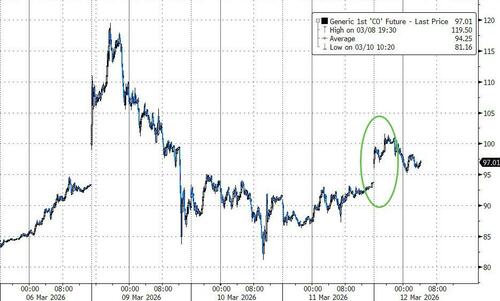
Brent crude oil prices top $100 amid "the largest supply disruption in the history of the global oil market," the IEA reports.
Dubai suffers significant drone attacks
Northern Israel hammered by Hezbollah, "largest wave" of missiles since war began
IDF says it struck key Iranian nuclear development site
US Intel assesses Iranian regime remains intact
Oman port operations halted
Trump proclaims "we won"
* * *
Brent crude futures in Asian trading jumped above $101/bbl overnight, despite news of a planned record emergency SPR release by the International Energy Agency's 32 member countries, in an effort aimed at capping triple-digit oil prices.

Today's focus is on reports that IRGC forces struck two foreign oil tankers in the Gulf area, bringing the total to six vessels hit over the past 24 hours. Iranian kamikaze drones also struck an energy export hub in Oman, while IRGC naval mine threats in the Strait of Hormuz soared by midweek.
The Wall Street Journal reported that two oil tankers were struck in Iraqi waters. The U.K. maritime security agency UKMTO also said a containership was hit off the coast of Dubai, adding to earlier reports that three cargo vessels were struck around the Strait of Hormuz area. Also worth recalling is the dramatic video from yesterday showing an IRGC drone slamming into a critical tank farm in Oman.
The market reaction to the overnight hostilities, as Operation Epic Fury rages on this week and IRGC forces lob missiles and bombs at Gulf states, was a surge in Brent crude futures to the $101 handle.
Goldman's Rich Privorotsky on the overnight energy market moves:
A series of attacks across the Gulf has sent oil up nearly another 10% (fading to up 5%), with Brent back briefly through the $100 level. The move in products looks even more acute, with distillates leading. Quite telling yesterday that, after yet another Whitehouse jawbone and the IEA’s record reserve release announcement, oil still failed to come in meaningfully. Overnight Reuters reported, “Iran has laid about a dozen mines in Strait of Hormuz, sources say” … if that is confirmed it's not quickly reversible.
Goldman expects longer disruptions on the Hormuz chokepoint:

Here's where things get even more complicated: Six commercial vessels and oil infrastructure in the Gulf area were hit in IRGC strikes, and attention is now shifting to another critical maritime chokepoint.
Overnight, Iran's semi-official Fars News Agency warned that the Houthis in Yemen and other Iran-backed groups could move to shut the Bab el-Mandeb Strait at the southern tip of the Arabian Peninsula.

The overnight chaos sent Brent crude back over $101/bbl, but it has since fallen to $96/bbl by 0630 ET. This comes after the IEA's 32 member countries agreed on a "record" 400 million barrel release to cap energy prices. U.S. Energy Secretary Chris Wright announced that the U.S. will contribute 172 million barrels. As we explained to readers on Wednesday, this SPR dump is likely to have only a minimal impact.
Meanwhile, President Donald Trump told supporters in Kentucky last night that Operation Epic Fury was effectively over almost as soon as it began. "It's just a question of when—when do we stop?" he said.
"Let me say we've won. You know, you never like to say too early you won. We won. We won, in the first hour it was over, but we won," Trump said.
He added, "We don't want to leave early, do we? We've got to finish the job."
It is clear that U.S.-Israeli operations have dealt a major blow to the IRGC's conventional military capabilities, but the lingering threat will be asymmetric warfare, including drone attacks, naval mines, the potential sabotage of undersea cables, and a wide range of other low-cost, high-disruption weapons.
What's important from the overnight (courtesy of Bloomberg):
Energy Market
The Iran war is causing the largest supply disruption in the history of the global oil market, hitting 7.5% of global supply and an even bigger share of exports
Oil prices surged above $100 a barrel as Iran escalated attacks on Dubai and shipping assets
IEA members agreed to release an unprecedented 400 million barrels from emergency reserves to calm the market
IRGC Military Actions
Iran escalated attacks on parts of Dubai with missile alerts and a drone that fell on a building in Creek Harbour on Wednesday night
Iran says it maintains control over the strategic Strait of Hormuz and claims it carried out strikes on Israeli military and intelligence facilities
Iran's military announced the policy of reciprocal strikes has ended, stating, 'from now on, our policy will be strike after strike'
More than 2,100 Shahed-136 weapons have been fired so far, damaging oil infrastructure, shutting airports and destroying military hardware
US Security Warnings
The US State Department warned that Iran and affiliated groups could be planning attacks on oil infrastructure owned by the United States in Iraq
US Central Command warned that Iran is using civilian ports along the Strait of Hormuz for military operations, making them legitimate targets
California Governor Newsom said he's aware of potential drone strikes in California after FBI warnings that Iran has allegedly considered launching offensive drones against the West Coast
Economic Impact
Goldman Sachs and Citigroup told staffers in Dubai to stay away from their offices amid Iran threats
On the Beach suspended its full-year guidance due to a 'significant slowdown' in demand following the Middle East conflict, with shares dropping as much as 15%
Chinese oil refiners have begun canceling agreed refined fuel export cargoes as Beijing tightens curbs to cope with the war's impact
Diplomatic Developments
Iran has told regional intermediaries that for a ceasefire, the US must guarantee that neither it nor Israel will strike the country in the future
A former IRGC chief said Iran would agree to no ceasefire until the country reaches a 'definite outcome'
The UN Security Council approved a resolution condemning Iran's attacks on its Gulf neighbors including Bahrain, Kuwait, Oman, Qatar, Saudi Arabia, UAE and Jordan
Related energy market reads:
Is it too early for Trump to be calling a "win" when asymmetric warfare is still a very big threat and will be lingering for many weeks, if not months? As one pundit has pointed out: "Endurance regimes do not need clean victory to change the game. They only need to survive the shock while making the old equilibrium too costly for their adversaries to restore."