On September 14, 2015, our first publicly-trusted certificate went live. We were proud that we had issued a certificate that a significant majority of clients could accept, and had done it using automated software. Of course, in retrospect this was just the first of billions of certificates. Today, Let’s Encrypt is the largest certificate authority in the world in terms of certificates issued, the ACME protocol we helped create and standardize is integrated throughout the server ecosystem, and we’ve become a household name among system administrators. We’re closing in on protecting one billion web sites.

In 2023, we marked the tenth anniversary of the creation of our nonprofit, Internet Security Research Group, which continues to host Let’s Encrypt and other public benefit infrastructure projects. Now, in honor of the tenth anniversary of Let’s Encrypt’s public certificate issuance and the start of the general availability of our services, we’re looking back at a few milestones and factors that contributed to our success.
Growth
A conspicuous part of Let’s Encrypt’s history is how thoroughly our vision of scalability through automation has succeeded.
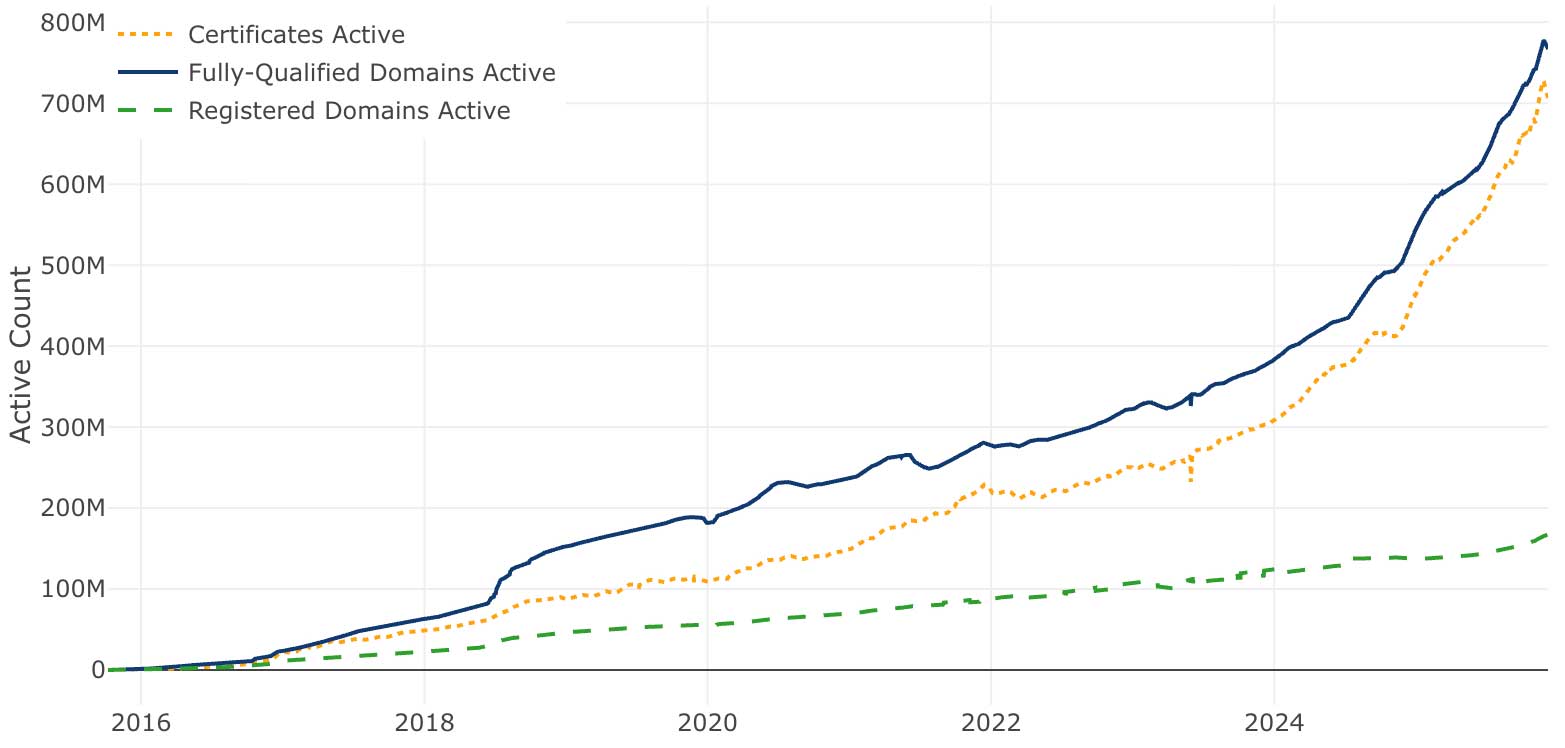
In March 2016, we issued our one millionth certificate. Just two years later, in September 2018, we were issuing a million certificates every day. In 2020 we reached a billion total certificates issued and as of late 2025 we’re frequently issuing ten million certificates per day. We’re now on track to reach a billion active sites, probably sometime in the coming year. (The “certificates issued” and “certificates active” metrics are quite different because our certificates regularly expire and get replaced.)
The steady growth of our issuance volume shows the strength of our architecture, the validity of our vision, and the great efforts of our engineering team to scale up our own infrastructure. It also reminds us of the confidence that the Internet community is placing in us, making the use of a Let’s Encrypt certificate a normal and, dare we say, boring choice. But I often point out that our ever-growing issuance volumes are only an indirect measure of value. What ultimately matters is improving the security of people’s use of the web, which, as far as Let’s Encrypt’s contribution goes, is not measured by issuance volumes so much as by the prevalence of HTTPS encryption. For that reason, we’ve always emphasized the graph of the percentage of encrypted connections that web users make (here represented by statistics from Firefox).

(These graphs are snapshots as of the date of this post; a dynamically updated version is found on our stats page.) Our biggest goal was to make a concrete, measurable security impact on the web by getting HTTPS connection prevalence to increase—and it’s worked. It took five years or so to get the global percentage from below 30% to around 80%, where it’s remained ever since. In the U.S. it has been close to 95% for a while now.
A good amount of the remaining unencrypted traffic probably comes from internal or private organizational sites (intranets), but other than that we don’t know much about it; this would be a great topic for Internet security researchers to look into.
We believe our present growth in certificate issuance volume is essentially coming from growth in the web as a whole. In other words, if we protect 20% more sites over some time period, it’s because the web itself grew by 20%.
A few milestones
We’ve blogged about most of Let’s Encrypt’s most significant milestones as they’ve happened, and I invite everyone in our community to look over those blog posts to see how far we’ve come. We’ve also published annual reports for the past seven years, which offer elegant and concise summaries of our work.
As I personally think back on the past decade, just a few of the many events that come to mind include:
We’ve also periodically rolled out new features such as internationalized domain name support (2016), wildcard support (2018), and short-lived and IP address (2025) certificates. We’re always working on more new features for the future.
There are many technical milestones like our database server upgrades in 2021, where we found we needed a serious server infrastructure boost because of the tremendous volumes of data we were dealing with. Similarly, our original infrastructure was using Gigabit Ethernet internally, and, with the growth of our issuance volume and logging, we found that our Gigabit Ethernet network eventually became too slow to synchronize database instances! (Today we’re using 25-gig Ethernet.) More recently, we’ve experimented with architectural upgrades to our ever-growing Certificate Transparency logs, and decided to go ahead with deploying those upgrades—to help us not just keep up with, but get ahead of, our continuing growth.
These kinds of growing pains and successful responses to them are nice to remember because they point to the inexorable increase in demands on our infrastructure as we’ve become a more and more essential part of the Internet. I’m proud of our technical teams which have handled those increased demands capably and professionally.
I also recall the ongoing work involved in making sure our certificates would be as widely accepted as possible, which has meant managing the original cross-signature from IdenTrust, and subsequently creating and propagating our own root CA certificates. This process has required PKI engineering, key ceremonies, root program interactions, documentation, and community support associated with certificate migrations. Most users never have reason to look behind the scenes at our chains of trust, but our engineers update it as root and intermediate certificates have been replaced. We’ve engaged at the CA/B Forum, IETF, and in other venues with the browser root programs to help shape the web PKI as a technical leader.
As I wrote in 2020, our ideal of complete automation of the web PKI aims at a world where most site owners wouldn’t even need to think about certificates at all. We continue to get closer and closer to that world, which creates a risk that people will take us and our services for granted, as the details of certificate renewal occupy less of site operators’ mental energy. As I said at the time,
When your strategy as a nonprofit is to get out of the way, to offer services that people don’t need to think about, you’re running a real risk that you’ll eventually be taken for granted. There is a tension between wanting your work to be invisible and the need for recognition of its value. If people aren’t aware of how valuable our services are then we may not get the support we need to continue providing them.
I’m also grateful to our communications and fundraising staff who help make clear what we’re doing every day and how we’re making the Internet safer.
Recognition of Let’s Encrypt
Our community continually recognizes our work in tangible ways by using our certificates—now by the tens of millions per day—and by sponsoring us.
We were honored to be recognized with awards including the 2022 Levchin Prize for Real-World Cryptography and the 2019 O’Reilly Open Source Award. In October of this year some of the individuals who got Let’s Encrypt started were honored to receive the IEEE Cybersecurity Award for Practice.
We documented the history, design, and goals of the project in an academic paper at the ACM CCS ‘19 conference, which has subsequently been cited hundreds of times in academic research.
Ten years later, I’m still deeply grateful to the five initial sponsors that got Let’s Encrypt off the ground - Mozilla, EFF, Cisco, Akamai, and IdenTrust. When they committed significant resources to the project, it was just an ambitious idea. They saw the potential and believed in our team, and because of that we were able to build the service we operate today.
IdenTrust: A critical technical partner
I’d like to particularly recognize IdenTrust, a PKI company that worked as a partner from the outset and enabled us to issue publicly-trusted certificates via a cross-signature from one of their roots. We would simply not have been able to launch our publicly-trusted certificate service without them. Back when I first told them that we were starting a new nonprofit certificate authority that would give away millions of certificates for free, there wasn’t any precedent for this arrangement, and there wasn’t necessarily much reason for IdenTrust to pay attention to our proposal. But the company really understood what we were trying to do and was willing to engage from the beginning. Ultimately, IdenTrust’s support made our original issuance model a reality.
Conclusion
I’m proud of what we have achieved with our staff, partners, and donors over the past ten years. I hope to be even more proud of the next ten years, as we use our strong footing to continue to pursue our mission to protect Internet users by lowering monetary, technological, and informational barriers to a more secure and privacy-respecting Internet.
Let’s Encrypt is a project of the nonprofit Internet Security Research Group, a 501(c)(3) nonprofit. You can help us make the next ten years great as well by donating or becoming a sponsor.