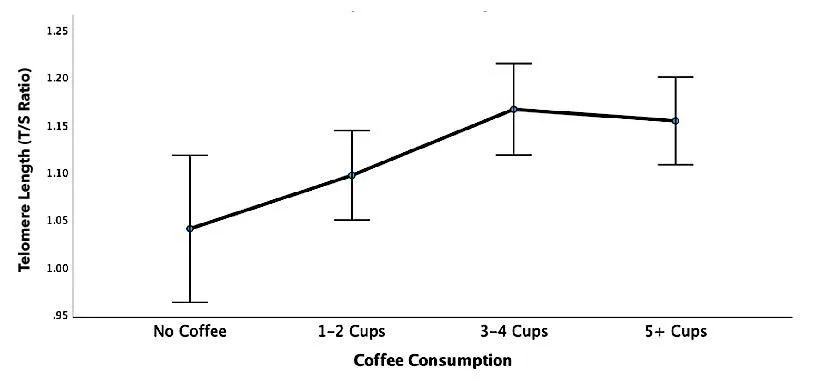
We know that coffee can help slow biological ageing in the general population, but little is known about its effect on people with severe mental illness – a population whose lifespan is already shortened, in part due to age-related diseases. Our study shows that up to four cups of coffee per day is linked to longer telomeres among people with bipolar disorder and schizophrenia. This is comparable to a biological age of five years younger than non-coffee drinkers.
Vid Mlakar, PhD student at King’s College London and first author of the study
原文
New research from King’s College London finds that coffee consumption within the NHS recommended limit is linked to longer telomere lengths – a marker of biological ageing – among people with bipolar disorder and schizophrenia. The effect is comparable to roughly five years younger biological age.
Telomeres are structures that protect DNA. As people get older, their telomeres shorten as part of the natural human ageing process. This process has been shown to be accelerated among people with severe mental illness, such as bipolar disorder and schizophrenia, who have an average life expectancy 15 years shorter than the general population.
Previous research shows that coffee possesses health benefits. It may reduce oxidative stress in the general population, helping slow biological ageing processes like telomere shortening. The new study, published in BMJ Mental Health, explores whether coffee consumption could slow this ageing process among those with severe mental illness.
Researchers at the Institute of Psychiatry, Psychology & Neuroscience measured the effects of coffee consumption on telomere length among 436 participants aged 18 to 65 with schizophrenia, bipolar disorder or major depressive disorder with psychosis.
They found that coffee consumption of up to four cups per day was linked to longer telomeres, comparable to a biological age five years younger than non-coffee drinkers.
The longest telomeres were seen among those who consumed three to four cups per day. Too much coffee reduced this positive effect, with participants who consumed more than four cups having shorter telomeres than those who consumed between three and four cups.

These effects remained after accounting for variations in age, sex, ethnicity, medication and tobacco use.
Coffee is a beverage that many people consume daily. On one hand, we know that excessive coffee consumption can have negative effects on health, such as reducing sleep quality. However, our new study suggests that coffee consumption up to a certain point may have benefits for biological ageing. Many of the factors that are known to affect biological ageing, such as genetics and negative stressful life experiences, are beyond our control. Lifestyle factors like coffee consumption are something we can actively modify, making research like this particularly valuable.
Dr Monica Aas, MRC Research Fellow at King’s College London and senior author of the study
Dr Aas added: "Studies such as this also support the idea that we should move away from viewing coffee as simply “good or bad”, and instead consider a more balanced view. Still, these results need to be confirmed in other independent studies and longitudinal research before we can determine if this is a causal effect."
Data were from the Norwegian TOP study, collected between 2007 and 2018. The researchers included participants who had available data on mental health diagnosis (assessed using the Structured Clinical Interview for DSM-IV), telomere length (measured by extracting DNA from blood samples) and self-reported coffee consumption.
The researchers note that the study did not have information on the type of coffee consumed (instant versus filter) or the caffeine concentration of each cup. The NHS advises limiting caffeine intake to 400 mg/day (approximately four cups of coffee).
The study was funded by the Research Council of Norway, the KG Jebsen Stiftelsen and an Medical Research Council Fellowship. The team has recently received funding from the British Medical Association’s Margaret Temple grant to investigate telomere shortening in a longitudinal cohort of patients with psychosis. This project will allow them to explore further how several lifestyle factors, as well as stress, influence the rate of telomere shortening over time.
"Coffee intake is associated with telomere length in severe mental disorders" (Vid Mlakar et al.) was published in BMJ Mental Health. DOI: 10.1136/bmjment-2025-301700
For more information, please contact Milly Remmington (School of Mental Health & Psychological Sciences Communications Manager).