By Haley Zaremba of OilPrice.com
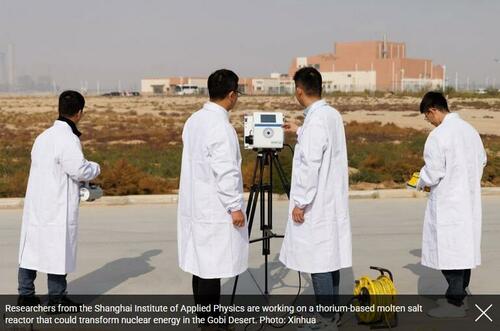
An experimental Chinese nuclear plant reportedly just crossed a historic threshold, successfully operating the world’s first thorium-based molten salt reactor (TMSR). The Chinese Academy of Sciences’ Shanghai Institute of Applied Physics has broken a major scientific barrier by successfully converting thorium to uranium in a historic first.
The Hong Kong-based South China Morning Post reports that the breakthrough, which took place at an experimental reactor out in the Gobi Desert, is “poised to reshape the future of clean sustainable nuclear energy.”

The process works by using a “precise sequence of nuclear reactions” in which naturally occurring thorium-232 absorbs a neutron, becoming thorium-233. Through a decay process, that isotope breaks down into protactinium-233 and then finally into uranium-233, a potent form of nuclear fuel that can sustain chain reactions for nuclear fission.

While this breakthrough was just publicized this month by a report by Science and Technology Daily, the TMSR has apparently been operational for years. Li Qingnuan, Communist Party secretary and deputy director at the Shanghai Institute of Applied Physics, told the outlet that “since achieving first criticality on October 11, 2023, the thorium molten salt reactor has been steadily generating heat through nuclear fission”.
If the reports are true, this breakthrough would signal an incredible leap forward in a nuclear technology race that China is already winning handily. Although the United States is still the world’s biggest producer of nuclear energy, that status won’t last much longer. In the same time period that the United States built the overdue and over-budget Plant Vogtle, China built 13 reactors of similar scale, and has 33 more on the way. Beijing is also making major forays into the nuclear sectors of emerging economies, with particularly concerted efforts in Africa.
“The Chinese are moving very, very fast,” Mark Hibbs, senior fellow at the Carnegie Endowment for International Peace and expert on the Chinese nuclear sector, told the New York Times. “They are very keen to show the world that their program is unstoppable.”
But while China has invested huge sums of money and manpower into becoming a global nuclear energy innovator and superpower, the nation lacks sufficient uranium to power its lofty goals. While nuclear power production growth is dominated by China, uranium supply chains are dominated by Russia, which is home to nearly half (approximately 44 percent) of all global uranium enrichment capacity.
China has been buying up more and more of Russia’s uranium, but reliance on exports is both risky and antithetical to China’s ethos of domestic energy independence and international energy dominance. Russia’s outsized presence in the nuclear fuel supply chain has resulted in some degree of risk and market volatility, as the Kremlin has shown that it is not afraid to use enriched uranium for political leverage.
“The nuclear energy supply chain sits atop the clean technology risk pyramid,” warned a recent article from the Carnegie Endowment for International Peace. “Beyond standard supply chain considerations, nuclear exports are subject to a suite of safety and security concerns, and overreliance on a single technology or fuel provider can create significant dependencies given the limited number of suppliers and distinct intellectual property (IP).”
By sidestepping the uranium supply chain issue by using thorium instead, China is leaping over a critical hurdle and straight over the finish line for global nuclear power sector domination. Thorium is much more accessible and abundant than uranium, and could theoretically solve all of China’s nuclear fuel problems. According to the South China Morning Post, just one mining site in Inner Mongolia “ is estimated to hold enough of the element to power China entirely for more than 1,000 years.”
Loading recommendations...