Authored by Stefan Barti via TheDailyEconomy.org,
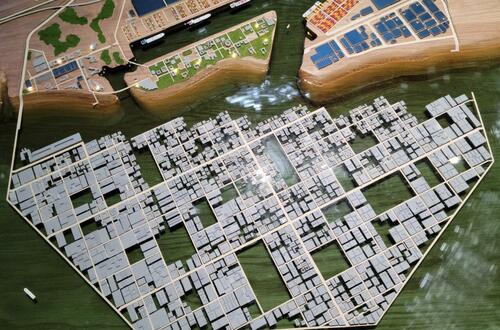
You can’t build a castle on sand, and you can’t build a city on assumptions. Saudi Arabia unveiled The Line in January 2021 as a perfect, linear utopia stretching 170 kilometers across the desert. Three years later, the castle is already sinking.

When Crown Prince Mohammed bin Salman announced The Line on January 10, 2021, he promised a radical reimagining of urban life. “We need to transform the concept of a conventional city into that of a futuristic one.”
Tucked into the upper corner of the kingdom’s Tabuk province, the city would run like a ruler through the Neom region, housing nine million people, the population of Austria, within just 34 square kilometers, all powered by renewable energy. It imagines a world where every need sits within a five-minute walk, yet one can cross the entire city in twenty minutes. But even in a country wealthy enough to seed rain clouds and bankroll vast infrastructure, reality is colliding with ambition. The city that promised to “deliver new wonders for the world” is struggling to deliver its own foundation.
By 2030, only 2.4 kilometers of the 170-kilometer project will be completed, with the rest delayed as the government prioritizes energy infrastructure and scrambles for funding. The project’s leadership has been reshuffled, with the head of the sovereign wealth fund, The Public Investment Fund, now steering the effort amid deepening financial uncertainty. This is unsurprising. The Line was imagined as an engineering object, an architectural marvel, rather than a city that must grow from real human demand. The economic foundation beneath that vision is equally unstable. Saudi Arabia’s fiscal fortunes depend on oil, a commodity that swung from over $110 a barrel in 2012 to $42 in 2020 and now hovers near $70. The financial bedrock for this trillion-dollar city is, like the desert beneath it, shifting.
As urban planner and George Mason scholar Alain Bertaud reminds us, cities are foremost labor markets, not works of art. “Planning,” he argues, “is based on the illusion that a city is a complex building that needs to be designed in advance by competent professionals.”
While the glossy Neom videos present a pristine, drone-filled future, they do so without answering the most basic question: who will live here? There is no target population beyond the slogan of “nine million,” no industries identified, no international firms committed to office space. The Line sells a vision of technological abundance while omitting the people needed to make a city function. Additionally, the BBC reports that construction has already displaced local communities, some labeled as rebels, and that Saudi authorities justified lethal force against those resisting eviction. The Line lacks the basics, let alone the advanced futurism it advertises: no jobs lined up, no residents committed, and human rights violations overshadowing its image.
For years, Saudi Arabia has attracted foreign workers with the promise of zero income tax and a reputation for safety. But these incentives, however appealing, are not in and of themselves a foundation for long-term economic growth. As Nobel laureate Daron Acemoglu argues, it is institutions, not tax perks or security guarantees, that sustain prosperity. On this front, Saudi Arabia functions less like an open society and more like a modern caste system, granting its citizens far broader rights and protections than the millions of residents, roughly 40 percent of the population, who live and work there. Citizens benefit from public goods such as public schools, where non-Saudis are capped at just 15 percent of enrollment, as well as welfare programs universally free for nationals. Foreigners, by contrast, are routed into private institutions and face sharply limited paths to citizenship waiting 10 years to apply, and even then nothing is guaranteed. This is a separation not only of services, but of ideas and talents. Even the labor market reflects this hierarchy.
Saudization quotas ensure that nationals are favored for desirable jobs: in many sectors, at least 30 percent of employees must be Saudi, and entire professions are reserved exclusively for citizens. A system built on quotas and exclusion cannot produce genuine meritocracy; talent competes at a disadvantage when citizenship, not ability, is the deciding factor. But the clearest institutional divide is not economic, it is political. Freedom of speech, the most fundamental inclusive right, remains unavailable to citizens and residents alike. The fate of journalist Jamal Khashoggi underlines the risks of dissent in a system built not on participation, but on silence.
History has shown that governments cannot simply erect structures and call them cities. In China alone, dozens of newly built towns stand largely empty. Anticipating rapid growth, the country produced more cement between 2011 and 2013 than the United States did during the entire twentieth century. One showcase city in China’s interior was designed to house more than one million people, but “currently houses less than 100,000, and it is still less than halfway toward the district’s goal of housing 300,000 people by 2020.” Government planning and reality rarely align.
Yet China’s ghost cities illustrate only the surface of the problem. The deeper issue lies in what a city fundamentally is.
Aristotle taught that a city requires three things: a functioning politeia, citizens capable of ruling and being ruled; autarkeia, an economic base that allows people to sustain themselves; and koinōnia, a shared conception of the good life that binds people into a community. The Line satisfies none of these conditions. Its residents will not form a politeia, because most will be non-citizens without political rights. It lacks autarkeia, with no industries, no labor market, and no economic ecosystem. Furthermore it cannot produce koinōnia, a communal life, in a system where people remain transient workers rather than members of a civic community. The Line attempts to design a polis without the very ingredients Aristotle believed made a city possible.
Aristotle reminds us that “the city exists by nature,” and that “man is by nature a political animal.” A city, polis, he taught, may come into being for the sake of living, but it endures for the sake of living well. Yet there can be no such good life in The Line without a community capable of shaping its own future, deliberating, dissenting, and holding its leaders accountable.
Cities grow from freedom, choice, and bottom-up demand, not from architectural decree. Saudi Arabia confronts an irony of its own making. A nation whose modern borders were once drawn from afar now seeks to draw a perfect line of its own. Yet it overlooks the oldest lesson in the desert: drawing lines is easy; living within them is not. Steel and glass can build walls, but they cannot build a city where the foundations of civic life are forbidden to take root.
Loading recommendations...