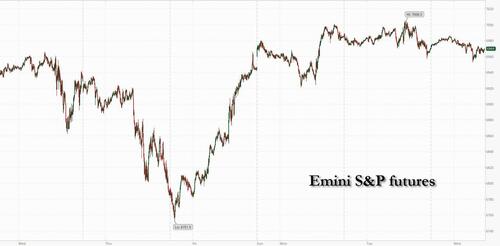
US equity futures are flat ahead of today's delayed January payrolls (full preview here) with the market now expecting a weaker print after the Retail Sales miss and weaker high-frequency data. As of 8:00am ET, S&P and Nasdaq 100 futures are both up 0.1%. Pre-market, Mag7 names are mostly lower; Discretionary, Energy, Industrials and Materials are all higher pointing to a potential broad-based cyclical rally while TMT is muted; AI ex-Mag7 is seeing a bid. JPMorgan’s trading desk expects the delayed January data to give a small boost to stocks — something much-needed amid the indiscriminate selling of those on the wrong side of AI. International markets are mixed with trends similar – Japan closed, KOSPI strong up 100bps, HSI not far behind up 30bps. Europe more flat to down with CAC down 13bps and DAX off 24bps. Australia leads the downside off 172bps. 10 TSY yields are at lows 4.13%, while the USD is weaker for the 4th consecutive session, the DXY down below $97 to $96.58 and Bitcoin trades down to $67k. FT reports Ukraine planning presidential elections and a referendum on any peace deal, potentially by mid-May, under US pressure. Timing uncertain given Donbas, Zaporizhzhia and escalation risks. China CPI soft +0.2% vs. 0.4%. Commodities moving higher this morning led by silver but Comex copper back above $6 to $6.07 up 3%, crude quietly moving up with WTI at $65. Today’s macro data focus is on the NFP release but watch the drop in Mortgage Approvals given the strength of the recent Homebuilders bid. McDonald’s and Cisco are due to report.

In premarket trading, Mag 7 stocks are mixed (Nvidia +0.6%, Amazon +0.2%, Microsoft +0.2%, Alphabet +0.07%, Apple -0.04%, Meta -0.4%, Tesla -0.2%)
- Astera Labs (ALAB) falls 11% after the semiconductor manufacturing company reported its fourth-quarter results. It also announced that its chief financial officer would retire.
- Beta Technologies (BETA) climbs 18% after Amazon.com Inc. disclosed a stake in the electric-powered aircraft manufacturer.
- Centrus Energy (LEU) falls 8% after the uranium company’s fourth-quarter earnings per share fell short of analyst estimates, with Citi pointing to higher-than-expected capex spending.
- Cloudflare (NET) gains 14% after the software company’s fourth-quarter results beat expectations and it gave a bullish revenue forecast.
- Humana (HUM) falls 6% after forecasting full-year profit that fell short of Wall Street’s expectations, adding to investor concerns about the challenges facing the US health-insurance industry.
- Kraft Heinz (KHC) falls 6% after pausing work on its planned separation as new Chief Executive Officer Steve Cahillane works to improve results.
- Lattice Semiconductor (LSCC) rises 11% after the semiconductor device company gave a first-quarter revenue forecast that was much stronger than expected.
- Lyft (LYFT) falls 17% after issuing a disappointing forecast that missed Wall Street expectations, a sign that its global expansion and new product offerings are not performing as quickly and as well as anticipated.
- Mattel (MAT) slumps 26% after the toymaker’s 2026 adjusted earnings-per-share forecast missed the average analyst estimate, triggering a downgrade at JPMorgan.
- Moderna (MRNA) falls 10% after US regulators refused to review its novel mRNA flu vaccine, dealing a major blow to the company as it seeks to expand beyond its Covid shot.
- Rapid7 (RPD) falls 22% after the software company’s outlook was seen as disappointing. Analysts cited weakness in annual recurring revenue as a concern.
- Robinhood (HOOD) declines 7% after the fintech company reported net revenue for the fourth quarter that missed the average analyst estimate.
- Teradata (TDC) gains 15% after the database management company reported fourth-quarter results that beat expectations and gave an outlook for adjusted earnings that is stronger than expected.
- Vertiv Holdings (VRT) rises 13% after the power equipment company forecast adjusted earnings per share for the first quarter; the guidance beat the average analyst estimate.
January’s payrolls report (full preview here) is due after several Trump admin officials, including National Economic Council Director Kevin Hassett and Peter Navarro, recently warned that investors should expect lower jobs numbers going forward. Analysts are also anticipating an annual revision to the jobs count, which is expected to reveal a huge markdown in the year through March 2025, to the tune of 750-900K jobs. Bloomberg’s consensus is for 65k job additions in January vs 50k in December, with a crowd-sourced whisper number of 35k, while scenarios laid out by JPMorgan Market Intelligence suggest a sweet spot between 60k and 110k to boost stocks. With the job market in the midst of a “low-hire, low-fire” environment, expectations are low, which could act as a potential catalyst for equities.

JPMorgan strategists also note that the S&P 500 options market is underpricing payrolls compared to historical swings, with past moves nearly double what is currently being priced. Meanwhile, interest-rate traders are betting on two or three Fed rate cuts this year, becoming slightly more conservative than the dovish bets seen after Warsh’s nomination earlier in the month.
“We’re still in this sort of, not-really-hiring, not-really-firing mode. But we haven’t seen a clear breakout in either direction,” said Graham Secker, head of equity strategy at Pictet Wealth Management. “Everyone’s very aware of the kind of the K-shape dynamic within the US economy, and the US consumer in particular.”
For Nicolas Bickel, group head of investment private banking at Edmond de Rothschild, the jobs report and Friday’s inflation data will offer insight into the impact of January’s extreme weather. A strong jobs report would instill confidence in the consumer outlook and help fuel a broadening of the stock rally.
“I really like that rotation personally, because it’s for me the lifeblood of a bull market,” Bickel said. Investors “are just choosing another horse, and means that they have money to be invested, or are confident in the economy.”
The selloff in software stocks has been overblown, creating buying opportunities for investors, according to Nannette Hechler-Fayd’Herbe, head of investment strategy for EMEA at Lombard Odier.
“There have been a lot of concerns that AI might be disrupting software companies, but we have held the view that actually, it is empowering them, it is shortening the time for coding, it is enabling efficiencies of workflows,” she told Bloomberg TV. “For us it’s actually been an opportunity to take exposure.”
In other assets, Bitcoin fell to its lowest level since last Friday’s selloff, despite support from its largest holders, so-called whale wallets, in their biggest buying spree since November. The dollar also fell for a fourth straight day. In Europe, shares in software firms and wealth managers continued to slide on AI disruption fears.
In politics, House lawmakers are set to vote today on whether to reject some of Trump’s tariff policies, starting with a resolution opposing levies on Canada. Trump is expected to unveil plans to use government funding and Pentagon contracts to sustain coal-fired power plants.
A quick look at earnings: Out of the 326 S&P 500 companies that have reported so far in the earnings season, 78% have managed to beat analyst forecasts, while 17% have missed. T-Mobile, Shopify and Kraft Heinz are among companies expected to report before the market open. T-Mobile’s new CEO is likely to maintain a strategy of promoting aggressively to sustain industry-leading postpaid phone net additions and service growth, according to Bloomberg Intelligence. Earnings from Cisco and McDonald’s follow later.
Stocks in Europe are mixed, the Stoxx 600 is up 0.1%. The FTSE 100 outperforms peers, boosted by energy and materials stocks. European wealth managers tracked their US peers lower amid fears over the disruptive impact of a new AI tool designed to create tax strategies. St James’s Place Plc slumped 12% in London, while investment platforms such as AJ Bell Plc and IntegraFin Holdings Plc were sliding as well. Weak guidance by Dassault Systemes SE played into fears that the French software firm may be vulnerable to AI, sending the stock lower by the most in three decades. Here are some of the biggest movers on Wednesday:
- Ahold Delhaize shares gain as much as 9.9%, the most since 2020, as the Dutch retail store operator reported margin beats across the board.
- Siemens Energy shares rally as much as 6.5% to its highest intraday level on record after first-quarter earnings surpassed the average analyst estimate, driven by strong order growth in gas turbines.
- Heineken shares rise as much as 5.5%, the most in nearly a year, after the Dutch brewer exited 2025 with what analysts consider an uptick in momentum, boosted by a cost-saving program that sees it cut up to 6,000 jobs.
- Renishaw shares rise as much as 6.4%, the most in five months, as the engineering firm’s order book grows.
- B&M shares climb as much as 5.4% after Peel Hunt upgraded its recommendation on the discount retailer, arguing that the shares appear undervalued given the prospects for stronger sales and earnings.
- Gerresheimer shares plunge as much as 35%, hitting their lowest level since 2009, after the German maker of packaging for medicines and cosmetics delayed the publication of its 2025 earnings.
- Dassault Systemes shares sink as much as 22% the most on record, after the software company gave a weaker-than-expected sales growth guidance for 2026, on top of 4Q results that missed estimates.
- St James’s Place shares fall as much as 11%, the most in nearly two years, leading a drop in European wealth managers over worries that artificial intelligence will disrupt their businesses.
- Randstad shares fall as much as 9.3%, touching the lowest level since March 2020, after the staffing and HR services provider reported organic revenue for the fourth quarter that missed the average analyst estimate.
- Barratt Redrow shares fall as much as 8.4%, the most since July, as pressure increases on the UK homebuilder’s margins.
Earlier in the session, Asian equities climbed to a fresh record, led by technology shares, as investors continued to rotate away from US assets amid a weaker dollar. The MSCI Asia Pacific ex-Japan Index rose as much as 1.3%, set for a third straight daily gain. TSMC, Commonwealth Bank of Australia and Samsung Electronics were among the major contributors. Benchmarks in South Korea, Hong Kong and Australia advanced, while those in mainland China slipped. Japanese markets were shut for a holiday. The strength in Asia’s technology shares and weakness in the greenback continue to drive investors into the developing world. The 30-day correlation between the dollar and MSCI Asia is minus 0.5, around the most severe level since April, Bloomberg-compiled data show. Bucking the trend, SK Hynix was among the major drags on the index following a report China’s CXMT plans to allocate a chunk of its DRAM capacity to produce superfast HBM3 chips that are used in AI. Samsung reversed earlier losses after a top executive said that the company is back at the top of the memory industry with its new HBM4 technology. Taiwan’s benchmark Taiex index jumped 1.6% to an all-time high on its last trading day before Lunar New Year holiday. Tech optimism rose after TSMC’s solid January sales data showed a sign of sustained global AI spending. The island’s stock market will resume trading from Feb. 23.
In FX, the yen has continued its climb against the dollar with USD/JPY briefly slipping below the 153 level. Accordingly the Bloomberg Dollar index is down 0.3%, also hampered by gains in NOK and AUD, with the latter bolstered by hawkish RBA remarks.
In rates, treasury yields are slightly lower on the day ahead of the rescheduled January employment report at 8:30am New York time. Overnight trading bands were narrow amid similarly muted price action European bonds, while S&P 500 futures hold small gain. US session also includes new-issue 10-year note auction for $42 billion, following good demand for 3-year notes Tuesday. US intermediate yields are richer by about 1bp with 10-year steady around 4.135% and curve spreads within 1bp of Tuesday’s close. German and UK peers are equally contained. For the 1pm auction, 10-year notes have when-issued yield near 4.142%, about 3bp richer than last month’s sale, a second and final reopening that stopped through by 0.7bp. IG dollar issuance slate empty so far. Eight names priced $11.3b Tuesday, led by Walt Disney Co. and pharmaceutical distributor Cencora’s multi—tranche trades. Issuers paid about 2bps in new issue concessions on deals that were 4.3 times covered
In commodities, metals prices are broadly firmer, with spot gold and silver up 1.4% and 6.2% respectively. Oil futures have continued to rise amid tensions in the Middle East. Bitcoin has extended this week’s declines, down 2.9%. Nickel has also been boosted by Indonesian output curbs. Gold hovered above $5,000 an ounce. Bitcoin slid under $67,000, with last week’s reprieve proving short-lived and highlighting investors’ lack of confidence in a sustained recovery.
Today's calendar includes the nonfarm payrolls for January are due at 8.30 a.m., followed by Fed budget balance at 2 p.m. Fed’s Bowman (10:15am), Schmid (10:00am) and Hammack (4pm) are scheduled to speak at events.
Market Snapshot
- S&P 500 mini little changed
- Nasdaq 100 mini -0.2%
- Russell 2000 mini little changed
- Stoxx Europe 600 -0.2%
- DAX -0.3%
- CAC 40 -0.5%
- 10-year Treasury yield -1 basis point at 4.13%
- VIX +0.5 points at 18.26
- Bloomberg Dollar Index -0.3% at 1179.03
- euro +0.2% at $1.1917
- WTI crude +1.3% at $64.8/barrel
Top Overnight News
- Top White House officials have started trying to downplay a highly anticipated jobs report set for release on Wednesday, insisting that the US economy remains strong even if the data may ultimately show a fresh slowdown in hiring. WSJ
- Negotiations between US Democrats and the White House are ongoing, but right now, a deal on a stopgap funding measure seems unlikely: Punchbowl
- Iran wants to make a deal with the US, Donald Trump told Fox. On the Fed, the president reiterated his call for lower rates, saying employment numbers are “really good.” BBG
- House lawmakers are set to vote today on whether to reject some of Trump’s tariff policies, starting with a resolution opposing levies on Canada. BBG
- The White House revised its fact sheet on the US-India trade agreement to adjust language around agricultural goods, adding to confusion about the deal already raised by farmer groups. BBG
- Ukraine has begun planning presidential elections alongside a referendum on any peace deal with Russia, after the Trump administration pressed Kyiv to hold both votes by May 15 or risk losing proposed US security guarantees. FT
- China’s consumer inflation eased at the start of 2026 after reaching a near three-year high in December, as food prices declined. China’s PPI for Jan came in at -1.4% (vs. the Street -1.5% and down from -1.9% in Dec) while the CPI was +0.2% (down from +0.8% in Dec and below the Street’s +0.4% forecast). WSJ
- Euro-area wage growth is poised to pick up in the second half, ECB predictions showed, supporting officials’ view that interest rates can remain steady. BBG
- The Reserve Bank of Australia sees the country’s inflation rate as too high and will take all necessary measures to bring it under control, a top central bank official said. WSJ
- China’s latest call to curb Treasuries in its holdings is stoking fear that Trump’s unpredictable policies may encourage traditional lenders like Europe and Japan to follow in its footsteps. BBG
Trade/Tariffs
- China is reportedly considering probing wine from France; could consider launching anti-dumping duty to French wine, and potentially take counter measures against the EU if it adopt duties.
- China plans to extend import VAT breaks on cancer and rare disease drugs until the end of 2027.
- White House revised Fact Sheet on US-India trade deal with reference to pulses dropped and it changed the wording around India's proposed USD 500bln purchase from a firm "commitment" to an "intent".
- US House Speaker Johnson fails in an effort to block votes on measures to rescind Trump’s tariff policies, according to CNN's Manu Raju.
- US Treasury Secretary Bessent said US-China ties are stable but competitive, aiming for fair competition and de-risking, not decoupling, while he adds China must rebalance amid persistent USD 1tln trade imbalance.
A more detailed look at global markets courtesy of Newsquawk
APAC stocks traded higher but with some of the gains in the region capped after the weak handover from the US and with the NFP report on the horizon, while participants also digested earnings and data in thinned conditions, with Japanese markets shut for a holiday. ASX 200 outperformed with the index led higher by the top-weighted financial sector after shares in Australia's largest lender and company by market cap, CBA, rallied following a 5% increase in H1 profits. Hang Seng and Shanghai Comp were kept afloat following the PBoC's liquidity operations and recent pledge to continue implementing an appropriately loose monetary policy in its quarterly implementation report. However, the upside was limited as participants also reflected on the mixed Chinese inflation data in which CPI printed softer-than-expected, while PPI was slightly better-than-feared but remained in deep deflationary territory.
Top Asian News
- Goldman Sachs revised its 2026 China PPI forecast to -0.5% Y/Y.
- ByteDance reportedly plans to produce 100k-300k units of AI chips this year, while it is developing the AI chip and is in talks with Samsung (005930 KS) to manufacture it, according to sources.
- Tencent Cloud (0700 HK) partners with Tesla (TSLA) to upgrade its cockpit experience.
- NetEase (9999 HK / NTES) Q4 (USD): EPS 1.58 (exp. 2.03), Revenue 3.90bln (exp. 4.10bln).
European Bourses (STOXX 600 -0.3%) opened mixed, but now display a mostly negative picture (ex-FTSE 100, buoyed by strength in oil/mining names). Sectors hold a negative bias. Energy and Basic Resources are towards the top of the pile, whilst Tech lags. Movers today include; Siemens Energy (+5%, strong Q1 results), Dassault Systemes (-17%, poor results and weak outlook), Lufthansa (-4%, pilots threaten to strike). Elsewhere, some modest pressure was seen in Pernod Ricard (+0.5%) following reports that China could consider an anti-dumping duty on French wine.
Top European News
- EU's von der Leyen said the EU needs one large, deep and liquid capital market, adding that its currently too fragmented. Completing their own single market also means completing their own energy union, which is crucial when it comes to bringing prices down even further.
FX
- DXY is slightly lower this morning and trades towards the lower end of a 96.49-96.91 range. Focus for the day lies solely on the US NFP report in the afternoon. The delayed January jobs data is expected to show 70k nonfarm payrolls added in the month (vs a prev. 50k; with the range of forecasts between -10k to +108k); the unemployment rate is expected to remain steady at 4.4%. Recent labour metrics are painting a subdued picture for the labour market, and commentary via WH Economic Adviser Hassett also dampened expectations ahead of the report today. Following his remarks, Bloomberg’s NFP whisper number dropped to 37k (prev. 50k).
- JPY remains at the top of the pile, continuing to extend on the recent strength seen following PM Takaichi’s landslide victory. As mentioned in the coverage since the election, there are numerous factors helping buoy the JPY; a) BoJ potentially to normalise faster, b) less friction for Japanese officials to conduct intervention, c) hefty flows to Japanese equities, d) FinMin Katayama suggesting that surplus foreign reserves could help to fund the food tax suspension. USD/JPY briefly dipped below the 153.00 mark, and currently holds within a 152.79-154.51 band. The pair is now approaching the touted rate check/intervention lows seen late Jan (152.09).
- G10s are firmer against the USD to varying degrees. JPY outperforms (mentioned above), whilst the Aussie follows closely behind. AUD/USD has now breached above the 0.70 mark, to now trade at levels not seen since Feb’23. The pair currently trades around 0.7113, and further upside could see a test of the high from 2nd Feb 2023 at 0.7157. Recent strength comes amidst the continued strength in underlying metals prices, and after commentary from RBA’s Hauser. He noted that inflation is too high, which they can't let persist and will do what is needed to bring inflation back to the target band.
- Elsewhere, EUR is slightly firmer and trades around the 1.19 mark, and off recent highs which saw the single currency top 1.2000 in late January. A weak US jobs report could see another bid higher for EUR/USD, which may lead to ECB doves to push for an FX-led rate cut. No move was seen after the ECB Wage Tracker, where the 2026 annual estimate was increased to 2.388% (prev. 2.316%).
- The NOK continues to strengthen against the EUR in the aftermath of Tuesday’s hotter-than-expected Norwegian inflation data; a report which led some banks to push back calls for Spring cuts. EUR/NOK is currently at session lows, in a 11.2638-11.3300 range.
Fixed Income
- In brief, benchmarks are contained into today's NFP report (delayed due to the brief shutdown), which includes benchmark revisions. US labour data during the window has been on the softer side of things, with claims steady, continuing easing, ADP weak and Revelio posting job losses. Furthermore, Challenger cuts were the highest for January since 2009, and JOLTS were at the lowest since September 2020.
- USTs approach this, and then data and Fed speak afterwards, firmer by a tick or two in a thin 112-15 to 112-18 band; note, trade was quiet overnight with no cash trade due to Japan's market holiday. For the Fed, markets currently fully price a cut in June (-25.2bps implied), with around a 20% chance of one occurring earlier in March and c. 40% in April.
- EGBs in-fitting with the above, Bunds firmer but only marginally so in a 128.60-74 band. ECB speak this morning once again sticking to the script. Interestingly, the latest ECB wage tracker was hot across the board and factors in favour of those who think the next move will be a hike rather than a cut. Adding to the hawkish narrative from/affecting some global central banks in recent sessions, i.e. the RBA and Norges Bank.
- Gilts are contained in a 90.71-90 band. UK specifics are much quieter thus far vs the last few sessions, with a busy docket of data scheduled for next week. Much of the UK press is focused on Angela Rayner after it was revealed that a "Rayner for leader" site briefly went live in January; a Bloomberg write-up on the subject characterises the discussion/view of insiders neatly as "Buy Rayner and Sell Streeting".
- Germany sells EUR 750mln vs exp. EUR 1bln 2.90% 2056 and EUR 1.16bln vs exp. EUR 1.5bln 2.50% 2054 Bund.
- UK sells GBP 300mln 4.25% 2049 Gilt via Tender: b/c 4.32x, average yield 5.256%.
- China's Ministry of Finance issues CNY 14 bln of treasury bonds in Hong Kong.
- Australia sold AUD 700mln 3.75% April 2037 bonds, b/c 4.14, avg. yield 4.8342%.
- JPMorgan launches USD 1.5bln tender offer for EA bonds ahead of USD 20bln buyout financing; buyback includes USD 750mln each of 2031 and 2051 maturities, expiring March 11th.
Commodities
- Crude benchmarks have steadily moved higher as the European session gets underway, with traders digesting a report by Axios quoting President Trump saying that he might send a second carrier to strike Iran if talks fail, pushing aside the larger-than-expected US private inventory build. WTI and Brent rebounded from a trough of USD 63.65/bbl and USD 68.49/bbl respectively in the later hours of Tuesday's trading session, and oscillated in a tight c. USD 0.50/bbl range during the APAC session, with WTI nearing USD 65/bbl to the upside.
- Spot gold remains contained in a USD 4965-5086/oz band that has been formed so far this week, ahead of a busy week of tier-1 US data.
- Base metals have been steadily bidding higher with 3M LME Copper reaching USD 13.25k/t. The broad-based move seems to have been driven by nickel prices. Weda Bay, the world's largest nickel mine, has been told by Indonesian authorities to cut its output by 70% in an effort to boost global prices. Indeed, LME nickel futures prices did lift higher following the report, rising from USD 17.75k/t to USD 17.95k/t, but have since pared back slightly.
- Indian state-owned refiners are to consider buying more US and Venezuelan crude after the trade deal with the US, Bloomberg reported.
- SHFE is adjusting the automatic conversion standard for hedging position limits in silver futures. "...starting from the last trading day of February 2026, the hedging transaction position limits for all silver contracts that have not obtained hedging transaction position limits for the near-delivery month will be temporarily adjusted to 0 lots for both buy and sell hedging transactions in the near-delivery month (the month preceding the delivery month and the delivery month itself).".
- Russia to complete building two ice-class LNG tankers in 2026, according to IFX.
- World's biggest nickel mine in Indonesia, Weda Bay, has been told to slash output by 70% to 12mln tonnes, Bloomberg reported.
- Syria taps energy majors to explore for trillions of cubic meters of gas with the state oil chief noting that Chevron (CVX) , ConocoPhillips (COP) and TotalEnergies (TTE FP) and Eni (ENI IM) are interested in exploration, according to FT.
- US Private Energy Inventory Data (bbls): Crude +13.4mln (exp. +0.8mln), Distillates -2.0mln (exp. -1.3mln), Gasoline +3.3mln (exp. -0.4mln), Cushing +1.4mln.
- US issues Venezuela related license authorizing certain transactions necessary to ports and airport operations, also authorising certain activities involving Venezuelan-origin oil.
- Wells Fargo raises its 2026 gold target to USD 6,100-6,300/oz citing geopolitical risks, market volatility, and strong central-bank demand.
Central Banks
- ECB Wage Tracker: 2026 Annual 2.388% (prev. 2.316%).
- ECB’s Makhlouf said uncertainty means the ECB should take a meeting-by-meeting approach.
- RBA Deputy Governor Hauser said Australia's economy is not just 'dig it and ship it', many parts of the economy are doing quite well, adds inflation is too high which they can't let persist and will do what is needed to return it to the band.
- Westpac anticipates RBNZ hiking rates more quickly in 2027.
Geopolitics: Ukraine
- Russia's Kremlin said that the US has prohibited Russia and China from dealing with Venezuelan oil and are looking to discuss with the US about the restriction.
- Russia to complete building two ice-class LNG tankers in 2026, according to IFX.
- Ukrainian President Zelensky plans spring elections alongside a referendum on the peace deal after US push, according to FT.
Geopolitics: Middle East
- Iranian Supreme leader Khamenei's advisor says that Iranian negotiators have no authority to discuss missiles.
- Iran's Foreign Minister Araqchi said the date for the next round of US negotiations have not been set.
- Iranian Foreign Ministry said they are ready to negotiate on the percentage of uranium enrichment and the size of its enriched stockpile.
- Iran's President said that the country is not seeking nuclear weapons and are ready for any kind of verification.
- US President Trump said Iran wants to make a deal and it would be foolish if they didn't.
Geopolitics: Others
- Australia charges two Chinese nationals with foreign interference.
- Taiwan's President Lai said Indo-Pacific nations are raising defense budgets and Taiwan must do the same, while he thanks US for its support of Taiwan's defence.
- UK expands settlement visa for Hong Kongers following Jimmy Lai's sentence.
US Event Calendar
- 7:00 am: United States Feb 6 MBA Mortgage Applications, prior -8.9%
- 8:30 am: United States Jan Change in Nonfarm Payrolls, est. 65k, prior 50k
- 8:30 am: United States Jan Change in Manufact. Payrolls, est. -6.8k, prior -8k
- 8:30 am: United States Jan Unemployment Rate, est. 4.4%, prior 4.4%
- 2:00 pm: United States Jan Federal Budget Balance, est. -94.35b, prior -144.7b
- 10:00 am: United States Fed’s Schmid Speaks on Monetary Policy and Economic Outlook
- 10:15 am: United States Fed’s Bowman in Moderated Conversation
- 4:00 pm: United States Fed’s Hammack Speaks on Leadership at Ohio State University
DB's Jim Reid concludes the overnight wrap
The last 24 hours have seen a modest risk-off move in markets, with the S&P 500 (-0.33%) and STOXX 600 (-0.07%) both falling back. In part, that was thanks to a weak batch of US data, which added a little bit more doubt on the near-term growth outlook, and pushed Treasury yields down across the curve. So in turn, that cemented expectations the Fed would keep cutting rates under a new Chair this year, and the 10yr Treasury yield (-5.9bps) fell back to 4.14%. But matters also weren’t helped by ongoing concerns in the tech space, whilst fresh geopolitical risks around Iran have seen Brent crude oil move up to a 1-week high this morning of $69.17/bbl. To be fair, US equity futures are back up again this morning, with those on the S&P 500 up +0.29%, but so far the index has been unable to get back up to its record high from a couple of weeks ago.
That weak US data was the biggest market driver yesterday, with a succession of prints that all leant on the softer side. Most notably, retail sales were unchanged in December (vs. +0.4% expected), which added to the sense the economy had stumbled into year-end, particularly after last week’s data where job openings were at their weakest since 2020. Meanwhile, the dovish narrative got even more fuel from the latest Employment Cost Index for Q4, which came in at just +0.7%. That’s a measure of labour costs that’s closely followed by the Fed, and it was the weakest it’s been since the current inflation surge got going in Q2 2021. Moreover, with the data coming in a bit weaker than expected, the Atlanta Fed’s GDPNow estimate for Q4 also came down, now showing an annualised growth rate of +3.7%.
Collectively, those releases helped to validate the dovish arguments pushing for more rate cuts this year. So investors priced in more Fed easing in 2026, and there was even a growing sense that Powell might deliver another cut before departing as Chair if the data continued in that direction. For instance, the probability of a cut by the April FOMC (Powell’s last as Chair) was up to 47% by the close. And looking further out, the amount of cuts priced in by December was up +3.3bps on the day to 60bps. In turn, that brought Treasury yields down across the curve, with the 2yr yield (-3.3bps) closing at 3.45%, whilst the 10yr yield (-5.9bps) fell to 4.14%.
That dovish repricing came as Trump continued to call for lower rates, saying in an interview with Fox Business that the US “should have the lowest interest rates in the world”, and that interest rates should be 2 points lower right now. However, commentary from Fed officials was more cautious, with Cleveland Fed President Hammack saying that “we could be on hold for quite some time”, whilst Dallas Fed President Logan said that it would take “further material cooling” in the labour market for more rate cuts to be appropriate.
Over on the geopolitical side, we also had some fresh headlines on Iran yesterday which put upward pressure on oil prices. First, President Trump told Axios in an interview that he was “thinking” about sending a second aircraft carrier strike group to the Middle East, and said that “Either we will make a deal or we will have to do something very tough like last time”. Separately, the WSJ reported that Trump administration officials had considered whether to seize tankers transporting Iranian oil, but have held off because of concerns about retaliation and the oil market impact. So oil prices moved higher after those headlines, and this morning Brent crude is currently around a 1-week high of $69.17/bbl.
Looking forward, US data will stay in the spotlight today, as we’ll get the January jobs report that was delayed from last Friday because of the partial government shutdown. In terms of what to expect, our US economists see nonfarm payrolls coming in at +75k, with the unemployment rate staying at 4.4%. Remember as well that today’s report will include the annual benchmark revisions to payrolls, which could rewrite some of the trends over recent history. We already got the preliminary number in September, which said that payrolls were -911k lower as of March 2025. However, that number can be different from the preliminary release, and last year’s preliminary benchmark revision was -818k but the final number was a smaller -589k, so not as negative as first thought. For more details, click here for our US econ team’s preview and their subsequent webinar.
Ahead of that, US equities fell back, with the S&P 500 (-0.33%) initially on course for a new record before reversing course later in the session. That came amidst a turnaround in software stocks, which were up over 2% in early trading, before paring that back to close just +0.09% higher. That tech drag was seen more broadly, with the Mag 7 (-0.60%) falling back as every member except Tesla lost ground, whilst the small-cap Russell 2000 (-0.34%) performed in-line with large caps as investors grew more cautious ahead of today’s jobs report.
Earlier in Europe, markets had also put in a steady performance, with sovereign bonds rallying after the US data. So that meant yields on 10yr bunds (-3.2bps), OATs (-3.7bps) and BTPs (-3.8bps) all moved lower. And similarly, 10yr gilt yields (-2.1bps) were also subdued as the political uncertainty over Prime Minister Starmer’s position eased back again. Meanwhile for equities, it was a quiet day as well, with the STOXX 600 (-0.07%) modestly declining from its record high the previous day.
Staying on Europe, tomorrow will also see EU leaders gather for a meeting on how to strengthen the single market and reduce their economic dependencies. They’ll also be joined by former ECB President Mario Draghi, who wrote a report on boosting EU competitiveness back in 2024. Our European economists have a preview of that summit (link here), where they also look at the progress so far in implementing Draghi’s recommendations.
Overnight in Asia, most equity markets have put in a decent performance, with gains for the KOSPI (+0.9%), the Hang Seng (+0.41%) and the Shanghai Comp (+0.20%), although the CSI 300 (-0.08%) is down slightly. Meanwhile in Japan, markets are closed for a public holiday, but futures on the Nikkei (+0.68%) are also pointing higher this morning, with those on the S&P 500 (+0.24%) rising as well. Otherwise, we also have the latest Chinese inflation data overnight, which showed that CPI decelerated by more than expected to +0.2% in January (vs. +0.4% expected). By contrast however, the PPI reading rose by more than expected, with a deflation rate of -1.4% (vs. -1.5% expected). So that’s actually the highest PPI reading in 18 months, even though it’s still in deflationary territory.
Looking at the day ahead, data releases include the US jobs report for January, and Italy’s industrial production for December. Central bank speakers include the Fed’s Schmid, Bowman and Hammack, along with the ECB’s Cipollone and Schnabel.
Loading recommendations...