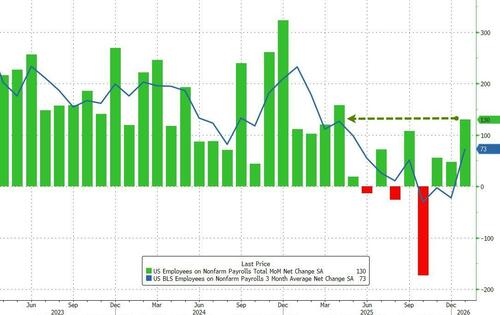
Ahead of today's jobs report, the Trump admin unleashed a full court press to warn markets about what was expected to be a very weak numbers, with Peter Navarro saying "we have to revise our expectations down significantly for what a monthly job number should look like" and Kevin Hassett told CNBC on Monday to "expect slightly smaller job numbers" and that "one shouldn't panic" if the labor data comes in weak. That's also why the whisper number ahead of today's jobs print was well below the consensus, at 35K vs 65K median consensus.
And so with markets and traders fully expecting a ugly print - with Bloomberg's chief economist looking for a 0 January print - the BLS decided to shock everyone, and reported than in January the US added 130K jobs, double the 65K median estimate and up from a downward revised December print of 48K (vs 50K previously). This was also the highest monthly jobs increase since December 2024.

While today's number was double the median consensus, here is some additional color: at 130K, the forecast was higher than 79 out of 80 forecasts, with just Citigroup's 135K forecast higher.

That said, expect today's number to be revised sharply lower last month: that's because the November report was revised down by 15,000, from +56,000 to +41,000, and the change for December was revised down by 2,000, from +50,000 to +48,000. With these revisions, employment in November and December combined is 17,000 lower than previously reported. It gets worse though, with 25 of the past 26 jobs reports revised lower.

There is another reason why today's report will be revised away: while the seasonally adjusted change was a stronger than expected 130K, the unadjusted was a negative 2.649 million. That means that the entire delta in today's "surprise beat" was due to seasonal adjustments.

The positive surprise in the payrolls number also translated into improvement in the unemployment rate, which unexpectedly dropped to 4.3%, down from 4.4% in December where it was expected to stay. Among the major worker groups, the unemployment rate for teenagers declined to 13.6 percent in January. The jobless rates for adult men (3.8 percent), adult women (4.0 percent), and people who are White (3.7 percent), Black (7.2 percent), Asian (4.1 percent), or Hispanic (4.7 percent) all posted modest improvements in recent months.

Tied to this, the labor force participation rate rose to 62.5%, up from 62.4% and fractionally better than the expected unchanged print.

There was more positive surprises: in January, hourly earnings rose 0.4% MoM, up from a downward revised (of course) 0.1% in January and above the 0.3% estimate. On a YoY basis, this translated to a 3.7% increase in average hourly earnings, in line with estimates and unchanged from the previous month.

Some more details from the report:
- The number of people employed part time for economic reasons decreased by 453,000 to 4.9 million in January but is up by 410,000 over the year. These individuals would have preferred full-time employment but were working part time because their hours had been reduced or they were unable to find full-time jobs.
- In January, the number of people not in the labor force who currently want a job decreased by 399,000 to 5.8 million. These individuals were not counted as unemployed because they were not actively looking for work during the 4 weeks preceding the survey or were unavailable to take a job.
- Among those not in the labor force who wanted a job, the number of people marginally attached to the labor force changed little at 1.7 million in January. These individuals wanted and were available for work and had looked for a job sometime in the prior 12 months but had not looked for work in the 4 weeks preceding the survey. The number of discouraged workers, a subset of the marginally attached who believed that no jobs were available for them, also changed little at 475,000 in January.
Taking a closer look at the Establishment survey, we find that job gains occurred in health care, social assistance, and construction, while federal government and financial activities lost jobs. Payroll employment changed little in 2025 (+15,000 per month on average).Here is the breakdown:
- Health care added 82,000 jobs in January, with gains in ambulatory health care services (+50,000), hospitals (+18,000), and nursing and residential care facilities (+13,000). Job growth in health care averaged 33,000 per month in 2025.
- Employment in social assistance increased by 42,000 in January, primarily in individual and family services (+38,000).
- Construction added 33,000 jobs in January, reflecting an employment gain in nonresidential specialty trade contractors (+25,000). Employment in construction was essentially flat in 2025.
- In January, federal government employment continued to decline (-34,000) as some federal employees who accepted a deferred resignation offer in 2025 came off federal payrolls. Since reaching a peak in October 2024, federal government employment is down by 327,000, or 10.9
- percent.
- Financial activities employment declined by 22,000 in January and is down by 49,000 since reaching a recent peak in May 2025. Within the industry, insurance carriers and related activities lost 11,000 jobs over the month.
And visually:

Of these, the most notable is was the ongoing sharp decline in government workers, which tumbled by 42K, and are down 5 of the past 6 months.

Last but not least, extending last month's move, in January the bulk of job creation was full time jobs which increased by 582K, while part-time jobs rose by only 31K.

And while the January numbers was stellar (at least until it is revised much lower in coming months), the much uglier part to today's jobs report was the dramatic negative benchmark revisions which we highlighted yesterday.
As we noted, the establishment survey data released today was re-benchmarked to reflect comprehensive counts of payroll jobs for March 2025. These counts are derived principally from the Quarterly Census of Employment and Wages (QCEW), which counts jobs covered by the Unemployment Insurance (UI) tax system. The benchmark process results in revisions to not seasonally adjusted data from April 2024 forward. Seasonally adjusted data from January 2021 forward are subject to revision. In addition, data for some series prior to 2021, both seasonally adjusted and unadjusted, incorporate other revisions.
The seasonally adjusted total nonfarm employment level for March 2025 was revised downward by 898,000. On a not seasonally adjusted basis, the total nonfarm employment level for March 2025 was revised downward by 862,000, or -0.5 percent.
AS a result, the change in total nonfarm employment for 2025 was revised from +584,000 to +181,000 (seasonally adjusted), which means that the US barely generated any jobs in 2025, and that instead of creating 49K average jobs per month, the US only added 15K jobs.

We will have more to say on the historic negative revisions shortly, but for now suffice to say, the picture is one of a much weaker jobs market, and the January bounce notwithstanding - and it won't stand once it is revised lower - the Fed will have no choice but to slash rates aggressively to prevent the already precarious labor market from rolling over into contraction.
Loading recommendations...