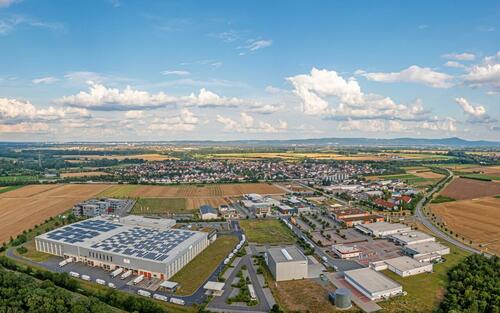
Germany is increasingly rebelling against multi-billion-euro data centers, reflecting a trend seen in other Western countries. This time, Groß-Gerau, a town outside of the mega internet hub of Frankfurt, is the latest to reject the construction of a major data center over fears of rising power costs, diminished water and environmental resources, ugly aesthetics, and skepticism over job creation.

Major U.S. investors were behind the push to build the 174-megawatt data center, but local residents and politicians have successfully stopped construction of the five-building complex, which represented €2.5 billion in investment.
The city parliament of the southern Hessian district town officially stopped the construction of the project by Vantage Data Centers. According to German media reports, the assembly rejected the proposal in an 18 to 14 vote, according to Welt newspaper.
The opposition was led by a coalition of mostly left-wing and libertarian parties — the SPD, Greens, FDP, Free Voters, and the Left Party. Meanwhile, the business-friendly CDU and the Free Voters’ Association backed the project.
Although the investors had already purchased the 14-hectare site on the outskirts of the city, residents were not convinced they wanted a data center in their own backyard.
Frankfurt already saturated
Frankfurt, also a major financial hub, has already seen some of the densest clusters of data centers in Europe.
In early 2026, NVIDIA and Deutsche Telekom launched a major industrial AI cloud in the region featuring over 10,000 GPUs, specifically designed for high-performance AI training and inference.
The market in Frankfurt has surpassed 1.3 GW (Gigawatts) of live capacity, with projections to reach 2.5 GW by 2031. Frankfurt is currently on track to overtake London as Europe’s largest data center market within the next five years.
Now, residents are revolting against these trends, with concerns over rising power costs, diminished water and environmental resources, and a lack of jobs generated by the centers.
Skepticism and fear
The town resisted for a variety of reasons, including aesthetics, a lack of jobs, and the sheer scale of the project.
Residents also feared the five massive buildings would tower over and damage the cityscape of the town, which has just over 20,000 inhabitants.
Mayor Jörg Rüddenklau (SPD) also did not believe the promised benefits would materialize, doubting the facility would generate significant new jobs or trade tax revenue.
The same resistance has been seen elsewhere in Germany, and in fact, on a global scale. In Bavaria, local groups have successfully argued that these “server barns” provide almost no local jobs — often fewer than 50 for a multi-billion euro site — while occupying vast amounts of valuable industrial land that could be used for manufacturing and other purposes.
In response to these growing concerns, the German government has introduced some of the world’s strictest regulations to appease locals.
By 2028, new data centers must reuse at least 20 percent of their waste heat, and projects that cannot prove this are being rejected. Starting in 2027, all German data centers must also cover their consumption entirely with renewable energy. This is making it harder for investors to find viable sites, as they now need to be located near major wind or solar sites.
Politicians celebrate
Following the vote in Groß-Gerau, Mayor Rüddenklau emphasized that he refused to be pressured, describing the rejection as a vital course of action. His party’s parliamentary group was even more direct, stating that the “city would not be sold to a major investor.”
The local Green Party also wrote on its website: “Bye-bye data center – billion-dollar ‘deal’ happily falls through.”
The Green Party characterized the decision as a victory for the community, noting that “with the rejection of the project, an oversized, highly problematic urban planning and ecological project is off the table.”
The party stated that the site would now be developed in a “socially acceptable and future-proof” manner.
More resistance on the horizon
Meanwhile, massive data center projects are advancing in other areas of Germany. A massive 300 MW “Mega Campus” is moving forward to serve the Brandenburg Wustermark region outside Berlin, but it has faced intense scrutiny over its impact on the local water table.
Beyond Groß-Gerau, towns like Hanau are seeing organized “neighbor resistance.” Residents are citing a 2025 study showing that some data centers consume as much water as small cities during summer heatwaves to keep servers cool.
Germany’s Energy Efficiency Act (EnEfG), which became strictly binding for many operators in 2025, has only exacerbated the problem. Grid connection requests have skyrocketed near many major cities. In Berlin alone, data center requests have reached nearly 3 GW, far exceeding what the city’s current infrastructure can handle.
Data centers are driving up the price of electricity for households and starving other sectors of power.
A similar conflict is also running in the German town of Maintal, where the U.S. firm “Edgeconnex” is pursuing a 170-megawatt data center.
Critics say these projects are necessary for Germany’s “digital future,” but with AI data centers not only generating very few jobs, but also threatening to wipe out jobs for millions in the future, some local residents are having trouble understanding what they are getting out of these deals besides high energy prices, diminished water supplies, and ugly eyesores on the landscape.
Loading recommendations...