Authored by Daniel McCarthy via The Epoch Times,
The contrast between America’s great island allies on opposite ends of the world couldn’t be more drastic.

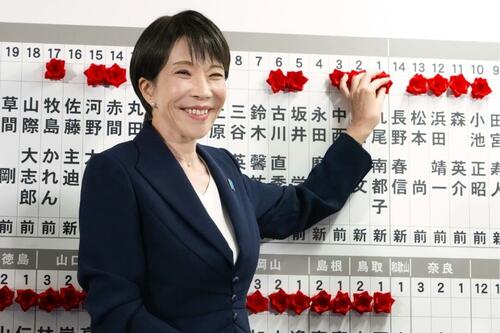
Japan has just given its commonsense conservative prime minister, Sanae Takaichi, a two-thirds supermajority in the national legislature’s Lower House; her Liberal Democratic Party took the highest proportion of seats of any party since World War II.
It’s an enormous vote of confidence not only in Takaichi’s economic agenda but also for her willingness to get tough with China.
Beijing’s mouthpieces have called Takaichi an “evil witch,” with China’s consul general in Osaka threatening, “the dirty neck that sticks itself in must be cut off” in response to Takaichi’s indication Japan would aid Taiwan against an invasion.
Such incendiary language didn’t intimidate Takaichi—nor, it turns out, Japan’s voters.
Yet even as Japan was rallying to its courageous prime minister, China was inflicting humiliation on America’s closest European ally.
Communist authorities in Hong Kong—which was a British colony until 1999—have just sentenced the businessman and free-speech champion Jimmy Lai to 20 years in prison.
The 78-year-old Lai, who holds British citizenship, will die behind bars under that sentence, but China isn’t worried about the UK’s reaction as long as Keir Starmer is prime minister there.
Just last month, the British government approved Beijing’s plans to build a vast new “mega-embassy” in London at the site of the former Royal Mint Court.
CNN notes that Xi Jinping has taken a personal interest in the complex and brought it up in his very first call with the then-newly elected Starmer in 2024.
Not that a larger presence for the People’s Republic of China in the very heart of London is the Labour government’s only recent concession:
Starmer has worked tirelessly to hand over the Chagos Islands, a British territory in the Indian Ocean, to Mauritius, an African island nation with tight connections to China.
This is no act of “decolonization.” The former Chagos natives, who were removed by Britain in the 1960s, don’t support turning the islands over to Mauritius.
The national-security implications of surrendering these small but strategic islets concern not only Britain but the United States as well, which shares a joint military base with the UK on the archipelago’s largest island, Diego Garcia.
While President Donald Trump has made his displeasure with the Mauritius deal known, Starmer has been pressing ahead.
His determination appears to derive from his background as a human-rights lawyer: he takes a nonbinding ruling proffered by the International Court of Justice as holy writ, Britain’s national interest be damned.
Starmer is a globalist at a time when the free world needs leaders who take their nations’ self-responsibilities far more seriously, especially in light of China’s ambitions.
He was swept into office in 2024 on a tide of revulsion against 14 years of leadership by Conservative prime ministers—five in all, most of whom never accepted the spirit of Brexit.
Unlike the overwhelming popular mandate the Japanese have given Takaichi, Starmer won big in Britain with a vote that was more a protest against his opponents than an endorsement of him or his party.
But he got a chance to turn that protest vote into real support—and failed.
At home, Starmer ranks as the least popular leader in the Western world, with disapproval numbers often above 70 percent.
His days are numbered, and his exit is being hastened by revelations in the Epstein files about Peter Mandelson, the man Starmer made ambassador to the United States.
Lord Mandelson stepped down from that post in September, but as further details of his dealings with sex trafficker Jeffrey Epstein have come to light, the heat on the prime minister who elevated him to Britain’s most sensitive overseas role has become unbearable.
On Monday, the leader of the Labour party in the Scottish parliament, Anas Sarwar, called on Starmer to resign.
He’s not going gracefully, however, and he still has enough backing in the UK parliament to hang on—for the moment.
But no one expects him to last until the next election, which, unfortunately for Britain, doesn’t have to be held before August 2029.
If Labour clings to power for another three years, the country’s woes will only multiply, with or without Starmer at the helm.
In Japan, Takaichi took a risk by calling a snap election just three months after she became prime minister.
Her confidence was justified—and rewarded.
In Britain, Labour knows full well it would get crushed in an early election, with Nigel Farage’s Reform party almost certainly winning power.
But Labour is only delaying the inevitable, and Britain can’t wait.
In a world where nations are aggressively pursuing their interests, the UK suffers under a government the people don’t want but can’t get rid of yet.
Loading recommendations...