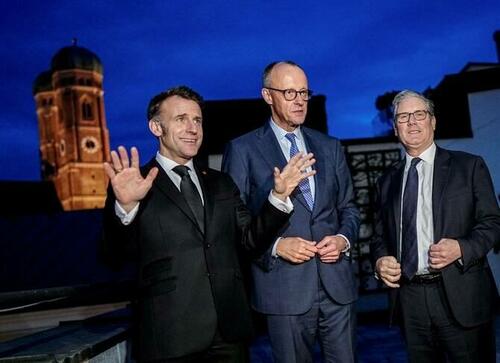
Has Europe really embarked on a nuclear reset, rethinking its US-led deterrent architecture? For the first time since the Cold War, major European capitals are openly debating the need for an independent nuclear deterrent - an emerging theme on clear display this week at the Munich Security Conference.
We've reported before that the turning point came in March, when Washington temporarily halted battlefield intelligence sharing with Ukraine - a move that forced allies to confront the prospect that Washington may no longer serve as a dependable security guarantor, also as ratcheting Trump rhetoric increasingly highlights Europe needing to shoulder its own defense burden.
France's Macron and Germany's Merz held "confidential talks" on European nuclear deterrence, the German chancellor has confirmed. Still, he tried to downplay the full implications in his Friday remarks: "We Germans are adhering to our legal obligations. We consider this strictly within the context of our nuclear sharing within NATO and we will not allow zones of differing security to emerge in Europe," Merz said.

However, President Macron on the same day was a little more forthright, describing amid the backdrop of ongoing direct talks between Moscow and the United States: "We will live with Russia in the same place, and the Europeans at the same place, and I don't want this negotiation to be organized by someone else," he said. And more bluntness on the nuclear issue:
Macron told the gathering in Munich, which focuses on security and brings together world leaders, future parameters of security may include a new, more holistic nuclear deterrence among European allies. Until now, deterrence has been a strictly national domain and a highly delicate issue because of its implications on sovereignty.
The French leader teased a "new strategic dialogue" on nuclear arms.
"We have engaged a strategic dialogue with Chancelor Merz and (other) European leaders in order to see how we can articulate our national doctrine" with special cooperation and common security interests in some key countries, he said.
"This dialogue is important because it's a way to articulate nuclear deterrence in a holistic approach of defense and security, Macron continued. "This is a way to create convergence in our strategic approach between Germany and France."
Macron's remarks before the Munich audience were tinged with implicit (negative) references to the US administration: "We need a much more positive mindset. There has been a tendency in this place and beyond to overlook Europe and sometimes to criticise it outright," he stated.
"Caricatures have been made, Europe has been vilified as an aging, slow, fragmented construct sidelined by history. As an overregulated economy that shuts innovation, as a society preyed by migration that would corruption its precious traditions."
"And most curiously yet, in some quarters, as a repressive continent," he added. "Everyone should take a cue from us, instead of trying to divide us."
Merz had some similarly dramatic things to say on 'lost American leadership'...
"The leadership claim of the U.S. is being challenged, perhaps already lost," Merz said during the opening of the Munich Security Conference, laying out the starkest assessment yet from Berlin of a world increasingly defined by great-power rivalry. “In the era of great powers, our freedom is no longer simply guaranteed. It is under threat.”
He argued the global system itself may already have collapsed. "The international order based on rights and rules… no longer exists in the way it once did," he said.

You will find more infographics at Statista
The Europeans are fundamentally worried that any new regional architecture related to potential settlement to the Russia-Ukraine war could leave the continent weakened and exposed, and that the Trump admin might be willing to cede too much in the way of compromise to Russia.
We underscored previously that ff the US and Russia craft the final settlement, Europe must either accept it or refuse and confront the consequences alone. And yet, neither Paris nor Berlin is prepared for the latter scenario.
Loading recommendations...