Authored by James Hickman via SchiffSovereign.com,
In January 2025, the federal government employed about 3 million people. By November, that number had fallen by roughly 270,000 workers — a reduction of about 9%.

According to the Cato Institute, that was the largest peacetime federal workforce reduction EVER.
More than 150,000 employees took the “Fork in the Road” buyout offer to resign or retire. Tens of thousands more were laid off outright. Entire offices were emptied. Agencies that had been growing for decades shrank to staffing levels not seen since 2014.
And yet, despite historic federal layoffs, government spending went UP last year.
The federal government spent $7 trillion in Fiscal Year 2025— roughly $300 billion more than the year before. Bear in mind, 2025 was the year that DOGE was supposed to take a chainsaw to the budget and cut spending.
This is not a failure of DOGE. It’s a revelation about the actual problem.
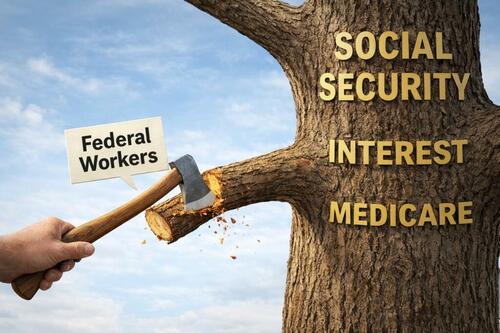
The total federal payroll— every salary, every benefit, for every civilian federal employee (excluding the military)— comes to about $336 billion a year— less than 5% of total federal spending.
In other words, you could fire every federal employee tomorrow— every bureaucrat, every regulator, every paper-pusher in Washington— and 95% of the spending would continue as if nothing happened.
That’s because around 60% of the budget is mandatory spending— Social Security, Medicare, Medicaid— programs that pay out automatically based on laws that were passed decades ago. Congress doesn’t vote on these expenditures each year. The checks just go out.
Then there’s interest on the national debt, which in total runs about $1.2 trillion per year. It’s the second-largest line item in the entire federal budget, bigger than Medicare, bigger than national defense.
(The government uses a lower number called “net” interest; they exclude hundreds of billions in interest owed to Social Security and military retirees. But unless they plan on screwing those people over, that interest still has to be paid. So, we use the “gross” interest number and not “net” interest).
All of these obligations grow automatically, every year, regardless of who’s in charge or how many people show up to work.
Social Security alone grew by over $100 billion last year. Interest payments grew by another nearly $100 billion. Those two-line items, by themselves, swallowed more than the entire savings DOGE could theoretically achieve by cutting the workforce.
In fact, according to the Congressional Budget Office, more than 80% of projected spending growth over the next decade comes from Social Security, federal healthcare programs, and interest on the debt.
This is the structural problem nobody in Washington wants to talk about honestly: America’s deficit problem isn’t exclusively because of bad decisions today. It’s a failure to address bad decisions made years ago… decades ago– commitments that are baked into law, growing on autopilot, funded by borrowing roughly $2 trillion every year.
In an ideal world, Congress would address these entitlement programs directly. They are, after all, the biggest driver of the problem. But reforming Social Security or Medicare is the political third rail— nobody wants to touch it.
But there are other ways to move the needle as well.
The $38+ trillion national debt is manageable as long as the economy grows faster than the debt— which right now is not happening. But America still has absurdly strong economic potential to make that happen.
Treasury Secretary Scott Bessent has publicly stated that roughly 10% of the entire federal budget— about $600 billion per year— is outright fraud. Not waste. Not inefficiency. Fraud. And much of that fraud is within entitlement programs— the welfare fraud that came to light in Minnesota, the hundreds of billions in Medicare and Medicaid fraud that have been documented for years.
So, reducing fraud would be extremely helpful. Stop paying criminals!! It shouldn’t be that hard.
Then they can take a hatchet to the regulatory maze that strangles productivity; this would substantially reduce the deficit and boost real economic growth— putting America in striking distance of growing the economy faster than the debt.
To its credit, DOGE proved that the federal government could function with far fewer employees.
After the historic reduction in federal employees, services didn’t collapse.
The IRS still processed returns. Air traffic controllers still showed up. The essential machinery of government kept running with 9% fewer people.
That confirms what many have long suspected: a significant portion of federal workers exist to justify their own existence.
But DOGE also proved something far more uncomfortable. Whenever the executive branch tries to go beyond workforce cuts and tackle the spending itself— even fraudulent spending— someone files a lawsuit, and a judge issues an injunction.
Federal judges blocked DOGE from accessing Treasury payment systems. A coalition of 20 state attorneys general sued to halt layoffs at over a dozen agencies. Even relatively modest cuts were tied up in litigation for months.
The legal system functions as a ratchet: spending can go up easily, but it almost never comes down.
Ultimately, the spending trajectory won’t change until Congress decides to root out fraud, cut spending across the board, and stop obstructing economic growth.
But Congress won’t act until voters force them to do so— which, based on the current state of American politics, isn’t happening anytime soon.
The window to fix this relatively painlessly is still open. But it’s narrowing. Within seven years, Social Security’s trust funds will be exhausted, and the national debt will exceed $50 trillion. At that point, the math won’t just be uncomfortable. It will be unavoidable.
We can hope they figure it out. But hope isn’t a strategy. And that’s what a good Plan B is all about— ensuring your family’s financial future doesn’t depend on Congress suddenly discovering fiscal discipline after decades of proving they have none.
Loading recommendations...