
Facing a demographic catastrophe, Ukraine is paying for troops to freeze their sperm
 BBC
BBCMaxim doesn't mind discussing his sperm. In fact, he wishes more in Ukraine's military would talk about their fertility – or at least think about it.
"Our men are dying. The Ukrainian gene pool is dying. This is about the survival of our nation," the soldier tells me, speaking by phone from a position somewhere near the eastern frontline.
The 35-year-old is serving with Ukraine's National Guard and when he returned on leave recently his wife persuaded him to visit a clinic in Kyiv and leave a sperm sample.
It was frozen free of charge as part of a programme to help serving soldiers.
If Maxim were killed, his wife could use the sample to try to have the child they've always wanted.
But he says his frozen sperm could be crucial to creating a family, in any case.
"Whether you are right on the 'zero point' of the frontline, or 30 or even 80 kilometres back, there is no guarantee that you're safe," the soldier says, explaining that Russian drones overhead are a constant threat.
"That means stress, and this [can have] an impact: your reproductive ability declines. So we have to think about the future and the future of our Ukrainian nation."
Private fertility clinics began offering what's known as crypto preservation to servicemen and women in 2022 at the start of Russia's full-scale invasion.
They could freeze their sperm or eggs for free in case they were injured in action or their fertility was affected.
The following year parliament stepped in to regulate the practice and provide state funding.
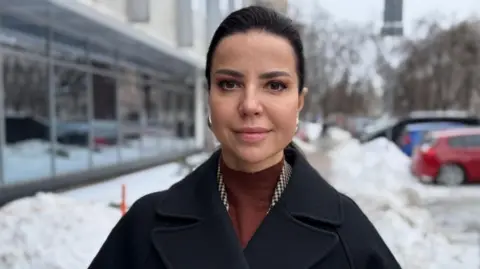
"Our soldiers are defending our future, but may lose their own, so we wanted to give them that chance," is how MP Oksana Dmitrieva describes the law she helped draft.
"It's to support them, so they can use their sperm later."
The politicians' initial efforts caused a public outcry though, when they stipulated that all samples should be destroyed on a donor's death. That came to light when a war widow tried to have a child using her husband's frozen sperm and was blocked.
The law has since been amended so that all soldiers' samples are preserved for free for up to 3 years after their death and are available for a partner to use with prior written consent.
The programme is also about addressing a demographic crisis which existed before Russia's invasion but has been made far worse by the large numbers of men dying in action, many of them Ukraine's youngest and fittest.
Then there's the millions, mainly women, who have left as refugees. Four years on, many are still abroad because life in Ukraine isn't getting easier.
That fact is driven home when I meet the MP in a hotel lobby and we talk without removing our coats: this winter Russia's relentless missile strikes on the power grid have left thousands of buildings in Kyiv freezing cold.
"We're also thinking about the future and all the young people we've lost. We need to replace them," Dmitrieva says. "This is one tiny step to improve the demographic situation."
On her own visits to the frontline the MP encourages soldiers to talk about their sex lives and fertility problems – and to think about freezing their sperm.
"At first they're really embarrassed, but we talk and I tell them to tell others, and then they come and they do it," she says.
"If they have this chance, then why not? It doesn't hurt!"
Kyiv's state-run Centre for Reproductive Medicine began accepting soldiers onto the "frozen sperm" programme in January.
Only a dozen or so have signed up so far but the clinic is confident that will change once word gets out.
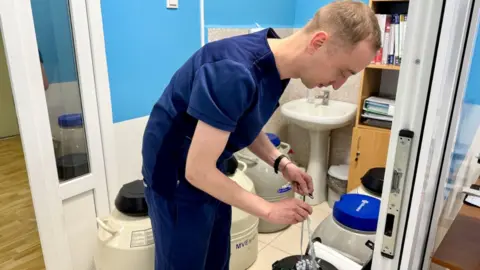
"We expect big demand. We have high hopes," director Oksana Holikova says, leading me towards the laboratory where the "biomaterial" is collected, prepared, and then stored.
Giant vats open with a puff of what looks like dry ice to reveal long, slim tubes suspended inside, full of sperm.
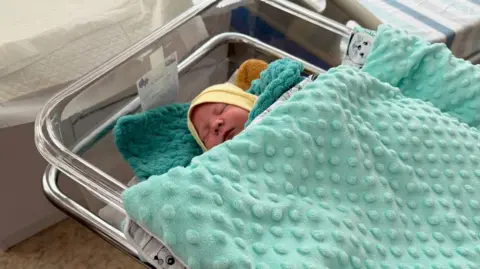
Our route through quiet corridors reveals the hidden strains of this war: just one newborn gurgling in a cot, and one woman in labour. The number of pregnant patients the clinic sees has dropped by half since the start of the all-out war.
"If women are stressed, they [can] have problems with their periods. It's all linked," Holikova points out. "About 60% of my patients are on anti-depressants, including people with panic attacks because of the missiles and drones."
Others have what she terms "delayed life syndrome": putting major life decisions, including childbirth, on pause.
"Women are scared of getting pregnant if they're going to end up running to bomb shelters."
So Ukraine needs every newborn child possible.
But the legislation to help military families doesn't always work smoothly.
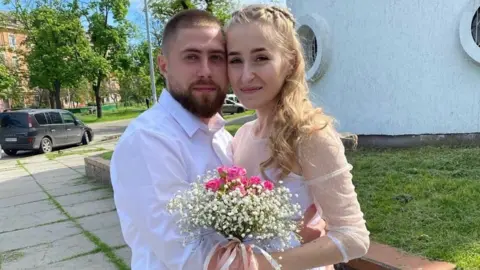
Katerina Malyshko and her husband Vitaly had been trying for a baby for a while. She believes their problems conceiving naturally were caused, or at least exacerbated, by the war: "all the stress and sleepless nights," Katerina says. "Every night is like a lottery: you don't know whether you'll wake up."
The young couple would have celebrated their fourth wedding anniversary this year, perhaps with a new baby. Last winter they had three viable embryos at the fertility clinic and Katerina was due to have them transferred to her womb.
Then Vitaly was killed.
"It was a direct hit with a guided bomb, he had no chance," she tells me.
Katerina talks frankly about her struggle just to go on living without her husband. Her pain was then made even more acute when the clinic said she had no right to continue treatment with the frozen embryos or Vitaly's sperm.
"They would store it," she says. "But I couldn't use it."
The MP, Oksana Dmitrieva, has intervened directly with some clinics to ensure soldiers' families get treated. But she admits the new law still needs "ironing out".
A vote on several amendments is due in Spring.
But Katerina, desperate and grieving, had to turn to the courts and it was only six emotionally exhausting months later that a judge finally decided in her favour.
"I read the ruling and sat there and cried. Because it was our family. We had waited to long for that and been through so much," Katerina recalls.
"I felt joy and grief at the same time because I'd had to fight for my rights. But I wanted to do it, to honour my husband."
 Instagram/Katerina Malyshko
Katerina isn't ready to try for a child just yet: she feels too fragile.
She also has no hopes the war will end soon, which would allow her to give birth in a country at peace.
"If we compromise now, then what did so many people die for?" is her reaction to the idea Ukraine might give up land Vitaly was killed defending, for Russia to stop its invasion.
But Katerina does want the option of having her husband's baby when she's ready for that.
"I think the children of our soldiers who've been killed should have a chance to live: they have the right to live in the country their parents died for."
Out on the frontline, in constant danger, Maxim agrees.
"That's why I did it, and it's great!" the soldier tells me over the phone. "Because maybe tomorrow, I'm suddenly gone. But my wife will have my sperm and can use it. It's one less thing for me to worry about."
The biggest problem Maxim sees is persuading men to sign up for the programme.
The Kyiv clinic director, Oksana Horlikova, recalls talking to one war veteran who told her soldiers were coming to him in tears because they were struggling to have sex with their partners or conceive.
"Men are secretive, but there are lots of psychological problems," Maxim admits.
So he suggests soldiers could be told to freeze their sperm when they're drafted, like they leave DNA samples to identify them if they're killed.
"All that's holding people back is that we need to talk about this more and explain why it's important," the soldier concludes.
"Because we men won't do anything, unless you shove it in our face – and make us."
Additional reporting by Tetiana Dankevych