Submitted by Thomas Kolbe
At times, it seems almost absurdly comical when senior European Union officials make conspicuous efforts to court local business on foreign trips. Didactic in tone, nearly arrogant in their demands toward potential trade partners, and buoyed by a taste for moral superiority, the EU takes the global stage.
It still attempts to force large parts of the world into Brussels’ doctrinal playbook—as if economic cooperation could be achieved through normative decrees.

Meanwhile, its own economic weakness is either overlooked or deliberately ignored.
Economic strength would at least provide some justification for such demands.
Yet the ongoing relocation of European industry to Asia and the United States undermines any carefully staged display of supposed superiority.
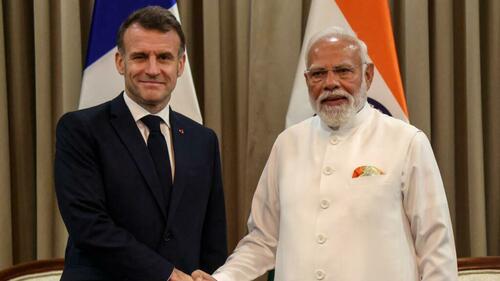
From February 17 to 19, France’s President Emmanuel Macron visited India—the newly discovered object of European diplomatic desire.
In Brussels, high hopes are pinned on Prime Minister Narendra Modi: unspoken is the goal of trade-policy support in the battle against Donald Trump’s America.
For Macron, this India trip could have been an easy diplomatic exercise—without missteps, without verbal blunders, simply by observing routine protocol.
He could have used the opportunity to study how a booming AI hub is being built. Instead, he presented his bewildered hosts with Europe’s “third way”—a performance that at best left them perplexed, likely met with a shrug.
Macron advocated for “transparent” AI focused on open-source models, strict privacy standards, and societal benefits in health, education, and especially climate protection. Initiatives like “Current AI,” an EU-funded €2.5 billion project to finance nonprofit activities, confirm what is already obvious: Brussels still believes technological innovation can be decreed by the state.
But new technologies do not emerge administratively or via bureaucratically managed grants. Innovation thrives where free markets operate, entrepreneurship takes risks, and open capital markets enable customer-oriented value creation.
For Emmanuel Macron, Friedrich Merz, and Ursula von der Leyen, this insight may seem like a dangerously heretical lesson. Yet it describes nothing more than the only viable civilizational path: an open self-discovery process that allows mistakes, does not stigmatize risk, and provides bold pioneers real opportunities—essentially turning EU policy upside down.
European policy has little interest in fostering genuine open-source dynamics—even if desirable for a flourishing market economy. Rather, the impression solidifies that state control mechanisms are being secured: through regulatory backdoors, software tools, and laws like the Digital Services Act—with the aim of steering markets and, above all, controlling public discourse.
Macron delivered perhaps his most revealing remarks before students in New Delhi at the AI Impact Summit. He lamented the lack of control over platforms like Elon Musk’s X and spoke of missing transparency. A “jungle” had arisen in which no one knew who was saying what, algorithms were beyond state reach. In this context, he called appeals to freedom of speech “bullshit”—a striking moment of candor that accurately reflects the stance of much of the EU’s political elite.
They are engaged in an open struggle with citizens—at least with the portion who see themselves as the true sovereign and view politics as representation within a democratic state, not an educational disciplinary apparatus. Macron, however, seems convinced he can use aggressive opinion control to postpone both the collapse of his minority government and the looming state insolvency—at least until his own political exit is secured.
Back in wintry Germany, his counterpart Friedrich Merz struck a similar note. At a CDU Ash Wednesday event in Trier, the chancellor outlined his vision for future communication platforms: real-name requirements and digital identities for youth. Translated, this means nothing less than the gradual end of online anonymity—a space that has so far been essential for opposition voices and political coordination.
The pressure to act grows: month after month, the European economy loses substance—regardless of, or precisely because of, the intensity of state intervention in the shrinking remnants of the continent’s once-proud social market economy.
The gap between aspiration and reality in Europe was recently on display at the Munich Security Conference. EU foreign policy chief Kaja Kallas presented Brussels’ demands toward Russia as a basis for potential peace talks. Moscow must make substantial compromises—limiting forces, cutting the military budget, and recognizing Ukraine’s pre-2022 borders. Territorial concessions or legitimizing occupied areas are out of the question. Sanctions and future use of frozen Russian assets, particularly via Euroclear, remain leverage.
A reminder: Russia’s de facto dominance in the Ukraine conflict is measured not least by its effects on Europe—ongoing energy crises across much of the continent and the visible erosion of the European economy. That Europeans weren’t even at the table in recent pre-negotiations for a peace deal is a diplomatic humiliation. Yet even this does not seem enough to fundamentally question their strategy or objectively assess reality.
Instead, growing elite resentment is increasingly directed inward. Citizens expressing dissatisfaction and supporting nationally sovereign political forces fall under scrutiny. This reflects a fear of competition that might effectively challenge what is perceived as coercive EU policy.
Upcoming state elections will reveal just how resilient the firewall really is—one that delivers more mass migration, digital censorship, and the construction of a green-military socialism.
* * *
About the author: Thomas Kolbe, a German graduate economist, has worked for over 25 years as a journalist and media producer for clients from various industries and business associations. As a publicist, he focuses on economic processes and observes geopolitical events from the perspective of the capital markets. His publications follow a philosophy that focuses on the individual and their right to self-determination.
Loading recommendations...