From Wikipedia, the free encyclopedia
Device used by the blind

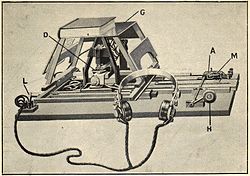
The optophone is a device, used by people who are blind, that scans text and generates time-varying chords of tones to identify letters. It is one of the earliest known applications of sonification. Dr. Edmund Fournier d'Albe of Birmingham University invented the optophone in 1913,[1] which used selenium photosensors to detect black print and convert it into an audible output which could be interpreted by a blind person. The Glasgow company, Barr and Stroud, participated in improving the resolution and usability of the instrument.[2]
Only a few units were built and reading was initially exceedingly slow; a demonstration at the 1918 Exhibition involved Mary Jameson reading at one word per minute.[3] Later models of the Optophone allowed speeds of up to 60 words per minute, though only some subjects are able to achieve this rate.[4]

- ^ d'Albe, E. E. F. (1 July 1914). "On a Type-Reading Optophone". Proceedings of the Royal Society A: Mathematical, Physical and Engineering Sciences. 90 (619): 373–375. Bibcode:1914RSPSA..90..373D. doi:10.1098/rspa.1914.0061.
- ^ d'Albe, E. E. Fournier (October 1920), "The Type-Reading Optophone" (PDF), Scientific American: 109–110, archived from the original (PDF) on 2012-04-26, retrieved 2011-12-01
- ^ Jameson, M. (1966), "The Optophone: Its Beginning and Development" (PDF), Bulletin of Prosthetics Research: 25–28, archived from the original (PDF) on 2024-01-30, retrieved 2011-12-01
- ^ Fish, R.M. (1976), "An audio display for the blind", IEEE Transactions on Biomedical Engineering, 23 (2), IEEE: 144–154, doi:10.1109/tbme.1976.324576, PMID 1248840