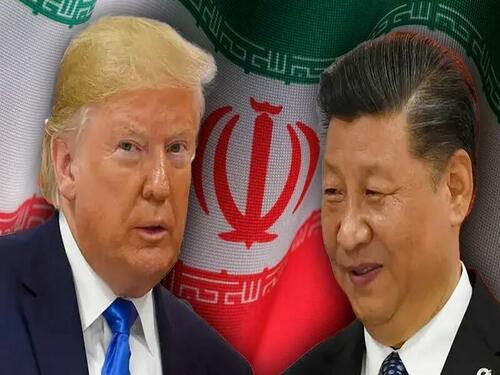
The goal is to obtain proxy control over Iran’s enormous oil and gas reserves so that they can be weaponized as leverage against China for coercing it into a lopsided trade deal that would derail its superpower rise and therefore restore US-led unipolarity.

Trump claimed that the US’ military campaign against Iran is to “defend the American people”, while many critics have alleged (whether in jest or not) that it’s to distract from the Epstein Files, but few observers realize that it’s actually all about China. It was explained here that Trump 2.0 “decided to gradually deprive China of access to markets and resources, ideally through a series of trade deals, in order to imbue the US with the indirect leverage required to peacefully derail China’s superpower rise.”
To elaborate, “The US’ trade deals with the EU and India could ultimately result in them curtailing China’s access to their markets under pain of punitive tariffs if they refuse. In parallel, the US’ special operation in Venezuela, pressure on Iran, and simultaneous attempts to subordinate Nigeria and other leading energy producers could curtail China’s access to the resources required for fueling its superpower rise.”
The resource dimension that’s relevant to Iran is a major part of the US’ “Strategy of Denial”.
That’s the brainchild of Under Secretary of War for Policy Elbridge Colby, and it was expanded on in this analysis here from early January.
As was written, “US influence over Venezuela’s and possibly soon Iran’s and Nigeria’s energy exports and trade ties with China could be weaponized via threats of curtailment or cut-offs in parallel with pressure upon its Gulf allies to do the same in pursuit of this goal”, which is to coerce China into indefinite junior partnership status vis-à-vis the US through a lopsided trade deal.
Most observers missed it, but the new National Security Strategy calls for ultimately “rebalance[ing] China’s economy toward household consumption”. This is a euphemism for radically re-engineering the global economy through the previously described means, namely curtailing China’s access to the markets and resources responsible for its superpower rise, so that it no longer remains “the world’s factory” and thus ends its era of being the US’ only systemic rival. US-led unipolarity would then be restored.
Circling back to Iran, “[it] represented about 13.4% of the total 10.27 MMbpd of oil [that China] imported by sea” last year per Kpler, hence why the US wants to control, curtail, or outright cut off this flow. ‘Plan A’ was to achieve this through diplomatic means for replicating the Venezuelan model that entered into effect after Maduro’s capture. Iran flirted with this but didn’t commit since it would entail the country’s strategic surrender, ergo why Trump authorized military action for achieving this instead.
In pursuit of this, Trump promised the IRGC in his video announcing his country’s military campaign against Iran that they’d have immunity if they laid down their arms. This reinforces the abovementioned claim that the US wants to replicate the Venezuelan model since it strongly suggests that he envisages newly US-aligned IRGC running Iran in the political interim before new elections just like the newly US-aligned Venezuelan security services run their own country during their own current political interim.
Such a scenario would avert Iran’s possible “Balkanization”, thus preserving the state so that it can then resume its prior role as one of the US’ top regional allies, which might then aid the Azeri-Turkish Axis’ efforts to project Western influence along Russia’s entire southern periphery. In that event, the US would simultaneously obtain unparalleled resource leverage over China via proxy control of Iran’s oil and gas industries while tightening its encirclement of Russia, which would deal a powerful blow to multipolarity.
Views expressed in this article are opinions of the author and do not necessarily reflect the views of ZeroHedge.
Loading recommendations...