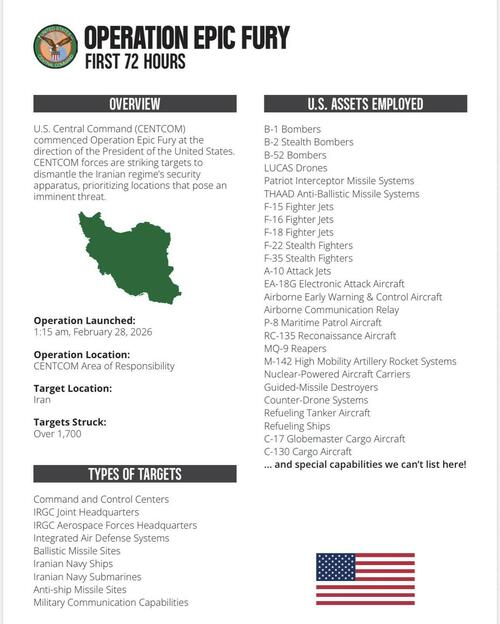
In the first 72 hours of Operation Epic Fury, U.S. forces conducted more than 1,700 strikes across Iran on high-value IRGC military assets and leadership. These strikes relied heavily on air-delivered munitions, including bombs, air-launched rockets, and missiles deployed from stealth fighter jets, stealth bombers, fourth-generation fighter jets and bombers, as well as guided-missile destroyers.

Notably, U.S. Central Command indicated the operation also marked the first combat use by the U.S. military of one-way kamikaze drones, a newly added capability likely shaped by lessons drawn from four years of high-intensity warfare in Eastern Europe.
"For the first time in history, it is using one-way attack drones in combat during Operation Epic Fury. These low-cost drones, modeled after Iran's Shahed drones, are now delivering American-made retribution," U.S. CENTCOM wrote on X.
OISNT account on X OSINTdefender published footage of what appears to be one of the Low-Cost Unmanned Combat Attack System (LUCAS) US drones used in the operation that crash landed.

OSINTdefender noted, "Locals in Iraq appear to have recovered a crashed and almost entirely intact Low-Cost Unmanned Combat Attack System (LUCAS), an American copy of the Iranian Shahed-136 Attack Drone, which is confirmed to have been used recently by Task Force Scorpion Strike during U.S. attacks on Iran as part of Operation Epic Fury."
Strike Map

Related:
Whether in Iran or Eastern Europe, the rapid proliferation of low-cost kamikaze drones has permanently altered the battlefield. Four years of war in Ukraine have made it clear to military planners and weapons manufacturers worldwide that these inexpensive, mass-produced drones are no longer optional, but are increasingly pivotal in changing the economics of war.
Loading recommendations...