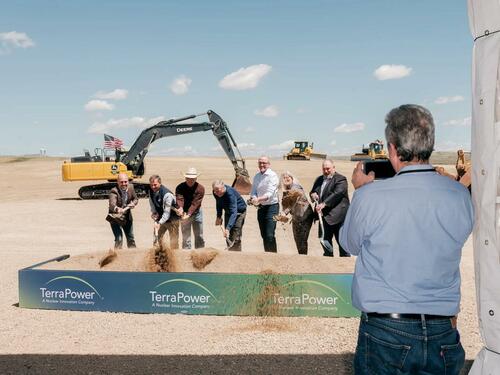
In a move that's got America's energy bureaucrats finally moving at something approaching market speed, the Nuclear Regulatory Commission has handed TerraPower - the Bill Gates-backed outfit pushing the Natrium advanced reactor - the first commercial nuclear construction permit issued in nearly a decade.
After years of regulatory theater and the usual alphabet-soup delays, the NRC unanimously approved the permit on March 4, 2026, for the Kemmerer Power Station Unit 1 in southwestern Wyoming. Construction on the actual reactor can now commence, with TerraPower signaling work will kick off "in the coming weeks."

When actual construction of the reactor breaks ground, the US will finally appear on this chart of countries which currently have nuclear reactors under construction, where China is at 38, Russia and India at 6... and the US is below Iran and Pakistan with 0.

For once, this isn't just another ribbon-cutting for legacy light-water tech that's been choking on paperwork since the Carter administration. The Natrium is a sodium-cooled fast reactor — pool-type design, paired with a molten-salt energy storage system that lets it ramp output like a gas peaker plant while running baseload clean. The reactor uses High-Assay Low-Enriched Uranium (HALEU) fuel, which as we explained in our nuclear primer for investors, is enriched to around 15-20% U-235, and allows for smaller, more efficient reactor cores. Reactor capacity clocks in at 345 MWe, with the storage boost potentially pushing it higher for grid flexibility.
It's the kind of innovation that actually addresses intermittency complaints from the wind-and-solar crowd without pretending batteries the size of small cities are economically sane.
In a shocking reversal to its standard operating procedure (and we use the term loosely, since US nuclear regulators haven't really done anything in decades), the NRC's staff reviewed the application (filed back in March 2024) in just 18 months — a blistering pace compared to the initial 27-month estimate. Translation: even the regulators are now feeling the heat from exploding AI/data-center demand and the obvious reality that coal retirements + renewables alone won't keep the lights on.
This marks the first approval for a non-light-water commercial reactor in over 40 years. Historic? You bet. Overdue? Even more so.
TerraPower CEO Chris Levesque didn't mince words: "Today is a historic day for the United States’ nuclear industry." The company has already been moving dirt on non-nuclear portions since 2024 (thanks to earlier exemptions and state permits from Wyoming's Industrial Siting Council in 2025), including the "energy island" components. Full commercial operation targets 2030, with costs estimated up to $4 billion for this demo plant — backed by DOE's Advanced Reactor Demonstration Program cost-share (up to $2 billion federal, matched by TerraPower and partners).
And the momentum isn't stopping at one unit. TerraPower inked a massive deal with Meta earlier this year for up to eight Natrium plants, potentially delivering gigawatts of firm, carbon-free power to feed the AI beast. Gates, ever the optimist on nuclear, has long positioned this as the scalable path forward — and with tech giants scrambling for reliable baseload to avoid blackouts or diesel generators at data centers, the economics are starting to look less speculative.
Critics will no doubt whine about sodium's reactivity (fire risks, anyone?), the first-of-a-kind premiums, or whatever regulatory bogeyman they can dredge up. But let's be real: the old paradigm delivered Vogtle-style overruns and decade-long builds. Advanced designs like Natrium promise modular construction, passive safety features, and actual cost/time discipline - exactly what the grid needs as electrification ramps and fossil plants retire. Small and mobile modular reactors like those built by Oklo and Nano Nuclear will be even more important for powering up the "behind the meter" data center revolution which at least check was short about 100 Gigawatts in the coming years .
While the legacy nuclear lobby clings to 1970s tech and endless EIS reruns, TerraPower is proving that American innovation - backed by private capital and a (finally) cooperative regulator - can deliver. The Wyoming project isn't just replacing a retiring coal plant; it's a blueprint for weaning the grid off intermittent fantasies and toward dispatchable, high-density power that doesn't bankrupt ratepayers.
Nuclear's back, baby. And this time, it's not waiting for permission slips from the 20th century. And as the atoms are about to start splitting in Kemmerer, the energy establishment is feeling the ground shake.
Loading recommendations...