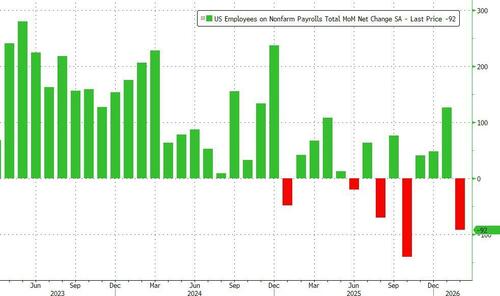
In our nonfarm payrolls preview, we quoted JPMorgan's Market Intel desk which said that "for this print, the stronger the better", which by implication means that a poor number would be bad. By that logic, the actual number couldn't be any worse, because moments ago the BLS reported that in February, the US lost 92,000 jobs, a huge drop from the downward revised (of course) 126K in January, and the second worst print since 2020 (only October's shock -140K was worse). The number of private payrolls dropped by 86K, also a huge miss to estimates of a 60K increase.

The February payrolls print was a six-sigma miss to the 55K median estimate, and came in 83K below the lowest estimate!

The change in total nonfarm payroll employment for December was revised down by 65,000, from +48,000 to -17,000, and the change for January was revised down by 4,000, from +130,000 to +126,000. With these revisions, employment in December and January combined is 69,000 lower than previously reported.

One potential mitigating factor: the number of people who were unable to work due to weather surged to 228K in February, well above last year's level 167K, due to the powerful winter storms hitting the US.

Looking under the surface does not reveal as silver lining: part-time workers dropped by 249K while full-time workers slid by 100K.

Perhaps the only silver lining was that native-born workers jumped by 877K (which was only a modest reversal of the 2.5 million drop last month), while foreign born workers dropped by 394K.

The unemployment rate rose from 4.3% to 4.4% vs estimates of an unchanged print, as the number of unemployed workers rose by 203K from 7.368MM to 7.571MM, while the civilian labor force was virtually unchanged (from 170.564K to 170.483K). Among the major worker groups, the unemployment rates for adult men (4.0 percent), adult women (4.1 percent), teenagers (14.9 percent), and people who are White (3.7 percent), Black (7.7 percent), Asian (4.8 percent), or Hispanic (5.2 percent) all rose modestly in February.

Both the labor force participation rate, at 62.0% (below the estimate of 62.5%), and the employment-population ratio, at 59.3%, changed little in February. These measures showed little change over the year, after accounting for the annual adjustments to the population controls.

Turning to wages, average hourly earnings rose 0.4% MoM, same as January and above estimates of a 0.3% imcrease. This translated into a 3.8% YoY increase, up from 3.7% and the consensus of an unchanged print.

Some more details from the report
- The number of long-term unemployed (those jobless for 27 weeks or more) changed little at 1.9 million in February but is up from 1.5 million a year earlier. The long-term unemployed accounted for 25.3 percent of all unemployed people in February.
- The number of people employed part time for economic reasons decreased by 477,000 to 4.4 million in February. These individuals would have preferred full-time employment but were working part time because their hours had been reduced or they were unable to find full-time jobs.
- The number of people not in the labor force who currently want a job changed little in February at 6.0 million. These individuals were not counted as unemployed because they were not actively looking for work during the 4 weeks preceding the survey or were unavailable to take a job.
- Among those not in the labor force who wanted a job, the number of people marginally attached to the labor force changed little at 1.6 million in February. These individuals wanted and were available for work and had looked for a job sometime in the prior 12 months but had not looked for work in the 4 weeks preceding the survey. The number of discouraged workers, a subset of the marginally attached who believed that no jobs were available for them, decreased by 109,000 in February to 366,000.
Turning to the establishment survey, which unveiled the shocking
- Employment in health care decreased in February, reflecting strike activity. Employment in information and federal government continued to trend down. Payroll employment changed little on net in 2025.
- Health care employment declined by 28,000 in February, following a large increase in January (+77,000). Offices of physicians lost 37,000 jobs in February, primarily due to strike activity. Hospitals added 12,000 jobs. Over the prior 12 months, health care had added an average of 36,000 jobs per month.
- Employment in information continued to trend down in February (-11,000). The industry had lost an average of 5,000 jobs per month over the prior 12 months.
- In February, federal government employment continued to decline (-10,000). Since reaching a peak in October 2024, federal government employment is down by 330,000, or 11.0 percent.
- Employment in social assistance continued its upward trend in February (+9,000), driven by individual and family services (+12,000).
- Transportation and warehousing employment changed little in February (-11,000). A job loss in couriers and messengers (-17,000) was partially offset by a gain in air transportation (+5,000). Employment in transportation and warehousing has declined by 157,000, or 2.4 percent, since reaching a peak in February 2025.
- Employment showed little change over the month in other major industries, including mining, quarrying, and oil and gas extraction; construction; manufacturing; wholesale trade; retail trade; financial activities; professional and business services; leisure and hospitality; and other services.

While we will have more to say about this report, the kneejerk reaction is, well, bad: this was about as ugly as it could be, and coming in a time when input costs are soaring due to the Iran war, it screams AI-driven stagflation.
Loading recommendations...