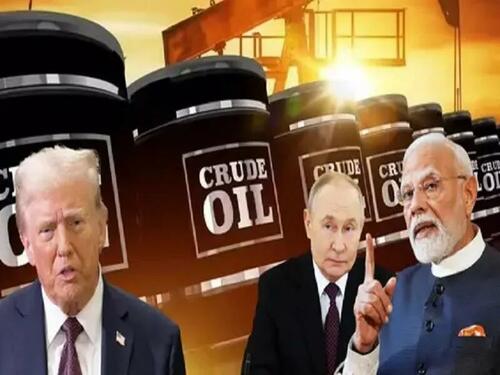
The “politically inconvenient” truth is that the US is unilaterally reshaping the world order in a bid to restore unipolarity, and regardless of one’s opinion about this, it’s objectively achieved some tangible progress as of late.

Treasury Secretary Scott Bennett announced that Indian refiners had just been provided with a 30-day waiver to purchase Russian oil, but only if it’s that which is already stranded at sea, thus ensuring “no significant financial benefit to the Russian government”. The stated purpose is “To enable oil to keep flowing into the global market” due to disruptions around the Strait of Hormuz caused by the Third Gulf War, which the US initiated as part of its grand strategy against China as explained here.
Depriving China of the 13.4% of its oil imports that it received from Iran last year is designed to give the US enormous leverage ahead of Trump’s upcoming trip at month’s end with the hope of then coercing the People’s Republic into agreeing to a lopsided trade deal for derailing its superpower rise. It’s beyond the scope of this analysis to critique that strategy, but the point in referencing it is to draw attention to how India could have suffered collateral damage had the US not temporarily waived its sanctions.
After all, Trump threatened last month to reimpose his punitive 25% tariffs on India for these purchases if they’re resumed after claiming that Modi agreed to zero them out as part of the Indo-US trade deal, which India denied. Nevertheless, India did indeed reduce its imports under what top Russian expert Fyodor Lukyanov described as “US pressure”, though he also clarified that this doesn’t mean that India isn’t a sovereign state despite the US unofficially exerting influence over its energy security.
In his words, “India’s understanding (of sovereignty), like that of many other states, is different (than Russia’s). Sovereignty does not necessarily mean refusing to bend under pressure; it means finding ways to realize one’s interests under less-than-ideal conditions…This is the practical reality of what is often called a multipolar world…look after your own first.”
This insight frames the rest of Bennett’s announcement about how “we fully anticipate that New Delhi will ramp up purchases of U.S. oil”.
Trump 2.0 weaponized tariffs to re-engineer India’s energy ties in order to place more long-term financial pressure on Russia while reaping more profits for US companies. Even though the Supreme Court ruled that some of its tariffs were unconstitutional, it was explained here how that only slightly complicates Trump 2.0’s foreign policy, while this analysis here argued that India is unlikely to defy Trump on Russian oil. Simply put, it doesn’t want to face Trump’s wrath no matter what form it takes, which is reasonable.
Be that as it may, it would be inaccurate to describe India as a US vassal in spite of the newfound influence that the US now wields over its energy security since “India’s New Multi-Alignment Trend Prioritizes Middle Powers For Tri-Multipolarity Purposes”. In simple English, India’s partnerships with similarly positioned countries in the emerging world order are aimed at collectively balancing the influence of the American and Chinese superpowers therein, thus preserving some of their sovereignty.
The “politically inconvenient” truth is that the US is unilaterally reshaping the world order in a bid to restore unipolarity, and regardless of one’s opinion about this, it’s objectively achieved some tangible progress as of late. The new world order that it envisages has India playing a prominent geo-economic and geopolitical role, especially vis-à-vis China, ergo why it temporarily waived the sanctions on Russian oil purchases in order to avoid India sliding into turmoil and possibly offsetting this scenario if it didn’t.
Loading recommendations...