Authored by Felicity Bradstock via OilPrice.com,
While attention is often on Venezuela's vast oil reserves, many experts believe that exploiting its natural gas fields, which were previously neglected, presents a more immediate opportunity for economic success.
Developing Venezuela's gas industry will likely require an energy partnership with neighboring Trinidad and Tobago, as the island nation possesses the necessary infrastructure for processing and exporting the fuel that Venezuela lacks.
Major international companies like Shell and BP are pursuing key Venezuelan gas projects, such as the Dragon and Cocuina fields, a move facilitated by greater leniency on U.S. sanctions.
Following the United States intervention in Venezuela on 3rd January, which brought an end to President Nicolás Maduro’s 13-year dictatorship, all eyes have been on the South American country’s oil industry. Once one of the world’s biggest oil producers, output has waned in recent years. However, with U.S. President Trump setting his sights on Venezuelan crude, many are speculating just how quickly its resources can be tapped. While the focus is on Venezuela’s potential as an oil power, others think that more immediate success may be seen in the exploitation of its gas fields.

Venezuela is home to the largest oil reserves in the world, with an estimated 300 billion barrels. However, years of underinvestment and mismanagement have led to a significant reduction in output. The recent U.S. intervention in the South American country has drawn new investor interest in its energy market, as President Trump vows to rapidly redevelop Venezuela’s long-neglected oil resources.
On 13th February, the White House published a press release that stated, “The Trump Administration is rapidly implementing President Trump’s vision to reopen and develop Venezuela’s oil industry for the shared benefit of the American and Venezuelan people. Thanks to President Trump’s leadership, the United States has already issued several general licenses at record speed for oil and gas companies?to make unprecedented investments in Venezuela’s energy infrastructure.”
The statement went on to say, “Venezuela holds tremendous economic potential, but years of instability, corruption, and economic mismanagement have limited the nation’s growth and prosperity. These general licenses invite American and other aligned companies to?play a constructive role in supporting economic recovery?and responsible investment.”
While the world eyes Venezuela’s untapped oil, some believe that there may be greater mid-term potential in exploiting its natural gas reserves. Most of Venezuela’s gas is trapped deep beneath the seafloor. While these reserves were first discovered several decades ago, ago, off the country’s eastern coast, along the border with Trinidad and Tobago, the Venezuelan government left them largely untouched as it focused its attention on oil production.
Several oil majors, such as Shell, have previously approached Venezuela for a stake in its gas business, even when interest in the country’s oil industry was waning due to geopolitical instability and U.S. sanctions. For years, U.S. sanctions on Venezuela’s government and its state-owned oil company, Petróleos de Venezuela, have restricted the development of its gas industry. In addition, developing its natural gas industry would require cooperation with neighbouring Trinidad and Tobago.
Trinidad and Tobago already has the necessary infrastructure to transport fuel onshore and export it, which Venezuela does not. If the two countries established an energy partnership, Trinidad’s pre-existing infrastructure could help Venezuela to develop its gas industry more rapidly. However, the two powers, which are separated by language (Spanish and English), have had a strained relationship in recent years. Trinidad and Tobago has generally sided with the United States when it comes to Maduro’s presidency and the decision to impose sanctions on Venezuelan energy.
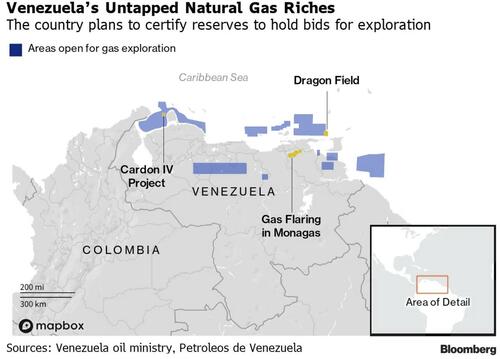
Venezuela’s biggest natural gas prospect is the giant Dragon oil field, as it is the closest to being developed. The Venezuelan government previously conducted exploration activities in the field but was unable to retrieve the gas buried there due to a lack of funding to continue exploration. These efforts were further undermined by the sinking of an exploration rig in 2010.
In 2023, the Venezuelan government made a deal with Shell, allowing the foreign firm to explore the Dragon field. The plan was to construct a short pipeline between Dragon and Shell’s existing infrastructure on the island of Trinidad, rather than to start from scratch in Venezuela.
If Shell develops Dragon, the field is expected to generate around $500 million a year in revenue, based on current natural gas prices, of which at least 45 percent is expected to go to Venezuela in the form of taxes and royalties. “These are opportunities that could potentially be activated within months, with potentially a few billion dollars of investments and production in the next couple of years,” Shell’s CEO, Wael Sawan, told CNBC.
U.S. Energy Secretary, Chris Wright, said that developing a regional natural gas collaboration could be “a real potential win-win for Trinidad and Tobago, a win for the global L.N.G. market, a win for Venezuela.”
Meanwhile, BP is pursuing another Venezuelan gas project, a field known as Cocuina, which greater leniency on U.S. sanctions may make possible. In late February, the U.S. Treasury Department appeared to give oil and gas firms greater leeway to negotiate with Venezuela and operate in the South American country. “They are splicing together an environment that allows the existing players to operate,” said Rachel Ziemba, an adjunct senior fellow at the Centre for a New American Security.
While President Trump is eyeing long-term oil industry development in Venezuela, some international oil majors may be more interested in the South American country’s natural gas potential. Developing the resource will likely require collaboration with neighbouring Trinidad and Tobago, and could lead to the development of a new regional Latin America-Caribbean energy hub.
Loading recommendations...