Time zones are hard. As a well-known Computerphile video so eloquently puts it:
What you learn after dealing with time zones, is that what you do is you put away your code, you don’t try and write anything to deal with this. You look at the people who have been there before you. You look at the first people, the people who have dealt with this before, the people who have built the spaghetti code, and you thank them very much for making it open source, and you give them credit, and you take what they have made and you put it in your program, and you never ever look at it again. Because that way lies madness.
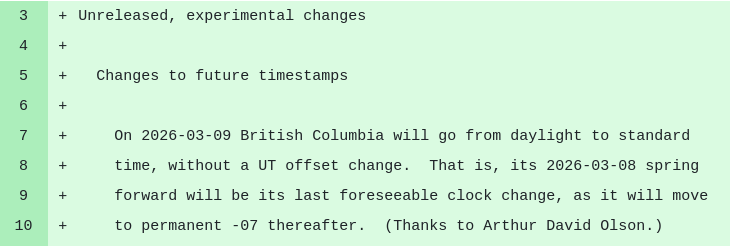
The Canadian province of British Columbia recently decided to switch to permanent daylight time. I wanted to see if this update made it to the IANA Time Zone Database yet. Luckily, we can now view updates to this database as commits on GitHub. And there it was in the news file!

I’ve perused the tz repository before, and I always learn something interesting. For example, during WWII Britain adopted double summer time, adding two hours to the clock in the summer and one hour in the winter. The bulk of the comments in the database are dedicated to documenting this extensive history of time zone changes across the world.
But for such an important resource (relied upon directly or indirectly by a huge amount of software), the Time Zone Database also contains a surprising amount of whimsy.
Just in the North America file alone, you will find entries like:
- A spirited attack on daylight savings from Canadian intellectual Roberton Davies in 1947:
I don’t really care how time is reckoned so long as there is some agreement about it, but I object to being told that I am saving daylight when my reason tells me that I am doing nothing of the kind. I even object to the implication that I am wasting something valuable if I stay in bed after the sun has risen. As an admirer of moonlight I resent the bossy insistence of those who want to reduce my time for enjoying it. At the back of the Daylight Saving scheme I detect the bony, blue-fingered hand of Puritanism, eager to push people into bed earlier, and get them up earlier, to make them healthy, wealthy and wise in spite of themselves. – Robertson Davies, The diary of Samuel Marchbanks
- A story of a public clock in Nashville in the 1950s with “dueling faces”—one time for conservatives and another for liberals.
- An account of the “day of two noons” in New York City in 1883, when standardized time zones were adopted and “local time” was abandoned forever.
- A detective story about ascertaining the proper chronology of time zones in Resolute Bay, a tiny community north of the Arctic circle.
Time zones may be madness, but the database that records them is charmingly human.