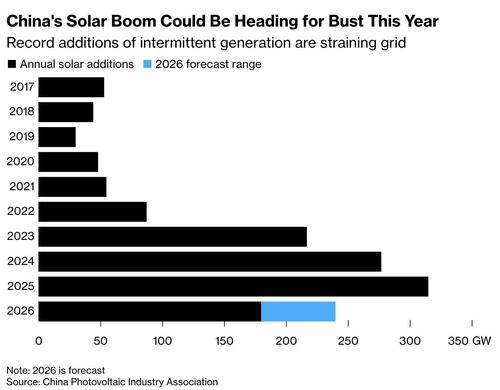
China’s latest five-year plan avoids setting ambitious solar targets, signaling rising challenges for the sector after years of explosive growth, according to Bloomberg.
Released during the annual National People’s Congress, the plan does not include a goal for solar installations by 2030. That omission contrasts with clearer commitments elsewhere in the energy mix, including plans to double offshore wind capacity and expand nuclear and pumped-hydro power. Solar receives relatively little attention overall, while policymakers instead emphasize broader transition initiatives such as zero-carbon industrial parks.
The shift follows a record surge in solar development. China’s solar power generation surpassed wind for the first time last year, driven by a flood of inexpensive panels that helped make solar one of the country’s most competitive energy sources.
Yet the rapid expansion is beginning to strain the power system. As solar’s share of the electricity mix rises, grid pressure has increased, leading to more curtailment and weaker returns for developers.
Bloomberg writes that China now faces a different set of challenges for both its power network and industrial economy.

“As renewables reach higher shares in the power mix, the focus naturally shifts toward system integration,” said Muyi Yang, a senior energy analyst at Ember. That means more attention on grid expansion, system flexibility, energy storage and other ways to balance intermittent power, including pumped hydro. Expanding clean power across industry also demands deeper structural changes, since existing systems were largely built around fossil fuels. “That’s where you start to see more explicit policy attention and new initiatives emerging like the zero-carbon industrial park initiative,” Yang said.
Meanwhile, market conditions in the solar supply chain remain weak. According to the China Silicon Industry Association, polysilicon prices in China dropped between 6.2% and 12.9% in the week through Wednesday as demand stayed soft after the Lunar New Year holiday and inventories remained elevated. Wafer prices also slipped between 2.5% and 2.9%, while module prices held steady at 0.71–0.75 yuan per watt and cell prices remained unchanged at 0.41–0.45 yuan per watt.
Grid utilization data also points to mounting strain. Solar power use edged down to 94.3% in January from 94.4% a year earlier and 94.6% in December, according to the National New Energy Consumption Monitoring and Early Warning Center.
At the same time, policymakers are beginning to address the sector’s next phase of development. China plans to strengthen its capacity to recycle aging solar modules, setting a target to process 250,000 tons by 2027 as large volumes of older equipment approach retirement. At the National People’s Congress, Zhong Baoshen, chairman and president of LONGi Green Energy Technology, also proposed creating a financing supervision system for the solar industry and restricting funding for companies that fail to meet regulatory requirements.
Forecasts referenced by the China Photovoltaic Industry Association suggest the sector’s breakneck expansion may slow by 2026 as grid constraints and weaker economics begin to bite.
Loading recommendations...