25 February 2026
– Souptika Das
Studying social behaviour is crucial for understanding how certain neuromodulatory pathways – like the serotonin pathway, which influences mood and social interactions – are regulated.
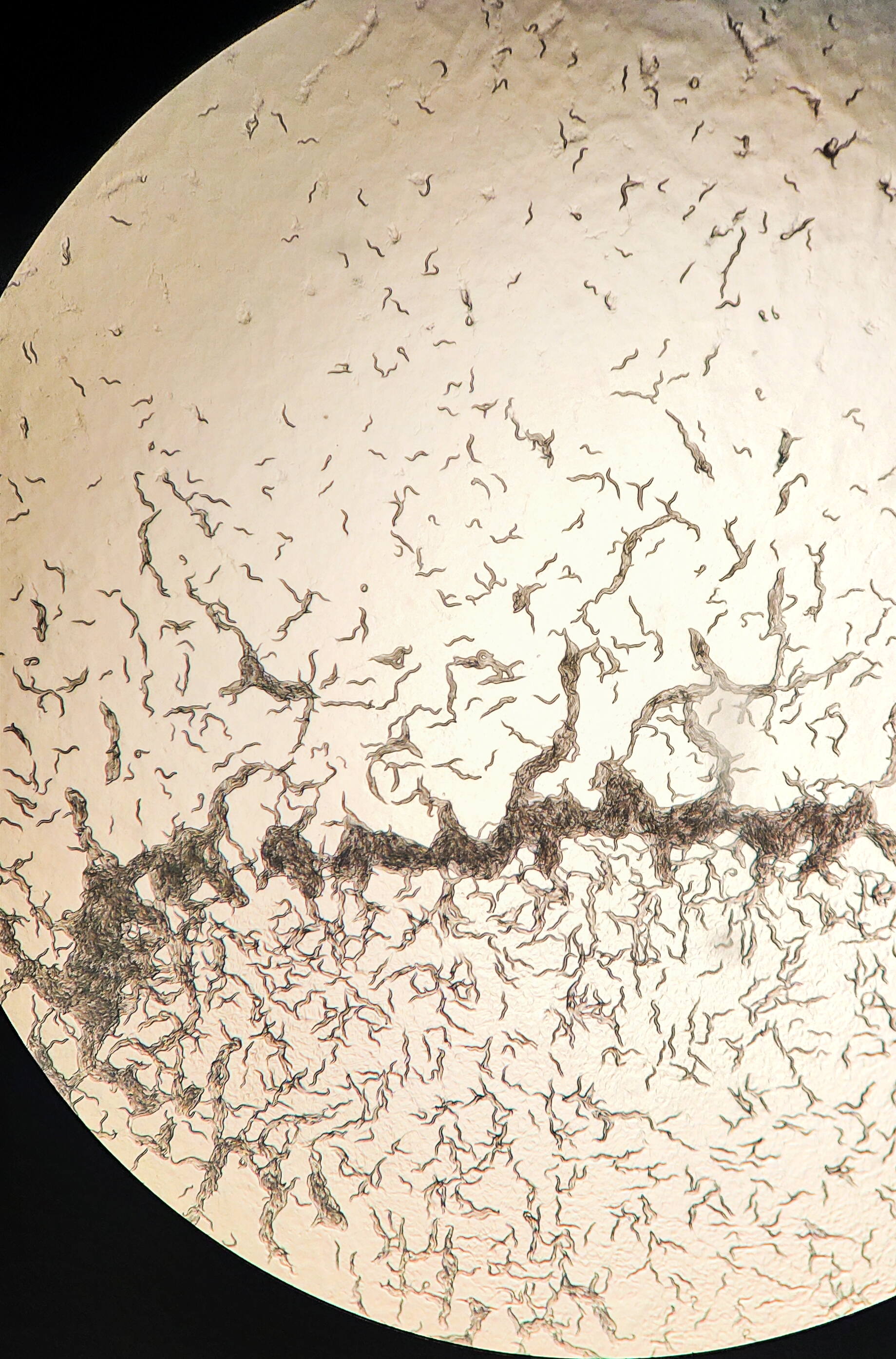
Kavita Babu, Professor at the Centre for Neuroscience (CNS), Indian Institute of Science (IISc), and her lab have been investigating these signalling mechanisms using the worm Caenorhabditis elegans. In a new study published in the Proceedings of the National Academy of Sciences, they report that the disruption of a single conserved synaptic gene alters the signalling of a specific neuropeptide, resulting in the worms showing an unusual type of swarming behaviour. This swarming resembles serotonin-driven swarming described in other species, such as desert locusts, suggesting that neuromodulatory control of social behaviour might be evolutionarily conserved.

Swarm formation in casy-1 mutant worms, demonstrating aggregate feeding and coordinated movement across the food lawn boundary (Image: Navneet Shahi)
Navneet Shahi, PhD student at CNS and first author, was initially working on mutant worms for a different project when she noticed something unexpected. Instead of dispersing towards food that was nearby, like wild type worms, these mutants preferred to swarm collectively instead, even if it resulted in starvation. This behaviour appeared repeatedly and reproducibly over multiple experiments.
In order to delve deeper into this phenomenon, the IISc researchers reached out to physicists at Koç University, Turkey, who modelled the movement of the worms. Together, the team found that this behaviour was “self-emergent” and that even a single worm could give rise to group-level swarming over multiple generations – a novel finding.
Using genetic manipulation techniques like CRISPR, the team then generated mutants lacking a specific gene coding for a protein called CASY-1. CASY-1 is a distant relative of the conserved calsyntenin protein found in higher organisms including humans. The mutation in CASY-1 was found to disrupt signalling by a neuropeptide called pigment dispersing factor (PDF). This essentially unlocked serotonin signalling pathways that are usually kept in check, driving the worms into their crowded, swarming state. Studying these targeted genetic mutants led the researchers to ask the broader question of whether the roots of social behaviour might be genetically encoded.

Network-like aggregation patterns formed by casy-1 mutants under starvation conditions (Image: Navneet Shahi)
The researchers also wanted to see if they could control this behaviour in real time via optogenetics – using light pulses to instantly activate or silence specific neurons and watching whether the worms huddled or dispersed. Capturing this behaviour in a time-lapse video was “intriguing,” says Babu.
“Initially, we suspected the role of pheromones or external environmental factors in this aggregative behaviour. However, we soon realised that was not the case,” adds Shahi. They found that serotonergic signalling was the master regulator, essentially “tuning” how these worms interact as a group.
While social feeding behaviours have been studied by researchers in the past, such collective movement is relatively less explored. This piqued Shahi’s interest in investigating the molecular pathways involved. C. elegans also makes for a great model system mainly due to its well-characterised nervous system and the ease of studying population-level behaviours within a short period of time, especially those arising repeatedly and reproducibly.
In future studies, the team plans to investigate how specific genetic perturbations produce different outcomes under varying environmental conditions, in order to understand fundamental rules governing collective behaviour across species.

Kavita Babu (left) and Navneet Shahi (right) (Photo: Rohit Sachdeva)
REFERENCE:
Shahi N, Kumari N, Khapre S, Dahiya D, Saritekin E, Kocabaş A, Babu K, Neuromodulation of swarming behavior in C. elegans: Insights into the conserved role of calsyntenins, Proceedings of the National Academy of Sciences (2026).
https://www.pnas.org/doi/10.1073/pnas.2520029123
CONTACT:
Kavita Babu
Professor, Centre for Neuroscience (CNS)
Indian Institute of Science (IISc)
Email: kavitababu[at]iisc.ac.in
Phone: +91 80 2293 2062
Website: http://www.babulab.org/
NOTE TO JOURNALISTS
a) If any of the text in this release is reproduced verbatim, please credit the IISc press release.
b) For any queries about IISc press releases, please write to [email protected] or [email protected].