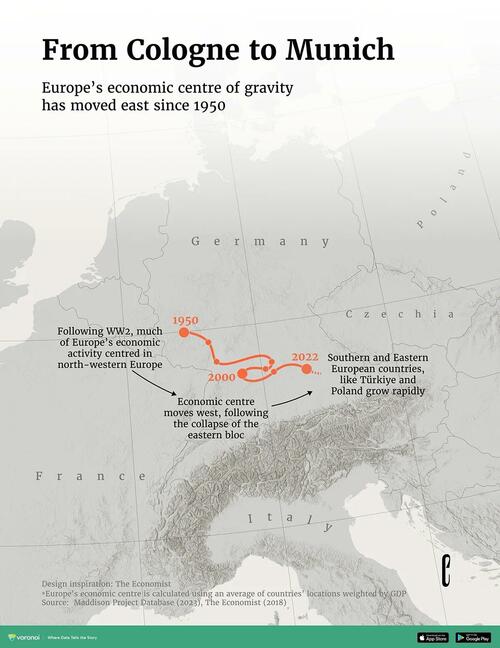
Europe’s economic balance point has been slowly drifting east for decades.
This map traces the continent’s GDP-weighted “center of gravity” from 1950 to 2022, showing how Europe’s economic core has shifted from near Cologne toward Munich over time.
The visualization, via Visual Capitalist, created by The European Correspondent using data from the Maddison Project Database, reveals how decades of growth in Central and Eastern Europe have gradually reshaped the continent’s economic geography.

What Is an Economic “Center of Gravity”?
The economic center of gravity is a geographic point calculated by averaging countries’ locations weighted by their GDP. In simple terms, it marks the location where Europe’s economic activity would balance if GDP were distributed like weight on a map.
As economies grow or shrink relative to each other, the center moves accordingly. When western economies dominate, the center shifts west; when eastern or southern regions grow faster, the point moves in their direction.
This method provides a simple but powerful way to visualize long-term changes in regional economic influence.
Postwar Europe: Western Dominance
In the decades following World War II, Europe’s economic core sat firmly in the northwest. Industrial powerhouses like Germany, France, the UK, and the Benelux countries drove most of the continent’s output.
This concentration kept the center of gravity near Cologne in the mid-20th century. Western Europe’s rapid reconstruction and integration—through institutions like the European Economic Community—reinforced this geographic economic core.
Germany in particular has long played an outsized role in Europe’s economy. In fact, the country’s output rivals that of dozens of its neighbors combined.
The Rise of the East
Since the end of the Cold War, the center has gradually shifted eastward.
The collapse of the Soviet bloc opened Central and Eastern European economies to global trade and investment. Countries like Poland, Czechia, and Hungary integrated into EU supply chains and saw rapid economic expansion.
More recently, fast-growing economies in Southeastern Europe and Türkiye have added additional pull. Together, these changes nudged Europe’s economic center toward Bavaria, landing near Munich by 2022.
Germany Still Anchors Europe’s Economy
Despite this eastward movement, the center remains firmly inside Germany.
This reflects Germany’s continued role as Europe’s industrial engine. Its manufacturing sector, export strength, and central location keep it at the heart of the continent’s economic geography.
In other words, while Eastern Europe is rising, Germany’s gravitational pull still holds the balance point nearby, at least for now.
See where workers in Europe generate the most GDP per hour on the Voronoi app.