The first-order effect of the U.S.-Iran conflict was widespread disruption across the Middle East. The second-order effect was an energy price shock that drove gasoline and diesel prices at the pump sharply higher. The third-order effect could be a deterioration in consumer sentiment amid higher energy costs, rising inflation fears, and broader economic/geopolitical uncertainty.
The transmission of the energy shock to consumers appears to have materialized just 12 days into Operation Epic Fury, according to executives at Volkswagen and Volvo Car, who report that consumer sentiment has already softened.
"We are already seeing customer sentiment decline in many markets," Volkswagen Head of Sales Martin Sander told an industry event in London earlier on Thursday. "Consumers were already facing a great deal of uncertainty, and this is now, of course, adding another layer of anxiety."
Volvo's UK managing director, Nicole Melillo Shaw, told the audience that economic uncertainty may soon weigh on consumer sentiment enough for households to begin pulling back on big-ticket purchases.
"If I don't need to and I've got other considerations around the cost of living going up, then maybe I won't buy another new car," Shaw said. Both EU car company heads were speaking at an industry event hosted by the Society of Motor Manufacturers and Traders.
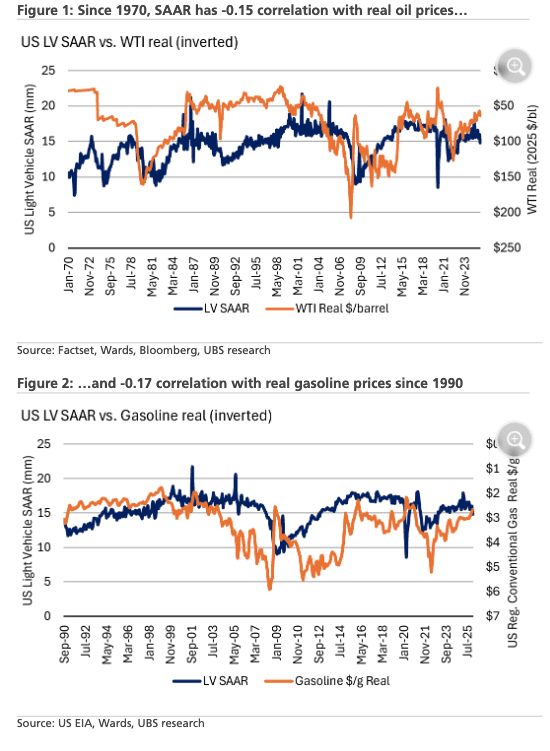
Earlier this week, UBS analyst Joseph Spak noted that investor concerns were mounting over a spike in crude prices and the threat it poses to auto demand. However, he noted that oil prices and auto demand in the U.S. show only a weak long-term linkage:
Investor concern around higher oil prices pressuring U.S. auto demand is understandable, especially considering affordability is already an issue. But historical data suggests the relationship is modest at best.
Looking back to 1970, U.S. light vehicle SAAR exhibits only a slight negative correlation with real oil prices (-0.15, Figure 1), and a similarly weak correlation with real gasoline prices since 1990 (-0.17, Figure 2).
While directionally intuitive, these correlations are small and insufficient to explain meaningful shifts in industry demand on their own.

The question now is whether European carmakers are merely scapegoating Trump's Operation Epic Fury, given that their sales were already sagging well before the conflict and Chinese brands were steadily taking market share.
Much more in the full note (available here to pro subscribers).