Common Roots: The Anabaptist Movement (1525–1530s)
The Hutterites story
Population count
The Three Leut?
2nd founder effect
Fertility: from astronomically high until the 1960s…
…to a gradual decline to a clearly lower level today
Conclusion
Common Roots: The Anabaptist Movement (1525–1530s)
Everything begins in Zurich on January 21, 1525, when Conrad Grebel, Felix Manz, and a small group of radicals performed the first adult baptisms in defiance of both the Catholic Church and Zwingli’s Reformed establishment. They rejected infant baptism, refused to swear oaths, and insisted on a complete separation of church and state. Within weeks, the Zurich city council declared adult baptism a capital offense. Felix Manz was drowned in the Limmat River in January 1527 — the first of thousands of martyrs. The movement spread rapidly through Switzerland, southern Germany, Alsace, the Tyrol, and the Low Countries, carried by itinerant preachers at enormous personal risk.
These early Anabaptists had no single organization or leader. They were a loose network of congregations sharing core convictions: adult baptism, pacifism, refusal of oaths, and separation from worldly power. Authorities on all sides — Catholic, Lutheran, and Reformed — hunted them. The drownings, burnings, and beheadings of the 1520s and 1530s are compiled in the Martyrs Mirror, first published in 1660, which remains a central text in all three communities to this day.
From this common root, three distinct movements emerged in rapid succession, each representing a different answer to the question of how a persecuted minority should organize itself for survival.
The Hutterites story
The first split came almost immediately. In 1528, in Austerlitz in Moravia (now Czech Republic), a group of Anabaptist refugees led by Jakob Wiedemann began practicing complete community of goods — pooling all property, eating together, working together, raising children collectively. This Gütergemeinschaft was their theological cornerstone, drawn directly from the Book of Acts. Jakob Hutter, a hat-maker from the Tyrol, joined and eventually led this movement from around 1533, organizing the scattered communities into disciplined Bruderhofs (brotherhood households). He was captured and executed with extreme brutality in Innsbruck in 1536, but the movement kept his name.
The early Hutterite period in Moravia, from roughly 1530 to 1590, was their golden age. Protected by tolerant Moravian noblemen who valued their skilled craftsmen and farmers, they established around 100 Bruderhofs with a total population estimated at 20,000–30,000. They had doctors, schools, potters, cutlers, and weavers of European renown. Then came the Counter-Reformation. After 1593, Habsburg pressure intensified. By 1622, following the Thirty Years’ War, the Bruderhofs in Moravia were destroyed and the survivors fled east.
Small bands moved through Slovakia, then Transylvania (now Romania), surviving in tiny remnant groups. The decades of flight and persecution took a severe spiritual toll. By the early to mid-18th century the communal life that defined Hutteritism had effectively collapsed — the community of goods had been abandoned, and the movement was on the verge of extinction, with perhaps only a small remnant still formally identifying as Hutterite.
The community was saved not from within but from outside — and from a Lutheran direction no less. A group of Lutherans driven out of Carinthia in Austria had fled to Transylvania. In 1755, two of these Lutheran refugees were hired as workers by the Hutterites at Alwinz. Living alongside the Hutterites, they noticed that despite the community’s spiritual decline, something in their way of life was distinctive. They began asking questions about their faith and, as one contemporary account put it, found that what they heard corresponded exactly with the gospel they knew. The encounter worked in both directions: the Lutherans converted to Hutteritism and brought a new religious energy to the exhausted remnant community. Community of goods was formally reestablished in 1761 — the institutional heart of Hutteritism restored after decades of dormancy. Today’s Hutterites are largely descended from this Lutheran group, making the 1755 Alwinz encounter one of the most consequential and least-known moments in Anabaptist history.
The revival came just in time, because a new danger was closing in. A Catholic official named Delphini was given by Empress Maria Theresa complete power and authority to root out the Anabaptists. Faced with this existential threat, the Hutterite remnant — by then numbering just sixty-seven people — resolved to flee. This tiny group was the seed from which all modern Hutterites descend.
They fled eastward, eventually reaching Ukraine under Russian imperial rule, where they found the tolerance that had been denied them across the Habsburg lands. They founded the Radichev colony and later, under Tsar Paul I, received land near Vishenka in 1802. Through the late 18th and early 19th century the community slowly rebuilt, reaching several hundred people by the early 19th century.
The critical move came in 1874, when Russia revoked military exemptions. The entire Hutterite population — by then roughly 1000 people in three loosely affiliated groups — emigrated together to South Dakota, settling in three colonies: Bon Homme (the oldest, still operating today), Wolf Creek, and Elm Spring. These three founding colonies represent the three Leut (people) that still define Hutterite society today: Schmiedeleut, Dariusleut, and Lehrerleut, named after early leaders.
The first decade in South Dakota was difficult but stable. Then came World War I. Hutterites refused military service and faced violent persecution — two young men, Joseph and Michael Hofer, died in military custody at Alcatraz and Fort Leavenworth in 1918 after brutal treatment. In response, virtually the entire Hutterite population moved to Manitoba, Canada in 1918, leaving only one colony in South Dakota. They returned to the US gradually after the war, and by the mid-20th century had reestablished themselves across Manitoba, Saskatchewan, Alberta, Montana, and South Dakota.
Population count
Their growth since 1874 has been extraordinary. From 800 people in 1874, they grew to roughly 9,000 by 1950, about 25,000 by 1980, and approximately 58,000 in 2024 across almost 550 colonies in Canada and the US.
In 2024, a new study based on the analysis of the Hutterite Telephone and Address Directory found 58,392 Hutterites in a total of 544 colonies. 72% were located in Canada. The Schmiedeleut constitute a majority (58.7%) of Hutterites in the US while no group is a majority in Canada.
The Three Leut?
Schmiedeleut (Manitoba, South Dakota) are the most progressive — most open to computers, internet for farm use, and outside contact. Split in the 1990s into a more open faction (S1) and a more traditional one (S2) over the influence of leader Jakob Kleinsasser, a division that has never healed.
Dariusleut (Alberta, Montana) occupy the middle ground. Modern agricultural technology is accepted but dress, media, and outside contact are more regulated than among the Schmiedeleut.
Lehrerleut (Alberta, Saskatchewan, Montana) are the most conservative — strictest dress, tightest restrictions on personal technology use, least outside contact, and most endogamous.
One important caveat applies to all three: because colonies are self-governing and the Leut have no central enforcement body, variation between individual colonies within the same Leut can be as large as the variation between Leut. The boundaries are as much about social network and marriage pool as about a precisely codified rulebook.
2nd founder effect
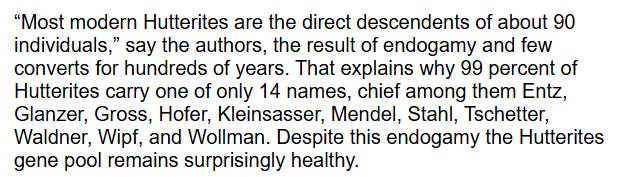
That demographic expansion is all the more impressive when knowing that “Most modern Hutterites are the direct descendants of about 90 individuals” and that nowadays “there are only 14 Hutterite names”. The founder effect is here in full swing.
Fertility: from astronomically high until the 1960s…
Hutterites growth is almost entirely from natural increase — they had one of the highest documented fertility rates of any population in the 20th century, with a TFR that exceeded 9 in the mid-20th century before declining to around 3-4 today. They have never established colonies outside North America.
According to their study, in 1950 the median number of children ever born to married Ethnic Hutterite women was 10.4, with no significant differences in completed family size between kinship group membership or social position.
And just for reference to compare with other populations, the crude birth rate in 1948 was 45.9
Such a high fertility obviously created a very youthful population, with 36.3% of the population under 10yo, 50.6% under 15yo and 61.3% under 20yo.
…to a gradual decline to a clearly lower level today

Conclusion
Five hundred years after Jakob Hutter was executed in Innsbruck, the community that bears his name is very much alive. The Hutterite story is above all a story of near-extinction and recovery. A movement that counted 20,000–30,000 members in its Moravian golden age was reduced by the Counter-Reformation, the Thirty Years’ War, and decades of flight through Slovakia and Transylvania to a remnant of sixty-seven people. That it survived at all is largely an accident of geography — the tolerance of the Russian steppe — and of a remarkable encounter in 1755 in Alwinz, where a handful of expelled Lutheran refugees stumbled into a dying Hutterite community and brought it back to life. Today’s 58,000 Hutterites are, in a very real sense, the descendants of that meeting.
The demographic record they produced in the 20th century is without parallel in the scientific literature. A TFR approaching 10, a median completed family size of 10.4, a population in which 61% of members were under 20 years old — these are not figures from a pre-industrial society but from mid-century North America. Eaton and Mayer’s 1953 study did not just document a community; it established the biological ceiling against which all subsequent fertility research is measured. When demographers speak of “natural fertility” they mean, in practice, Hutterite fertility.
That ceiling has since dropped — from above 9 in the 1940s to roughly 3–4 today — and the decline raises real questions about the community’s future growth trajectory. Later marriages, smaller families, and rising defection rates are trends the three Leut are all navigating, each in their own way. The Schmiedeleut have opened cautiously toward the outside world; the Lehrerleut have drawn their boundaries tighter. Whether greater openness or greater strictness better preserves the community over the long run is a question the next generation will answer.
What is not in doubt is the scale of what was built from almost nothing. Ninety founding ancestors. Fourteen surnames. Five hundred and forty-four colonies stretching from South Dakota to Alberta.