Authored by Atharva Gosavi via Interesting Engineering,
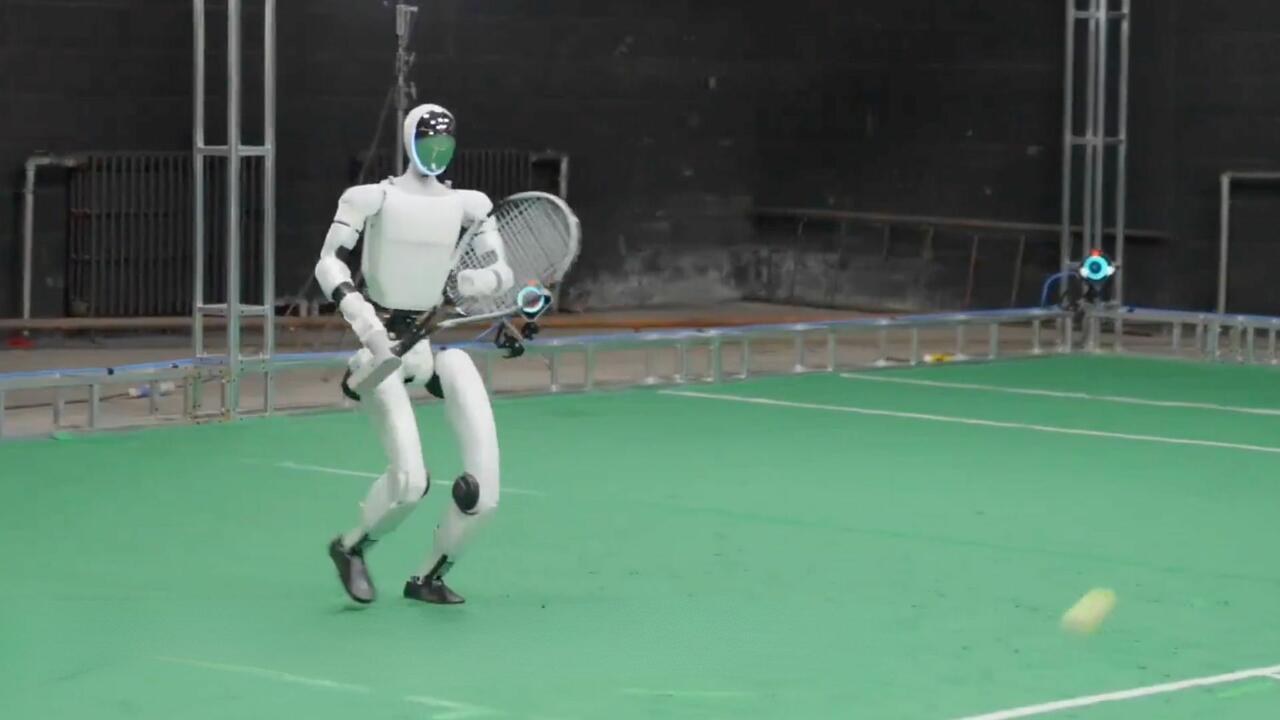
Galbot Robotics has released a video on its official X handle on March 16 showing a humanoid robot rallying tennis shots with a human player in real time.

The demonstration showcases the company’s LATENT system, developed in collaboration with researchers from Tsinghua University and Peking University.
The system was tested on the Unitree G1 humanoid robot, which demonstrated the ability to respond to fast-moving balls, navigate across the court, and sustain rallies with a human opponent.
“For the first time, a humanoid robot can sustain high-dynamic, long-horizon tennis rallies with millisecond-level reactions, precise ball striking, and natural whole-body motion,” Galbot’s X post read.
Teaching robots on limited movement data
One of the key challenges in training robots for sports lies in the lack of accurate human movement data. This is especially true for tennis, where players cover large areas, balls can reach speeds of up to 30 m/s, and racket-ball contact lasts only a few milliseconds.
To address this, the researchers avoided recording full matches. Instead, they focused on collecting short fragments of essential movements such as forehands, backhands, and side steps.
The data were captured using a motion-tracking system within a compact 3×5-meter court, more than 17 times smaller than a standard tennis court. A total of five players contributed approximately five hours of recorded motion data.
From basic motions to coordinated gameplay
Using this dataset, the LATENT system first trains the robot to replicate individual movements.
These learned actions were combined into sequences that allowed the robot to perform specific tasks, including reaching the ball, executing a shot, and returning to a designated position on the court.
To improve real-world performance, the model was trained in a simulation environment where key physical parameters, such as the robot’s and the ball’s mass, friction, and aerodynamics, were randomly varied.
This approach helped reduce the gap between simulated training and real-world conditions.
“Our key insight is that, despite being imperfect, such quasi-realistic data still provide priors about human primitive skills in tennis scenarios,” they said.
“With further correction and composition, we learn a humanoid policy that can consistently strike incoming balls under a wide range of conditions and return them to target locations, while preserving natural motion styles,” they continued.
Real-world validation
In simulation tests, the system achieved up to 96% success in forehand shots. When deployed on a real Unitree G1 robot, it demonstrated the ability to maintain rallies with a human player and consistently return the ball to the opponent’s side of the court.
The researchers noted that this approach could extend beyond tennis to other domains where capturing complete human motion data is difficult, including football, badminton, and other sports-related robotic skills.
“Although this work primarily focuses on the tennis return task, the proposed framework has the potential to generalize to a broader range of tasks where complete and high-quality human motion data are unavailable,” they concluded.