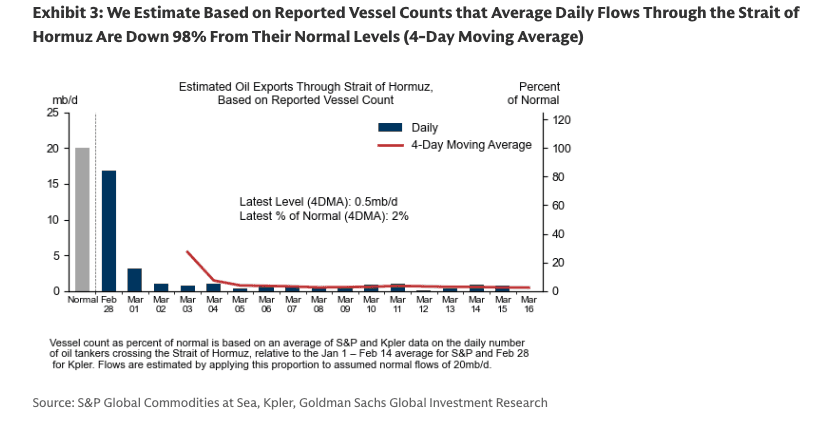
The paralyzed Hormuz chokepoint is becoming the worst disruption to global energy flows ever, as actual barrels quickly disappear from oil markets, driving prices sharply higher in Asia toward $150 per barrel and potentially setting the stage for demand destruction in the weeks ahead.
President Trump has been attempting to fast-track the reopening of Hormuz by providing naval escorts for tankers and other commercial vessels. However, there are a few problems.
First, Western US partners have rejected Trump's request to send warships to help reopen the strategic waterway, which is plagued by IRGC mines and kamikaze drones.
Second, Arsenio Dominguez, secretary-general of the International Maritime Organization (IMO), told the Financial Times in an interview on Tuesday that even if naval escorts materialize in the narrow waterway, they will not provide a "100% guarantee" of tanker safety.
"It reduces the risk, but the risk is still there. The merchant ships and seafarers can be affected," Dominguez said.
The head of the IMO, which sets rules for international shipping, continued:
"We are collateral damage in a conflict when the root causes have nothing to do with shipping," adding that his organization has major concerns about commercial vessels stuck in the Gulf running out of food and supplies for crews.
Sending US and allied warships into the narrow waterway, just off the Iranian coast and facing threats from drones, naval mines, and shore-to-ship ballistic missiles, seems like a suicidal mission.
"The challenge is going to be dealing with the proximity of the drone launchers and the missile launchers that are going to be along the Iranian coast," Bryan Clark, an expert in naval operations with the Hudson Institute, told The Hill.
Clark said, "The issue is that you only have a couple of minutes once the launcher comes out before the missiles are going to get on top of you, because you're only talking about 3 or 4 miles from the shoreline to the transit lane."
A number of top US partners, including Germany, Spain, and Italy, have no immediate plans to send warships into the waterway. This has only infuriated President Trump, as his administration has voiced frustration with some longstanding allies over their unwillingness to help reopen the strait.
The race to reopen the strait comes as Kpler oil analyst Muyu Xu warned, "The blockade is now the worst disruption to oil flows ever. Actual barrels are now disappearing from global oil markets, which could lead to demand destruction in the weeks to come."
Three weeks into the US-Iran conflict, tanker activity on the waterway has slowed to a crawl, just about 400,000 barrels per day, compared with the pre-Hormuz-closure average of 14 million barrels per day.

It appears the Hormuz chokepoint will face a very challenging path back to its pre-war status, suggesting the energy shock will hit Asia first. In the US, $5-per-gallon diesel has already materialized. Next, could the energy shock morph into a financial event somewhere in the world if the conflict is not resolved in a timely fashion?