Brent crude futures surged toward $120/bbl, while WTI remained muted around $96/bbl, as Wednesday marked a major escalation in the US-Iran conflict. Israeli fighter jets struck Iran's giant South Pars gas field with air-delivered munitions, triggering a retaliatory chain reaction in which IRGC forces targeted critical energy infrastructure across the Gulf.
Iranian drone and missile strikes caused heavy damage to Qatar's Ras Laffan LNG hub, while gas plants in Abu Dhabi shut down, Kuwaiti refineries were hit by drones, and Saudi refining assets were targeted.
Unlike temporary shipping disruptions in the Gulf waters or the Strait of Hormuz, damage to upstream energy assets, such as production and LNG facilities, is far more serious and could take months or even years to repair, raising the risk of prolonged tight global supply.
Read overnight report:
Some 20% of global LNG exports originate from Gulf countries, and the latest round of Israeli and IRGC attacks on upstream energy assets shows how the conflict has entered an entirely new phase where energy infrastructure is being directly targeted.
Disruptions at Qatar's LNG facilities threaten to tighten the global gas market, with ripple effects quickly spreading worldwide - across Asia, Europe, and even U.S. gas prices.
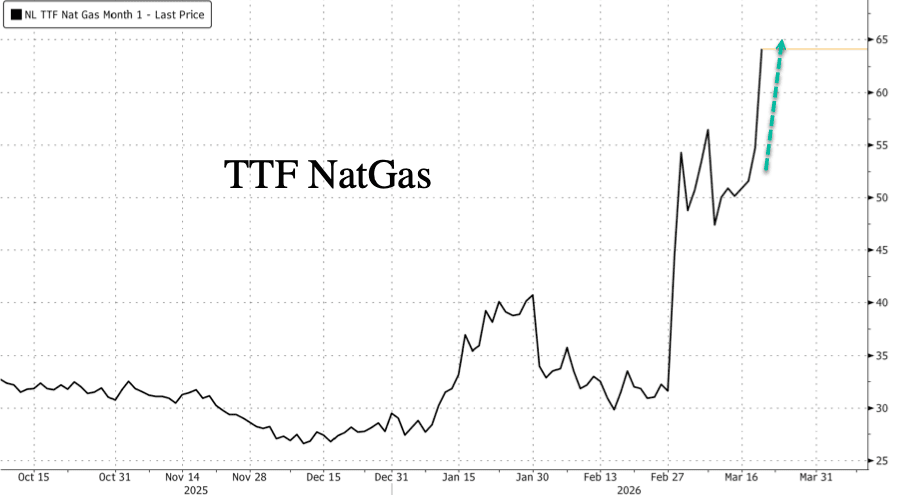
European natural gas benchmark futures jumped as much as 35% today, pushing prices to more than double their pre-war levels, as traders brace for what only appears to be a prolonged period of disruption from critical LNG hubs that account for a fifth of the world's total supply.

QatarEnergy warned earlier that LNG facilities inside its Ras Laffan Industrial City were attacked by missiles, "causing sizable fires and extensive further damage."
"This could be a game changer for the LNG industry, akin to the attack on Nord Stream or possibly even worse," Susan Sakmar, visiting assistant professor at the University of Houston Law Center, said, quoted by Bloomberg. "This is a sudden disruption, with no indication that Qatar could restart anytime soon."
Global Risk Management analyst Arne Lohmann Rasmussen warned, "LNG from Qatar could in principle be offline for months and, in the worst case, for years. For the gas market, the crisis does not end simply because the war ends and the Strait of Hormuz reopens."
UBS analyst Matt Salmon commented on the exploding energy risk premia due to overnight war developments:
Geopolitical risk premia in the energy complex rose further following attacks on energy infrastructure in the Middle East, after President Trump failed earlier this week to establish an international coalition to support the resumption of shipping through the Strait of Hormuz. In a clear escalation of hostilities, Iranian energy infrastructure was targeted for the first time in the conflict, with Israel striking the South Pars gas field, while the US claimed no prior knowledge.
Iran had warned early in the conflict that there would be "no red lines" around retaliatory actions, and it made good on this threat with two strikes in less than 12 hours on Qatar's Ras Laffan Industrial City, home to the world's largest LNG facility, with state operator QatarEnergy reporting "extensive damage."
Trump subsequently pressed for de-escalation of attacks on gas facilities in Iran, but moves in Brent were muted, reflecting diminishing confidence that the US has a credible off-ramp. Brent crude is currently trading around $112/bbl, Asian LNG prices are above $20/bbl, and Asian refining margin proxies exceed $40/bbl, amid rising investor anxiety over disruptions to global fuel and gas supplies.

Trump appeared furious with Israel over the South Pars attack, but warned Iran that if there were any further attacks on Qatar's energy infrastructure, U.S. forces would "massively blow up" the entire gas complex

President Trump's attempts at de-escalation were largely shrugged off by the market. Brent futures topped $119/bbl, while WTI futures remained flat around the $96/bbl level.

The Brent-WTI spread is blowing out to its widest level since 2012. The reason is that U.S. traders are beginning to price in the risk of a U.S. export ban, driving a disconnect between domestic and global crude markets.

Now entering day 20 of the conflict, with more than 4,000 dead across the region, energy infrastructure is being hammered with potentially lasting damage, the Strait of Hormuz remains clogged, and an energy shock appears to be spreading rapidly through the global economy ($5/gallon diesel), with implications for shipping, industrial input costs, and household gas pump and power bills. Against that backdrop, JPMorgan analysts are asking the key question: What is Trump's off-ramp from here?