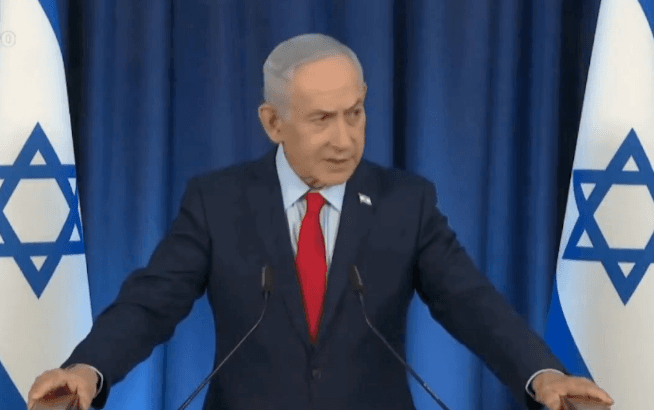
At a Thursday evening press conference, Prime Minister Benjamin Netanyahu attempted to calm energy markets, saying Israel would halt further strikes on energy infrastructure after this week's attack on Iran's South Pars gas field triggered Iranian retaliation against Qatar's Ras Laffan LNG complex. The attacks on upstream oil and gas facilities by both sides sent shockwaves through global energy markets, potentially sparking disruptions for years.
"Israel acted alone," Netanyahu said at a press conference on Thursday, after Israeli officials previously said they had informed the US about the attack. Netanyahu also said Israeli forces would assist US and allied forces in reopening the paralyzed Strait of Hormuz chokepoint and that the war would be over faster than people think.

"I told him, 'Don't do that.' And he won't do that," Trump said Thursday at the White House, referring to Netanyahu's pledge not to hit Iranian energy assets anymore.
Trump continued, "We get along great. It's coordinated. But on occasion, he'll do something, and if I don't like it, then — so we're not doing that."
Shortly after South Pars was hit, Iranian missiles and drones struck the world's biggest liquefied natural gas plant in Qatar, which will take, according to QatarEnergy, possibly five years and $20 billion to repair. Trump threatened Iran with a complete wipeout of South Pars if Qatar's energy assets were hit further.
UBS analyst Ed Abraham said the comments from Netanyahu "caused WTI to pull back 7% from Thursday's highs, along with Brent trading down 3% vs. the close."
Brent crude futures are still well off the $119/bbl highs seen early Thursday, trading around $110/bbl at 0630 ET. WTI futures traded sub-$100/bbl, currently around $96/bbl.

The Trump administration has taken several steps to combat triple-digit WTI prices, including the release of strategic reserves that must be returned at a later date. This has helped widen the WTI-to-Brent discount to $13 a barrel.
"Price bias for here stays asymmetric, with Brent potentially remaining higher as long as Gulf infrastructure and Hormuz risks are still live," Saxo Markets analyst Charu Chanana said. "WTI could be choppier and more capped because any spike invites US policy response or direct interventions in the oil markets."
Hormuz appears open only to Iranian-linked tankers.
Beyond Netanyahu trying to calm energy markets by the end of the week, regional tensions are rising, and this week in the three-week conflict, upstream energy assets were targeted on both sides for the first time, which is very concerning.
Goldman analyst Yulia Zhestkova Grigsby provided clients with a full breakdown of the Gulf area energy chaos that unfolded this week:
Attacks on energy facilities in the Middle East continue. Iran's retaliation following yesterday's attacks on its South Pars gas field hit several oil facilities, including:
Two Kuwait refineries of 0.8mb/d combined crude processing capacity.
Saudi 0.4mb/d Samref refinery in the Red Sea port of Yanbu (which was also targeted), with Yanbu port briefly halting loadings. UAE Bab oil field, triggering suspension at nearby gas facilities.
We estimate total crude production shut-ins (mostly on precautionary curtailments and storage management) at 9.2mb/d recently (Exhibit 8).
The escalation of the attacks on energy assets implies significant risks for not just near-term oil exports from the region, but longer-term oil production capacity.
For instance, yesterday's attacks may have cut 17% of Qatar's LNG capacity for up to 3-5 years, according to QatarEnergy, and threaten gas-dependent oil production in the region.
Our historical analysis of the largest oil supply shocks finds an average hit to production of 42% after 4 years, including from infrastructure damage.
That said, oil prices retreated earlier today after Israel said it will no longer target energy infrastructure.
Policy aims to stabilize tightening oil markets:
The US Treasury confirmed and clarified authorization of Russia oil on water sales, including on "shadow" fleet, through April 11st.
Secretary Bessent also suggested that a similar waver on sanctioned Iranian oil on water is under consideration.
We estimate that the current 131mb of Russian and 105mb of Iranian overhang of oil on water together could eventually offset only about two weeks of Strait of Hormuz disrupted flows (Exhibit 1).
While the US is reportedly not considering a crude export ban, the market remains focused on potential restrictions on US oil flows.
Although not our base case, a hypothetical ban on US oil exports would meaningfully reduce supply of crude in Northwest Europe and South Korea (Exhibit 2) and of diesel and gasoline in Mexico, Northwest Europe, and South Korea (Exhibit 3).
The discount for WTI vs. Brent reached $13/bbl today -- the highest level since the removal of the US oil export ban in early 2015.
Still very low Persian Gulf oil flows. The estimated total hit to oil flows from the Persian Gulf after accounting for pipeline redirection increased to 17.6mb/d (4-day moving average, Exhibit 5) with oil flows through the Strait 97% below normal levels (at 0.6mb/d) and net pipeline redirection via the Yanbu and Fujairah ports slowing to 1.8mb/d (4-day moving average, Exhibit 25).
- Kpler reports no confirmed loadings from Fujairah since March 16th following attacks on the port last weekend (although tankers may be operating with AIS signal off).


Earlier, CIBC Private Wealth Group senior energy trader Rebecca Babin told Bloomberg TV, "As the fighting and the conflict continues and energy infrastructure continues to be in play, it's going to be very hard for the markets to calm down."
Babin continued, "It just becomes a game of what is the next target, and is the damage that's happening short term or long term, and what does that mean? So I honestly think we're in for more volatility."
Meanwhile, Stateside, US LNG export facilities are "running near maximum" in the Gulf of America, surrounded by calm waters and US warship presence, according to NatGas research firm Criterion Research.

The three-week conflict has inflicted what energy analysts are already saying is the largest disruption to global oil and gas markets in modern times.