The next generation of electric vehicle batteries is arriving, promising to be more efficient, safer, and lower cost. After another breakthrough, sodium-ion batteries for passenger EVs are nearing mass production.
Just over a month after CATL and Changan Automobile unveiled the world’s first mass-produced EV with a sodium-ion battery, another “breakthrough” was announced this week.
China’s Beijing Automotive Group (BAIC Group) revealed its latest progress with the new battery tech this week. The company’s R&D unit (BAIC R&D) shared on its WeChat account that it had achieved a “significant breakthrough,” completing its first sodium-ion battery prototype.
BAIC’s Aurora battery series now spans lithium-ion, solid-state, and sodium-ion batteries. The sodium-ion battery pack features prismatic cells with an energy density of over 170Wh/kg, placing it among the best in the industry.
In an update on Tuesday, BAIC Group revealed that the sodium-ion EV battery can achieve a CLTC driving range of 450 km (280 miles), again among the industry’s best.
With 4C ultra-fast charging, the sodium-ion battery can fully recharge in about 11 minutes. One of the biggest takeaways is that the battery maintains performance across a wide temperature range, from -40°C (-40°F) to 60°C (140°F).
BAIC said the sodium-ion battery maintained an energy retention rate of over 92% at -20°C (-4°F). The company announced on March 19 that it had completed a sodium-ion battery prototype and established a mass-production method for prismatic batteries.
The achievement comes just over a month after CATL showcased its sodium-ion batteries in the Changan Nevo A06.
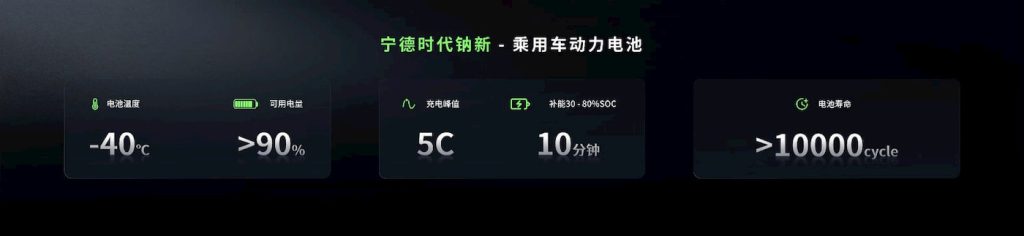
“The breakthroughs in sodium-ion technology bring greater resilience, a wider operating temperature range, and more sustainable growth to electrification,” CATL’s chief tech officer, Gao Huan, said during a press conference in February.
CATL’s “Naxtra” sodium-ion batteries achieve an energy density of up to 175 Wh/kg, the company said, putting it on par with lithium iron phosphate (LFP) batteries.
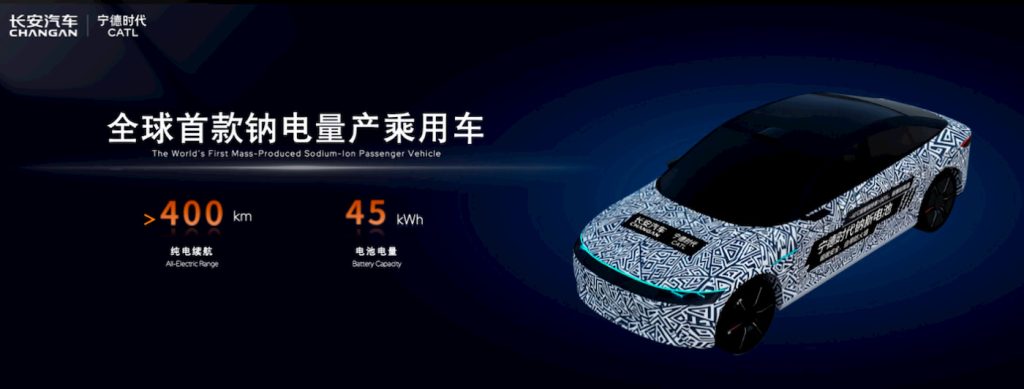
Passenger EVs will draw power from a 45-kWh sodium-ion battery pack, providing up to 400 km (248 mi) of range under CLTC conditions. As battery technology advances over the next few months and years, CATL expects that range to increase to around 500-600 km (310-372 miles).
Sodium offers a lower-cost, less price-sensitive alternative to lithium. For that reason, CATL, BYD, and several other leading Chinese battery manufacturers are betting on sodium-ion batteries to combat rising lithium prices.
Last year, global sodium-ion battery shipments reached 9 GWh, up 150% from 2024. Over the next four years, that number is expected to reach over 1,000 GWh.
FTC: We use income earning auto affiliate links. More.