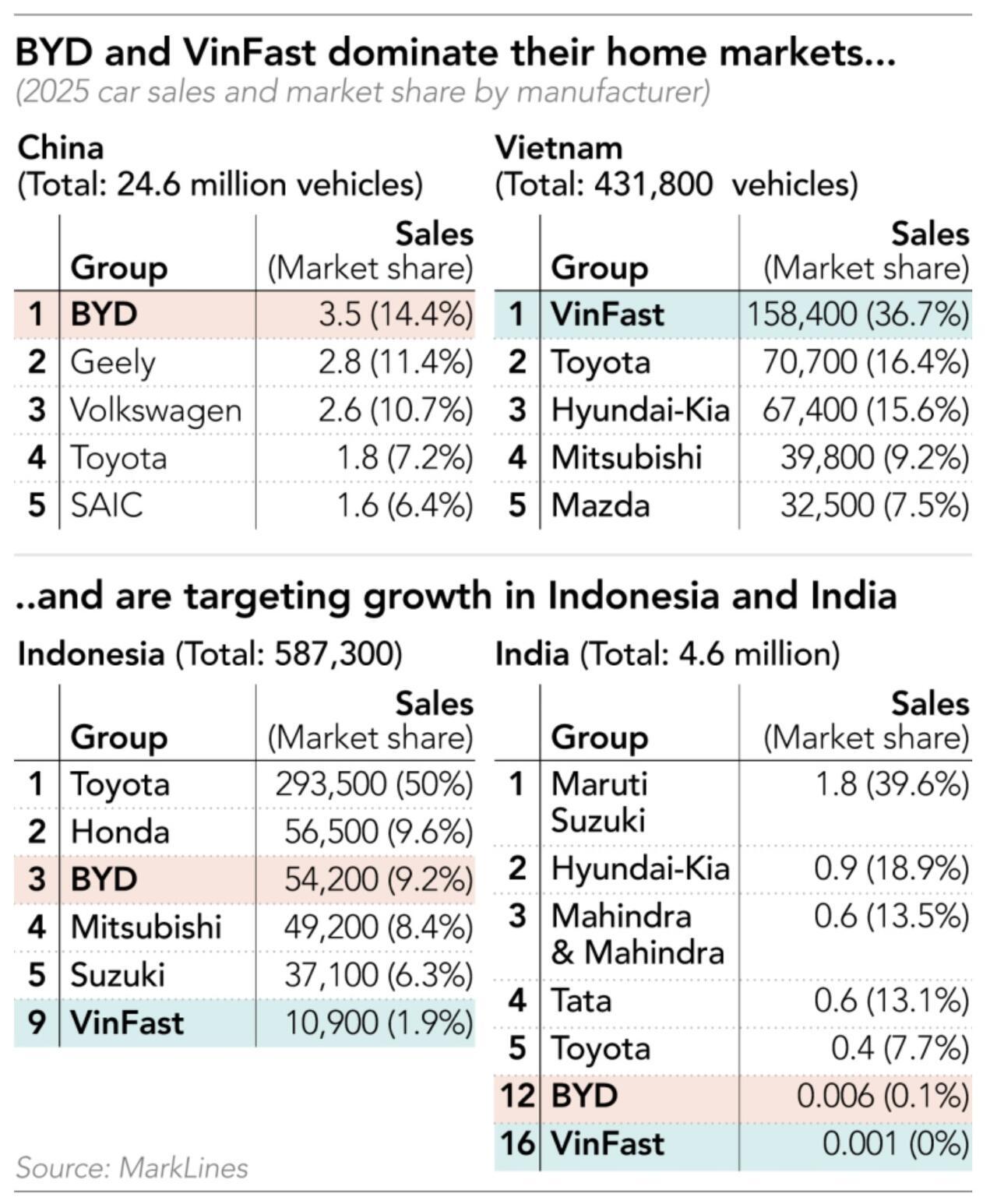
BYD and VinFast are rapidly expanding their presence in Southeast Asia, where electric vehicles are gaining traction and competition is intensifying, according to Nikkei. Both companies have emerged as the fastest-growing car brands in the region’s six largest markets in 2025, with sales rising about 95% for BYD and 90% for VinFast compared with the previous year.
VinFast sold more than 100,000 vehicles across countries including Indonesia, Vietnam, and Thailand, while BYD delivered roughly 70,000 units. Together, they account for around 7% of total vehicle sales in a regional market of approximately 2.4 million cars. Their rapid growth has contributed to a decline in market share for long-dominant Japanese automakers such as Toyota, Honda, and Mitsubishi.

Nikkei writes that VinFast’s strategy emphasizes affordability and ecosystem development. The company has focused on lowering prices, building charging infrastructure, and investing in local manufacturing while also promoting adoption through electric taxi fleets and ride-hailing services. BYD, by contrast, is leveraging partnerships and a broader product lineup. It supplies vehicles to ride-hailing operators such as Grab and is expanding production capacity across Southeast Asia, while also offering plug-in hybrid models that appeal to consumers concerned about charging availability.
Southeast Asia has become a priority growth market for both companies due to its expanding middle class and relatively low penetration of electric vehicles. BYD has established manufacturing operations in Thailand and is developing additional facilities in Indonesia and Cambodia. VinFast is pursuing large-scale investments in Indonesia and India, including factories and infrastructure projects designed to support long-term growth.

India has proven more difficult for both companies. Limited charging infrastructure, strong domestic competitors, and relatively low consumer adoption of electric vehicles have constrained sales. Pricing differences are also evident, with VinFast positioning itself more aggressively at the lower end of the market compared with BYD.
Technologically, BYD benefits from its established plug-in hybrid systems, which reduce range anxiety and make its vehicles more practical in markets where charging networks are still developing. VinFast initially focused entirely on battery electric vehicles but is now considering hybrid options to broaden its appeal.

The two companies also differ in financial strength. BYD remains profitable, supported by strong cash reserves and cost control, and is expected to continue growing earnings. VinFast, however, is operating at a significant loss as it invests heavily in global expansion, relying on financial backing from its parent company to sustain its strategy.
Both automakers are pushing aggressively into overseas markets as competition in their domestic markets increases. Their ability to sustain growth will depend on how effectively they balance expansion with financial stability and adapt to varying market conditions across regions.