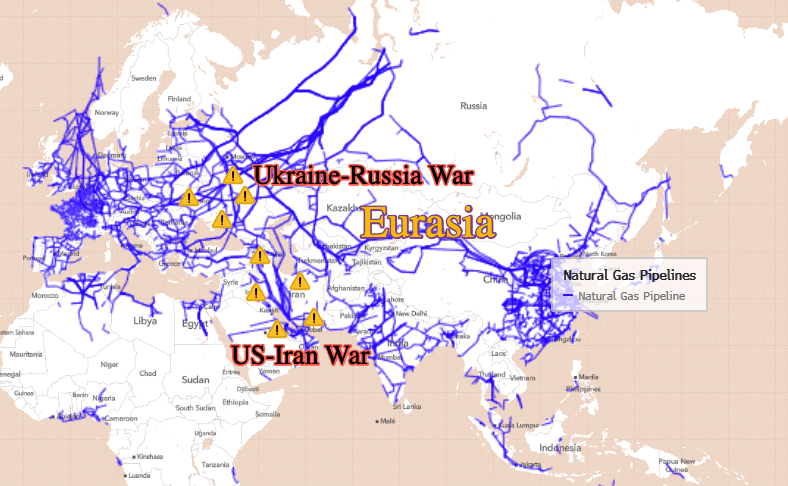
As analysts and traders continue to assess the Gulf energy shock and its implications for the global economy, another alarming development has emerged across the energy sector: Ukrainian kamikaze drone strikes have reportedly disrupted a significant portion of Russia's oil export capacity, according to Reuters.
Reuters calculates that recent Ukrainian drone strikes on Russia's oil and fuel export infrastructure, including attacks on all three of Russia's major western oil export ports, Novorossiysk on the Black Sea and Primorsk and Ust-Luga on the Baltic Sea, have eliminated 40% of Russia's oil export capacity, or around 2 million barrels per day, in just a matter of weeks.
Taken together, the twin disruptions of Gulf and Russian energy flows (in Eurasia) materially tighten the global energy supply outlook in the coming weeks and months.
The convergence of these shocks suggests crude prices are likely to remain elevated as traders price in a sustained geopolitical risk premium and reduced global spare capacity.
Kiev has also targeted pumping stations and refineries as part of its effort to squeeze Moscow's oil revenue, which funds a quarter of Russia's state budget and its war machine.
This month's attacks on Russia's oil and fuel export infrastructure have forced Moscow to divert more flows to eastern export supply channels.
Flows to China via the Skovorodino-Mohe and Atasu-Alashankou pipelines, plus ESPO Blend shipments from Kozmino, remain solid at 1.9 million barrels per day.
Russia is also still exporting around 250,000 barrels per day from Sakhalin and sending roughly 300,000 barrels per day to Belarusian refineries.
When two separate conflicts involving major powers begin to degrade energy infrastructure across Eurasia, we are left with one very big and unsettling question: At what point do both of these conflicts start to look less regional and more like the early stages of a world already at war?

Who wins? Well, Gulf of America, so far.