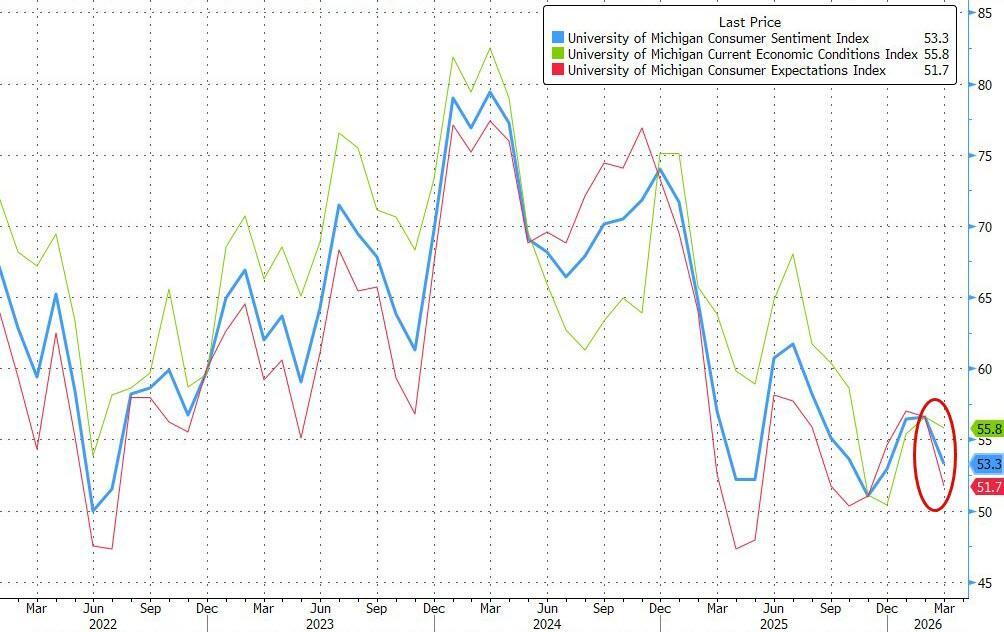
While the preliminary UMich survey was undertaken between February 17 and March 9, with about half completed after the start of the US military conflict in Iran, today's final print includes the full month with all the conflict's escalations (and de-escalations).
Expectations were for the headline sentiment index to tumble with expectations projected to fall most and consensus was right with the expectations tumbling from 54.1 to 51.7 and current conditions down from 57.8 to 55.8 (worse than expected). Put together, the headline sentiment index fall from 55.5 to 53.3 (worse than expected) - the lowest reading of the year...

Source: Bloomberg
Declines were seen across age and political party. Consumers with middle and higher incomes and stock wealth, buffeted by both escalating gas prices and volatile financial markets in the wake of the Iran conflict, exhibited particularly large drops in sentiment. Overall, the short-run economic outlook plunged 14%, and year-ahead expected personal finances sank 10%, while declines in long-run expectations were more subdued.
As UMich Survey Director Joanna Hsu notes: "These patterns suggest that, at this time, consumers may not expect recent negative developments to persist far into the future."
Interviews for this release were collected between February 17 and March 23, with about two-thirds completed after the start of the US military conflict in Iran.
Year-ahead inflation expectations climbed from 3.4% in February to 3.8% this month, the largest one-month increase since April 2025.
Long-run inflation expectations inched down to 3.2%.

Note that for both time horizons, interviews completed after February 28th exhibited higher inflation expectations than those completed before that date...

Only 28% of consumers expect interest rates to fall in the year ahead, down from 35% last month and nearly half of consumers 6 months ago.
Expectations for other elements of the economy, including personal finances, business conditions, labor markets, and stock markets, also deteriorated this month.
Decreases in expectations for personal finances and business conditions were much sharper for the short run than the long run.
However, Hsu concludes, "these views are subject to change, however, if the Iran conflict becomes protracted or if higher energy prices pass through to overall inflation."