Even as homebuilders offer mortgage-rate buydowns, closing-cost incentives, and upgraded amenities to attract buyers on the sidelines, clouds of uncertainty continue to build over the housing market. New U.S. single-family permit activity fell again in January, highlighting yet more caution among builders ahead of the spring selling season as they respond to softer demand.
Goldman analysts, led by Susan Maklari, provided clients on Friday with a snapshot of homebuilders across America and a housing heat map suggesting continued sluggishness across the industry.
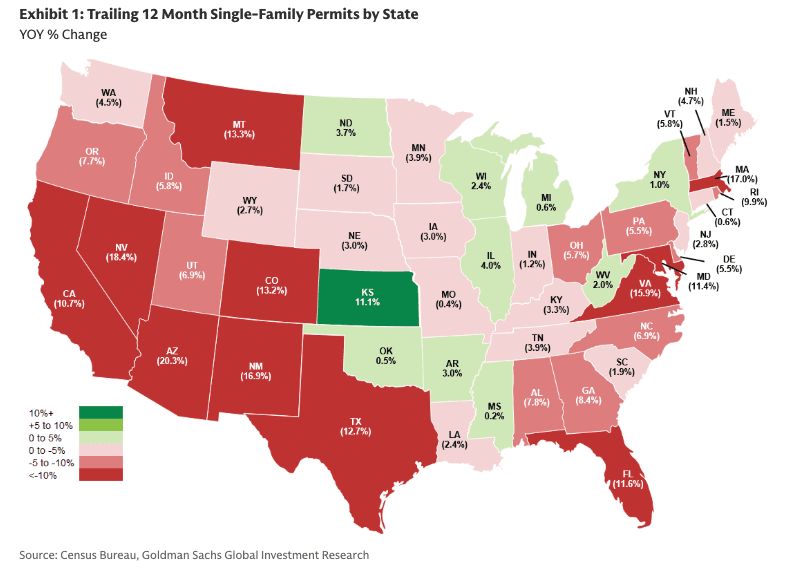
On a trailing 12-month basis, single-family permits fell 8% in January, versus 7% in the previous month, and were up 6% in December 2025.
Maklari said, "Ongoing moderation comes as builders look to limit unsold inventory given limited visibility to demand."
Some of the January weakness stemmed from severe winter weather and dangerously cold temperatures, which delayed permits and construction in parts of the eastern U.S., including major homebuilding markets such as Texas, Florida, and the Southeast. However, the snow and sub-zero temperatures are only one part of the slowdown story.
The analyst added that builders are dealing with a challenging macroeconomic environment for buyers, noting that sales traffic improved earlier in the year but vanished in March, according to the latest industry checks, as consumers "react to the effects of the Middle East conflict."
At the same time, mortgage rates have jumped about 40 basis points over the last month, making monthly payments even less affordable as the housing market is stuck in the worst affordability crisis in a generation, a leftover gift from the Biden-Harris era.
The slowdown is most visible in some of the biggest new-home states:
Single-family permits for the 3-months ended January fell 11% YOY, compared to -9% in December, and -1% a year ago. That said, they were up 7% vs the comparable pre-pandemic period. Looking at the largest new home markets, the deceleration was led by Colorado (-21%), Texas (-20%), and Nevada (-19%) while the Northeast and Pacific Northwest outperformed. Nationally, we note 8 states were flat to up vs 11 in December. This comes as builders continue to align starts to demand while focusing on profitability and cash generation. As such, we expect permits will remain under pressure in the near-term.
At the metro level, the permit picture is deteriorating across the top 50 metro areas, with permits down 15% from one year ago, and some of the sharpest declines are in places such as Stockton, Richmond, and Cape Coral.
Permits in the top 50 MSAs declined 15% YOY for the 3 months ended December vs -13% in December and -4% in January 2025. On a YOY basis, Miami, FL (+33%), North Port, FL (+31%), and Portland, OR (+17%) showed the greatest gains while Stockton, CA (-47%), Richmond, VA (-39%), and Cape-Coral, FL (-36%) lagged. On a 2-year stack, growth was led by Colorado Springs, CO (+33%), Oklahoma City, OK (+30%), and Columbus, OH (+13%) while Lakeland-Winter Haven, FL (-52%), Myrtle Beach, SC-NC (-48%), and Denver, CO (-45%) had the largest losses.
Trailing 12 Month Single-Family Permits by State

Trailing 3 Month Single-Family Permits by State

Permits for Top 50 MSAs

A look at home prices shows the market is still rising nationally, but momentum has cooled.
Zillow's single-family home value index showed prices were modestly higher in February versus one year ago, in line with January and below the 3% annual gain seen a year ago. The data shows that home values remain up 55% since February 2019.
Regionally, home price strength was concentrated in the Midwest and parts of the Northeast, with Wisconsin, North Dakota, Illinois, and New York each posting 5% annual increases, while Connecticut, Michigan, and Iowa rose 4%. Sun Belt weakness persisted due to oversupply concerns, led by a decline in Florida, while Colorado, Texas, Arizona, Nevada, and Georgia were down around 2%.

The slowdown in permits suggests the spring selling season may be weaker than expected. Builders remain wary of demand, and with mortgage rates moving higher and uncertainty growing due to the US-Iran conflict, the housing market as a whole appears to be in continued paralysis.
Professional subscribers can read the full "Americas Building" note at our new Marketdesk.ai portal