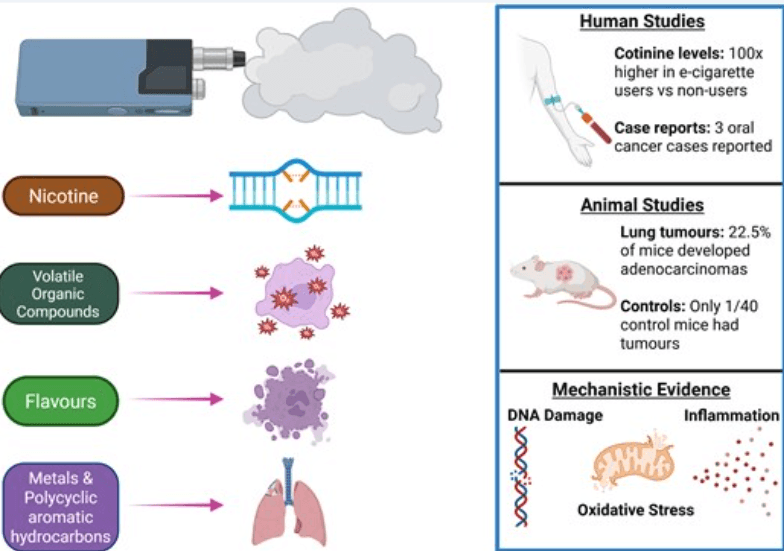
A new report from researchers at the University of New South Wales in Australia, published in Carcinogenesis, finds that nicotine-based e-cigarettes are likely to cause lung and oral cancers, a finding that may alarm the millions of young people, from high school through college, and into the professional world, who use them heavily.
Researchers examined human studies, animal experiments, and lab tests. Together, they found signs that vaping can damage DNA, cause inflammation and oxidative stress, and expose users to harmful chemicals considered drivers of cancer. Some rodent studies also found lung tumors after vape exposure.
"Nicotine-based e-cigarettes are likely to be carcinogenic to humans who use them, causing an indeterminate burden of oral cancer and lung cancer," the researchers wrote in the report.

The researchers still don't fully understand the long-term risks, given that vaping only entered commercial markets worldwide in the last 20 or so years. However, they say the warning signs are already present and should not be ignored as cigarette risks once were.
"Though smoking was once given the benefit of the doubt, the same should not now be accorded to vaping, given the strength of relevant carcinogenicity data," wrote study co-authors Freddy Sitas and Bernard Stewart of UNSW in a related commentary.
Vaping in the U.S. emerged in 2007 and was widely touted as a safer way to consume nicotine than traditional methods involving inhaling smoke from burning tobacco leaves. The trend exploded in 2015 with the introduction of Juul.

Millions of Americans started vaping to quit smoking cigarettes. Instead, if the study is correct, they may actually be increasing their health risks.
Vaping is not as harmless as once thought, and the researchers' point is that e-cigarettes should not receive the same "benefit of the doubt" cigarettes once did, because the cancer warning signs are already present.
Even before the assessment was released, NielsenIQ data showed e-cigarette sales in the U.S. were weak as of March 21 (according to the Goldman report, which can be viewed in full here for Pro subscribers):
Within Tobacco, dollar sales for BAT were up 1.8% over the past four weeks, versus 1.0% last month; sales for IMB were down 3.5% over the past four weeks, versus down 3.4% last month; and sales for MO were down 2.0% over the past four weeks, versus down 3.2% last month.

The question now is whether the study will go viral and alarm consumers enough with cancer fears, and whether those fears will be enough to change spending behavior in a way that shows up in the NielsenIQ data over the coming weeks.