Authored by Kimberley Hayek and Matthew Vadum via The Epoch Times,
Democrats asked a federal judge Wednesday to block parts of President Donald Trump’s executive order on federal elections.

The lawsuit challenges Trump’s directive, signed a day earlier, that will create a list of eligible voters in every state and prohibit the U.S. Postal Service (USPS) from sending absentee ballots to those not included on the list. The order, titled “Ensuring Citizenship Verification and Integrity in Federal Elections,” directs the Department of Homeland Security and Social Security Administration to conduct voter information collection.
Trump said the executive order was needed because “the cheating on mail-in voting is legendary. It’s horrible what has been going on.”
“The right to vote in Federal elections is reserved exclusively for citizens of the United States under the Constitution and Federal law,” the order reads. “The Federal Government has an unavoidable duty under Article II of the Constitution of the United States to enforce Federal law, which includes preventing violations of Federal criminal law and maintaining public confidence in election outcomes.”
Trump signed the order after Congress recently failed to pass the SAVE America Act, which would have imposed voter ID and election integrity requirements. Administration officials described the order as a necessary step to restore public confidence ahead of the midterm elections in November.
White House staff secretary Will Scharf said the provisions in the order would prevent past problems from being repeated.
“We believe, combined, the measures in this order will help secure elections in the future and ensure the many abuses of our elections in the past are not repeated in future elections,” Scharf said.
Commerce Secretary Howard Lutnick echoed the goal.
“The fundamentals of our democracy are built on voter integrity,” he said during a signing ceremony.
The order reiterates that only U.S. citizens are eligible to vote by mail, and that to enforce the relevant federal statutes, lists of voters are to be verified by the Department of Homeland Security in coordination with the Social Security Administration, “consistent with applicable law, including but not limited to the Privacy Act of 1974.”
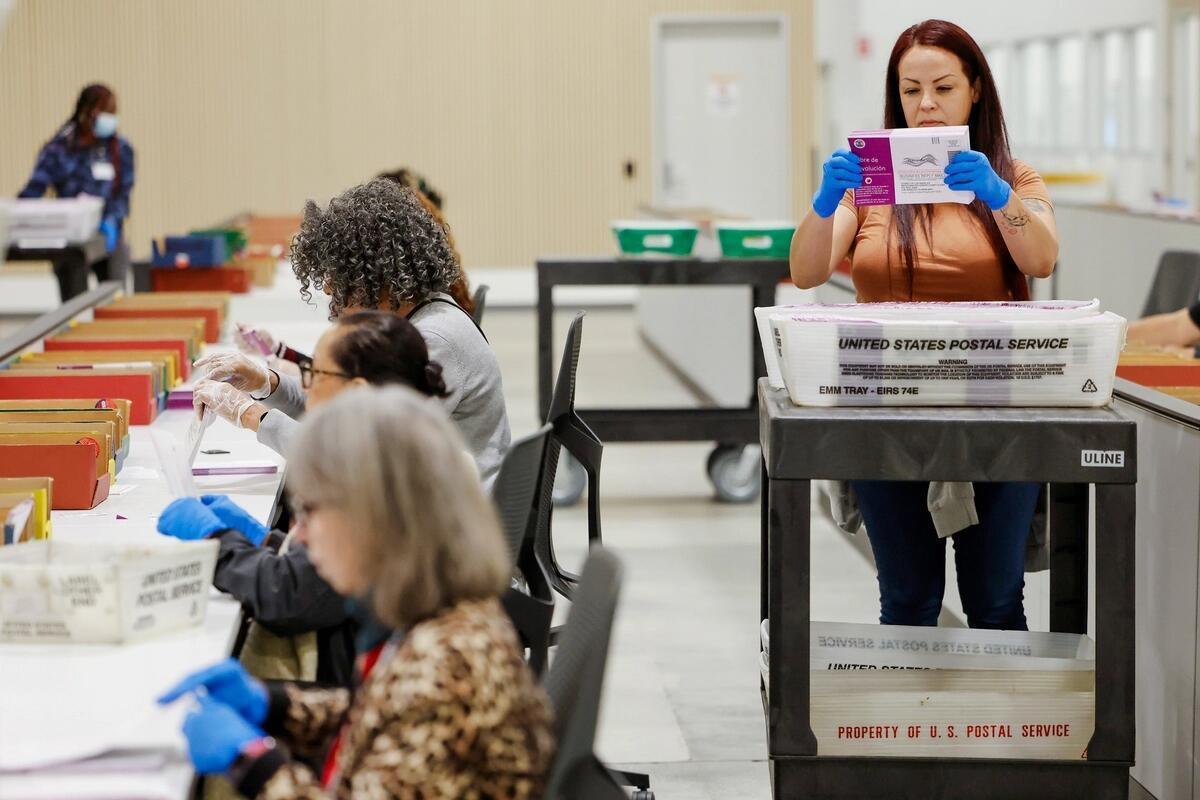
The order directs USPS to send ballots only to verified individuals included in the lists, with unique bar codes applied to each envelope—one per voter—to facilitate tracking and audits.
The U.S. attorney general and the heads of various executive departments and agencies were directed to take steps to deter and address noncompliance with federal law by taking steps such as withholding federal funds from noncompliant state and local governments. Evidence that state or local election officials or other individuals of entities have violated existing federal laws is to be referred to the Department of Justice for investigation, the order said.
The Democratic Party campaign organizations that filed the lawsuit contend the order exceeds presidential authority and disrupts state election processes. They seek an immediate injunction to halt enforcement of parts of the order.
The legal complaint states that Trump “has tried again and again to rewrite election rules for his own perceived partisan advantage,” and that he wants to ban mail voting, “a favorite scapegoat for his 2020 electoral defeat,” and impose other restrictions on voting.
The executive order “dramatically restricts the ability of Americans to vote by mail, impinging on traditional state authority,” largely by requiring the USPS “to take actions unrelated to the agency’s statutory mandate that run roughshod over established protections for voters who rely on the mail to exercise their fundamental right to vote.”
This instruction violates the Administrative Procedure Act and the Privacy Act, which require agencies to follow existing law and forbid the use of federal records unless previously authorized under federal law, the complaint says.
The order would unlawfully take steps to create a “national citizenship registry” and require that “state citizenship lists” be shared with states within 60 days of each federal election, the complaint says.
The plaintiffs in this case—the Democratic Senatorial Campaign Committee, the Democratic Congressional Campaign Committee, the Democratic National Committee, the Democratic Governors Association, and the Democratic leaders of the U.S. House and Senate—urged the U.S. District Court in the nation’s capital to act quickly because federal elections are soon approaching.
The plaintiffs asked the court to block the sections of the executive order that mandate the creation of state citizenship lists and require the USPS to establish uniform standards for mail-in or absentee ballots. They also asked the court to block the parts of the order requiring the Department of Homeland Security, the Social Security Administration, and the USPS to coordinate with the Department of Commerce.
Democratic leaders reacted sharply to the executive order. Sen. Alex Padilla (D-Calif.) called the order “a blatant, unconstitutional abuse of power.”
California Gov. Gavin Newsom, a Democrat, vowed to sue over the order.
“The President wants to limit which Americans can participate in our democracy,” Newsom’s press office wrote on Tuesday on X. “California will see him in court.”
When signing the order, Trump said he anticipated legal challenges.
“I don’t know how it could be challenged. It could probably be challenged if you find a rogue judge,” he said. “We will appeal if it is, but I don’t see how anyone else could challenge it.”