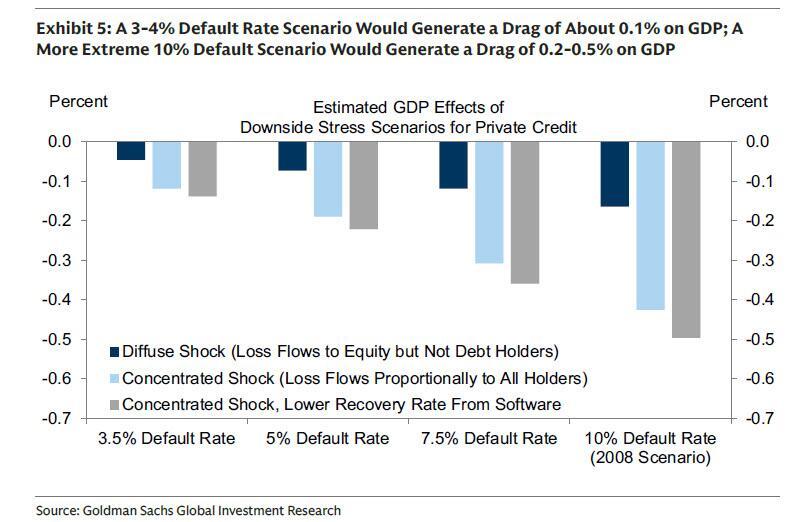
A week ago, in an attempt to calm the market, Goldman's economists published a lengthy, if at times disjointed, report discussing why a crisis in private credit would not lead to another financial crisis.

We are about to find out if they were right.
Recall that in mid-March, while attention was understandably focused on the Iran war, we explained why Blue Owl's February decision to commence liquidations of loans in its three core private credit funds to fund current and future redemptions, was the industry's "Margin Call" moment, to wit:
First it was Blue Owl, the largest pure play Private Credit fund with over $300 billion in AUM. The company, the first to face massive redemption demands, refused to gate investors and instead announced it would sell $1.4 billion in private loans (it was unclear which loans were sold, but Goldman suggested that these are likely the best ones so as to find willing buyers, leaving the company with the toxic sludge) from its three BDCs (OBDCII, OBDC and OTIC) at 99.7 cents (a number which was meant to inspire confidence yet was laughable, especially since once of the "buyers" was a related-party insurance company, Kuvare, also owned by Blue Owl), to satisfy redemption requests.
In our February 19 article describing the Blue Owl transaction, we said that "while it is unclear how deep the secondary market for private credit assets is, to the extent demand is relatively scarce, a transaction of this size could dry up market liquidity. If that assumption is true, other BDCs looking to exit portfolio investments could be jeopardized. Recall the immortal line from Margin Call: "Be First, Be Smarter, or Cheat."
We then said that "this could very well be Blue Owl's "Be First" moment... "Sell it all, today" especially if it were to later emerge that the secondary market is only deep for higher quality private credit assets, like the ones in the portfolio OWL is selling. In a concurrent report, Barclays warned that "if this transaction dries up secondary liquidity for private credit assets (or proves that the bid is only there for higher quality assets), it could be negative for other BDCs exploring portfolio sales."
In retrospect, this is precisely when the "Margin Call moment" of the private credit sector happened, because what happened next would make the market's head spin.

And unfortunately for Blue Owl, while the firm's catastrophic practices and financial engineering was indeed the snowflake that started the avalanche in the broader private credit sector, it has now boomeranged on the company itself and may have well led to its demise when two months after desperately seeking to avoid gating redemptions, the private credit giant announced it will in fact limit redemptions from two of its private credit funds after facing a historic surge in withdrawal requests that is unprecedented among major firms in the $1.8 trillion market.
Redemption requests in Blue Owl's marquee $36 billion Credit Income Corp. fund, one of the industry’s largest, soared to 21.9% in the three months ended March 31, according to an investor letter first reported by Bloomberg, up from "only" 5.2% in the prior period. But it was the smaller Blue Owl Technology Income Corp, which was at the center of the February turmoil, that was the real shock after its shareholders asked for a shocking 40.7% back, compared with 15.4% three months earlier, according to a separate letter.
Both funds had previously met the requests in excess of its 5% tender offer. This time, though, Blue Owl - whose actions sparked the crisis that is now sweeping across pricvate credit - said it would join industry peers in capping redemptions at that level, “in accordance with the fund structure, reflecting our commitment to balancing the interests of both tendering and remaining shareholders.”
For the bigger fund, OCIC, that amounts to $988 million of redemptions honored and about $3.2 billion remaining in the fund, while for OTIC it means redeeming $179 million and keeping roughly $1 billion of investors’ cash, according to Bloomberg.
Craig Packer, Blue Owl’s co-president, said in an investor update that he believed the uptick in redemptions reflected a “period of heightened negative sentiment toward the asset class that has intensified as peers have reported tender results”.
And why would their tender results be intensified one wonders? Would it have something to do with that pinnacle of financial engineering where Blue Owl dumped many of its best loans to a related entity? Maybe Craig thinks that his investors are all idiots, but as he just found out, they may be far smarter than him.
“While we believe market perception has driven elevated tender activity, underlying credit fundamentals across our portfolio have remained resilient,” he added. “We continue to observe a meaningful disconnect between the public dialogue on private credit and the underlying trends in our portfolio.”
In the letters, OCIC said 90% of its shareholders chose not to tender, reflecting concentrated withdrawal demands, which means it was driven by institutions not retail investors who have been frequently blamed for all the ills plaguing private credit.. OTIC said its redemption pressure “was amplified by the fund’s more concentrated shareholder base, particularly within certain wealth channels and regions, and its specialized investment mandate.”
Both Blue Owl funds, which have returned more than 9% annualized since inception (not all too different from how Bernie Madoff generated double digits returns until one day his ponzi scheme collapsed), said they’re in a “strong position” to meet the 5% redemption requests and future tenders. OCIC and OTIC had $11.3 billion and $1.3 billion, respectively, across cash, available borrowing and liquid Level 2 assets as of the end of February, according to the letters.
While Blue Owl joins industry peers including Apollo Global, Ares Management and BlackRock in sticking to their redemption threshold on non-traded business development companies, the staggering magnitude of the requests underscores how Blue Owl has found itself squarely in the middle of worries about private credit.
The limitation on outflows highlights the risks to individual investors who had flocked to so-called non-traded private credit funds over the past three years in periods of stress. Those wealthy individuals had been promised access to higher-yielding investments in exchange for limited liquidity. Now they are regretting it.
Private credit asset managers have diverged in how they have dealt with redemption requests, with some going to great lengths to cash out investors, while others have stuck to their limit. Still, no major manager has disclosed facing the percentage that Blue Owl’s BDCs were asked to pay back.
And with Blue Owl's private credit business now effectively in wind down mode, and mothballing the entire private credit industry, one wonders where so many crappy small and medium (mostly tech) companies will get the funding to exist. But before that, one wonders more just how wrong Goldman's analysis is that a private credit crisis won't impact the broader economy. We'll find out very soon.