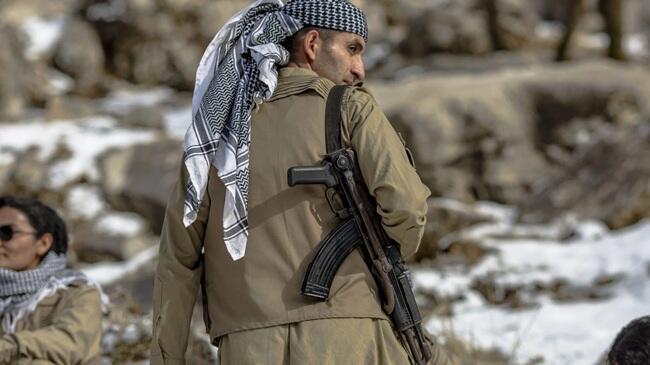
Several Iranian Kurdish opposition groups on Monday denied reports that the US had armed them during anti-government protests and riots that erupted in January, leaving over 3,000 Iranians dead.
Mohammed Nazif Qaderi, a senior official from the opposition Kurdistan Democratic Party of Iran (KDPI), called the reports "baseless," saying, "We haven't received any weapons. The weapons we have are from 47 years ago, and we obtained them on the Islamic Republic's battlefield, and we bought some from the market."

"Our policy is not to make demonstrations violent and use harsh methods, rather we believe we must make our demands in a peaceful and civil manner without weapons," Qaderi said.
The protests and riots began in January after the US Treasury deliberately created a shortage of US dollars in Iran's heavily sanctioned economy, causing the Iranian currency to collapse. The uprising began with economic-driven demonstrations in Tehran's Grand Bazaar, which saw shopkeepers shutter their stores.
Armed groups then used the protests that erupted in response as cover to carry out attacks against Iranian security forces and paramilitary groups, known as Basij. Rioters also attacked and burned government buildings and mosques.
Israeli media reported that Mossad had agents on the ground in Iran to organize armed groups and create chaos in advance of the US-Israeli bombing campaign launched weeks later, on 28 February.
The Kurdish denial came one day after US President Donald Trump admitted for the first time during an interview with Fox News that the US attempted to ship "a lot of guns" to anti-government protesters in Iran.
While confirming the intent to arm the uprising that began in late 2025, Trump claimed the operation failed because the Kurds, who were used as the delivery channel, "kept the weapons" for themselves instead of passing them to the demonstrators.
This blunt disclosure not only provides the Iranian government with direct evidence of US interference but also publicly blames the US's Kurdish allies for the missing arms.
In response to Trump's comments, Amjad Hussein Panahi, head of communications for Komala of the Toilers of Kurdistan, stated, "We assure you we haven't received a single bullet or weapon from any country or place, and we're not aware of the existence of such a thing; what we have is our own."
Reports first emerged that the CIA was working to arm Kurdish forces in an effort to foment an uprising in Iran in early March.
Multiple people familiar with the plan told CNN that the Trump administration had been in active discussions with Iranian opposition groups and Kurdish leaders in Iraq. The CIA wished to provide weapons and air support to Kurdish militants as part of an operation to topple the Iranian government.