In an early clue how the Iran war will impact energy earnings, ExxonMobil warned of a $6.5bn hit to Q1 earnings from the Iran war but said the bulk of this was the result of unfavorable timing for its accounting of hedging contracts, which would be offset as underlying transactions were eventually completed. The US supermajor also said that global oil and gas production would be 6% lower in the first three months of the year than in the fourth quarter of 2025 because of attacks on facilities in Qatar and the United Arab Emirates in which it holds ownership stakes.
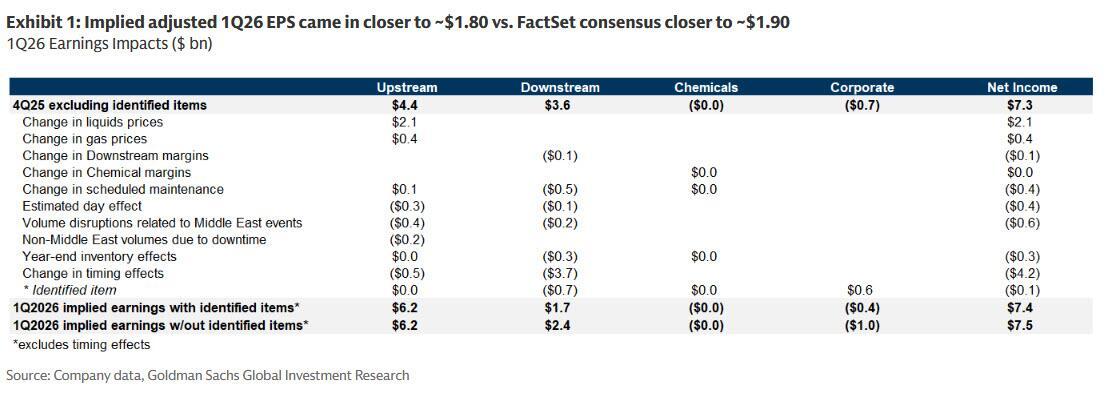
According to Exxon's 8K filed this morning, Goldman calculated that the company's adjusted EPS at the mid-point came in at ~$1.80 vs. consensus closer to $1.90 and Q4 levels closer to $1.71. As shown in the chart below, there was sequential improvement in Upstream driven by higher liquids prices, sequential declines in Downstream due to higher maintenance and relatively flat performance in Chemicals.
Volume disruptions at Exxon's production and refining businesses would deliver a $400mn to $800mn hit to earnings, while trading losses incurred because of a failure to deliver physical cargoes hedged with financial derivatives would cost another $600mn to $800mn, the company said in a statement.

Separately, the company provided a number of strategic updates, including: (1) the Permian likely producing at 1.8 mn boe/d in 2026, (2) first gas at Golden Pass having been achieved on March 30, and (3) that the Middle East production negatively impacted Q1 Upstream volumes by 6% compared to Q4 levels, with the overall Middle East portfolio representing 20% of Upstream production (albeit a lower level of segment earnings). As an aside, the quarterly comparison was challenging given disruptions in the Middle East, and large timing effects, the latter of which are excluded for the purposes of comparison.
Exxon has one of the largest exposures among western oil majors to the Middle East, according to the FT, which accounts for about 20% of its oil and gas production and 5% of its refining and chemical capacity.
The company’s assets in the region include stakes in LNG joint ventures with QatarEnergy that were damaged last month by Iranian attacks. Exxon said two gas liquefaction facilities in Qatar in which it has an ownership interest accounted for about 3% of its 2025 global oil and gas production.
“Public reports indicate the damage will take a prolonged period to repair. Pending an on-site evaluation, we are unable to comment,” the company said.
But the largest hit to Exxon’s first-quarter earnings, worth $3.5bn to $4.9bn, is linked to the surge in oil and gas prices caused by the Middle East conflict and the accounting treatment of financial derivatives it used to hedge prices while shipping products.
The company said the negative impact on its first-quarter earnings was a LIFO “timing effect” that would unwind over subsequent quarters and result in net positive profit once the underlying transactions covered by the hedges were completed.
“This quarter’s earnings include an unusually large, negative timing impact associated with our trading programme and the temporary earnings impacts that result from how we account for certain trades . . . These are sound trades and the profitability that will result from them will be material,” said Neil Hansen, Exxon’s CFO.
“Because we are using derivatives, we are required to account for them at month-end prices and reflect the resulting impact in earnings at the end of each quarter. This accounting often happens well before the sale of the associated physical product is complete. As noted, this earnings mismatch always results in a timing difference that eventually unwinds itself in periods of rising price.”
Exxon said that excluding the unfavorable timing effects that would reverse over time, earnings in the quarter would be higher than in the fourth quarter of 2025.
Offsetting the timing effect loss was the surge in oil and gas prices following the start of the Middle East war on February 28 would deliver a $2.1bn to $2.9bn boost to first-quarter earnings.
Exxon shares fell 5% in pre-market trading on Wednesday to $154.70, as traders reacted to a two-week US-Iran ceasefire deal.