The 3-D space in the pre-visualization didn't always relate to the physical stage, but effects cinematographer Bill Neil and his associate, Paul Gentry, found it to be useful, if only as a timing guide. Neil explains, “It was a wonderful communications tool between the visual effects team and the director to help clarify what his vision contained, and to reach a common understanding."
Neil insisted on shooting the city background plates before filming the cars in order to create interactive light on the vehicles that would relate to their environment. Although Besson's center-focused perspective ran contrary to Neil's experience in composition, the cameraman found that it offered some interesting problems to solve — such as creating depth when shooting a limited number of buildings being elongated to infinity via digital matte paintings.
Adding to this challenge was Besson's directive that the sequence occur in broad daylight. "I was shocked," admits Neil. "Miniatures are often saved by the fact that you don't see much of them, but this whole sequence took place late in the day, and it had to hold up to scrutiny. The stage ceiling was only a few feet above the top of the buildings, so we did tests to see how we could light that expanse of vista. Fortunately, my gaffer, George Ball, and my key grip, Joe Celeste, were able to realize my ideas on the stage. We had a general skylight that came from the top, and then a golden key light that was supposed to be the late day sun raking through any gaps between the buildings. But instead of having key light all coming from roughly the same direction, I took what I came to call a 'fractured light approach,' where I added broken light coming off buildings that were not in frame, often at steep angles, reflecting back in the opposite direction from the sunlight key. That gave the city an energy, a modulation of the light that was quite wonderful.
"I also built aerial perspective into the scene so that as the distance from camera increased, the contrast of the scene decreased. Dark things become lighter and light things become darker until ultimately they become monotone. I took that into account in my miniature lighting, and that carried through in the matte painting, which gave us great depth in the streets."
Stetson had set some basic specs for the kinds of motion-control rigs needed to shoot down into the canyon of buildings toward the floor: "I wanted to fly the camera from the stage ceiling down into the miniature, so we put the camera on a cruciflex motion-control rig, a motion-control crane with a vertical tower for descent and a horizontal crossbeam for forward motion."
Stetson also planned to thread the camera on a 20' extension arm through the miniature streets. At four feet wide, the streets were too narrow for Neil's motion-control camera to run along a horizontal track between the buildings. For the chase's climax, when Korben's cab is pursued below the city through a girder-walled tunnel beneath an underground railroad, Stetson expected Neil to use the extension arm to travel into the 1/6-scale tunnel model. Although the miniature set measured 48', it still wasn't long enough for the high-speed chase. "We made it appear twice as long by shooting it twice, the second time with the camera displaced 48' back," Stetson says. "We needed a very long camera track and two sets of mattes to complete it, but the pieces lined up perfectly with Karen's help. The tunnel chase was almost entirely miniature. Brian Grill some CG debris, some 2-D debris, and smoke resurrected from prior shows to sweeten the scene. The cab is in the foreground, the vanishing point is in the center, and there's a lot of weaving and bobbing."
At five minutes and 70-plus shots, the cab-chase sequence represents nearly a third of Digital Domain's Fifth Element effects. Most of the shots involve CG traffic, and sometimes CG hero cabs and police cars. "We digitized the 1/6-scale [models of] Korben's cab and the cop car," Goulekas says. "The hero police car dive down following Leeloo's jump was done in CG because we wanted to see all six surfaces; there was no place to hide an armature mount. You'd be surprised. Our CG traffic pipeline enabled us to say, 'We want a certain percentage of cabs, police cars, red cars, blue cars." The artists worked with low-res versions of the traffic, and then we'd substitute the real traffic on the output on the Tenderer."
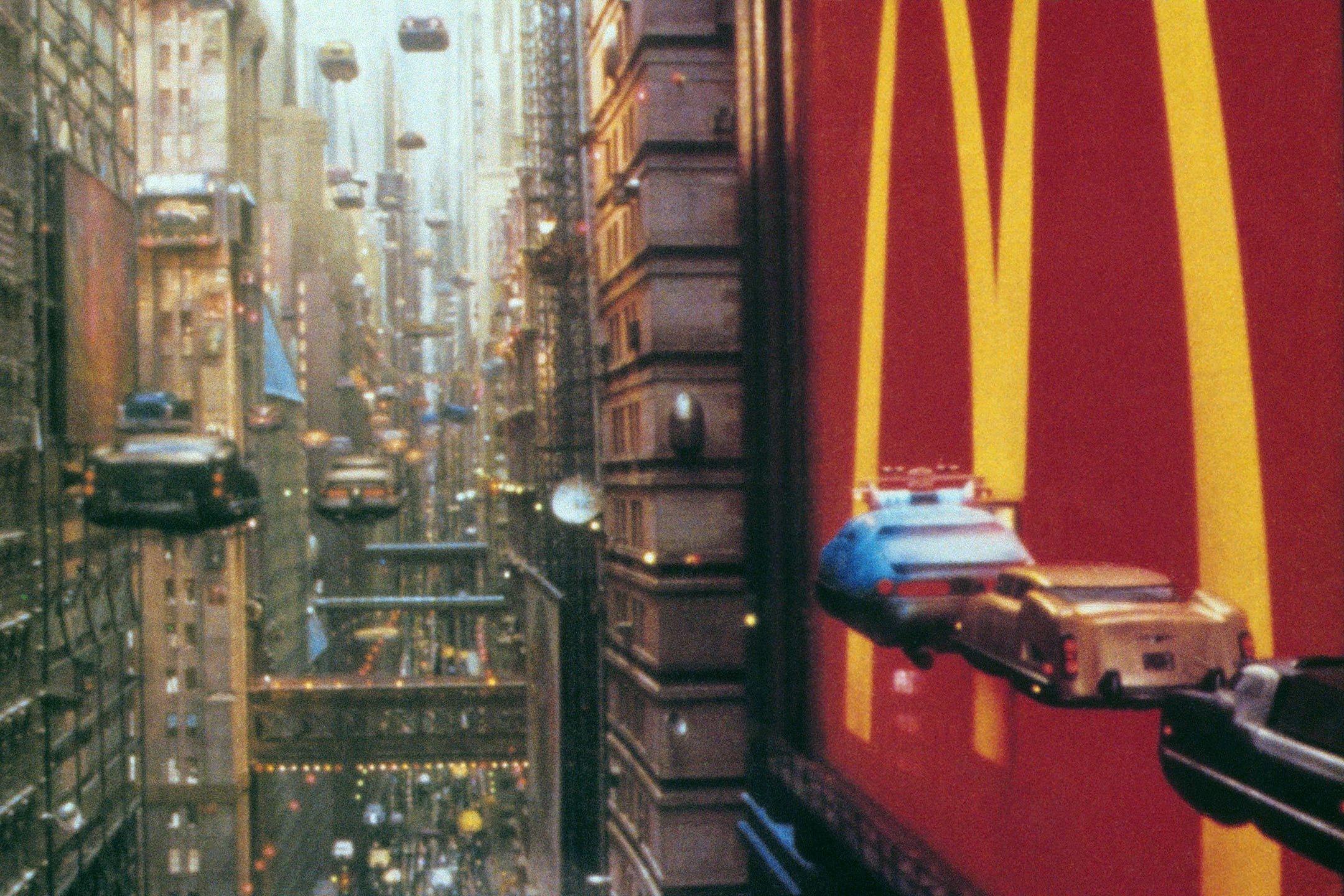
Sequence supervisor Sean Cunningham coordinated the creation of all of the pieces for the cab chase, and shader supervisor Simon O' Connor conceived all of the shaders and surfaces for the traffic. But putting all the different elements together fell to compositing supervisor Egstad. "Getting the color balance and the contrast range of all the objects matching properly in daytime was a big challenge," Egstad says. "We composited hundreds of computer graphics cars, which wouldn't fit unless we blurred them a little and boosted their contrast. Also, matte edges aren't nearly as forgiving, so we used a number of different atmospheric tricks, like adding density fog and using filters in Flame to add a nice optical glow from headlights and take the curse off the CG objects."
Amid the craziness of production, Stetson was left to his own artistic instincts in terms of directing the development of the cityscape — a potentially dangerous situation. "We'd walk Luc onto the stage when we were shooting, but he'd just look at stuff without any reaction, because he was totally absorbed with directing his actors," Stetson recalls. "Had I been really wrong about what Luc wanted, it would've cost us horribly in terms of time and money.
"Finally, when we had traveled way past the point of no return design-wise, I went to his editing suite in Malibu and showed him a color print of a test shot of one of the first big model setups of the city, which represented hundreds of thousands of dollars' worth of work. Up to that point, it was unknown whether he was going to bless it or not. Luc looked at it and his face just lit up completely. He held up the picture to show his editor, Sylvie Landra, pointed to it and then pointed to his face with this big smile on it. He really loved it. That was a huge relief."
For more on this production, from the same issue: Astral Grandeur: The Fifth Element Offers a New Sci-Fi Aesthetic.
Besson would later adapt Jean-Claude Mezieres’s Valérian: Spatio-Temporal Agent into the film Valerian and the City of a Thousand Planets (2017), photographed by Thierry Arbogast, AFC.
If you enjoy archival and retrospective articles on classic and influential films, you'll find more AC historical coverage here.