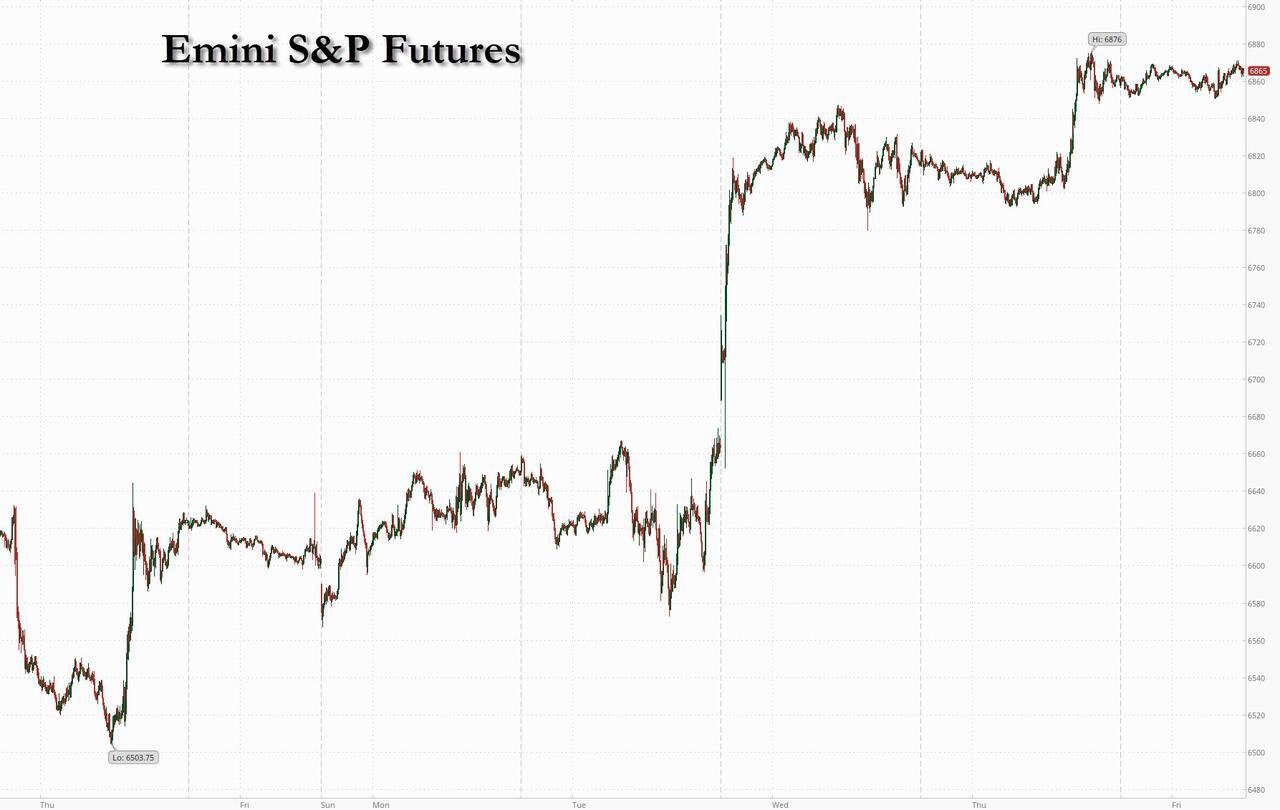
US equity futures are flat, recovering from an earlier drop, and set to extend a seven-day rally, the longest since October, as investors looked to talks between the US and Iran for signs a fragile truce can hold while bracing for a big jump in today's CPI report (full preview here). As of 8:00am ET, S&P futures were up 0.1%,on track for their biggest weekly advance in almost a year. Nasdaq futures rose 0.2%, its winning streak is the longest since September, led once again memory stocks while Mag 7 were mixed (NVDA -0.5% and MSFT +0.5%). Europe’s Stoxx 600 gained 0.8% as Ukraine’s top negotiator with Russia expressed optimism about peace talks. Overnight, headlines were mostly quiet as investors continue assessing the negotiation progress between the US and Iran. Hormuz and Lebanon remains the two key focuses. Meanwhile, a BBG headline this morning saying that Ukraine may be near a deal with Putin drove futs modestly higher; gold trades flat around $4,765. Bond yields are unchanged to 1-2bp lower, the 10Y TSY trading at 4.29%; oil is 1% higher to $98.6; base metals are mostly lower. Brent crude was steady at near $96 a barrel but on pace for its steepest weekly loss in nine months. On today's calendar, we have March CPI due at 8:30 a.m. ET, followed by factory orders for February and final readings for February durable/cap goods at 10 a.m. University of Michigan Sentiment also due at 10 a.m.

In premarket trading, Magnificent Seven stocks are mostly higher (Microsoft +0.2%, Meta +0.6%, Alphabet +0.2%, Amazon +0.2%, Apple -0.3%, Tesla +0.2%, Nvidia -0.1%)
- CoreWeave (CRWV) gains 4% after Anthropic PBC agreed to rent data center capacity from the company.
- Docusign (DOCU) slips 1.7% after Citi downgraded the company and other application software stocks to neutral, saying the group they doesn’t have any exciting 12-month catalysts. The other downgraded stocks include Autodesk (ADSK), which is down 1.4%.
- Kyivstar Group (KYIV) rises 9% after Ukraine’s top negotiator with Russia said he sees progress toward a possible peace deal between the two countries.
- Lumentum (LITE) climbs 5% after the firm said demand from the biggest US tech companies is accelerating. Peer Coherent (COHR) climbs 4%.
- Organon & Co. (OGN) soars 21% after the Economic Times reported that Sun Pharmaceutical is set to make a $12 billion offer for debt-ridden company. Sun Pharmaceutical called the report speculative in nature.
- Taiwan Semiconductor Manufacturing Co.’s ADRs (TSM) are up 2% after the company reported March sales that reinforced how the company is seeing strong AI demand.
- Tecnoglass (TGLS) slips 2% after the window manufacturer lowered its full-year adjusted Ebitda outlook due to tariffs on certain aluminum-containing products and derivatives.
In other corporate news, an earnings beat by CATL may set the stage for a short squeeze, after a surge in the battery maker’s shares on bets tied to soaring energy prices. Lumentum said demand from the biggest US tech companies for its optical components is accelerating and on track to fill its order books through 2028. AI is also on traders’ radars this Friday. TSMC reported a 35% increase in quarterly revenue, suggesting ongoing global chip demand remains intact. China AI firm Sharetronic procured hundreds of Super Micro systems containing banned high-end Nvidia chips. Treasury Secretary Bessent and Fed Chair Powell summoned Wall Street bank CEOs to discuss Anthropic’s new AI to discuss cyber risks.
Anticipation of weekend talks between the US and Iran following this week’s ceasefire agreement are keeping markets on edge. The longest winning run for the S&P 500 since October looks set to be tested as traders prepare for CPI data before attention turns to US-Iran discussions in Islamabad at the weekend. The truce announced on Tuesday remains shaky, with Kuwait reporting large-scale drone attacks on “vital” facilities overnight and accusing Iran and its proxy groups of violating the terms of the agreement.
Israel continued to target towns in south Lebanon, where its parallel campaign against Tehran-backed Hezbollah threatens to undermine negotiations. “I’m not trimming into the weekend,” said Rajeev De Mello, global macro portfolio manager at Gama Asset Management SA. “The direction of travel seems to be to talk rather than to fight.”
The latest tone in markets suggests some optimism negotiators from Washington and Tehran will make progress on longer term de-escalation, despite the remaining points of tension. Whatever the outcome, there are plenty of supply chain bottlenecks and delayed consequences still to work through. Daily commercial traffic through the Strait of Hormuz remains close to zero. The “Trillion Dollar War” is weighing on global economic outlooks, note Bloomberg Economists whose global growth tracker – which uses a machine-learning algorithm to extract signals from data for 18 advanced and EM economies – points to an abrupt reversal, after a build-up in momentum at the start of the year. “Investors are hoping for fruitful negotiations,” said Guillermo Hernandez Sampere, head of trading at asset manager MPPM. Still, “a swift conclusion will be difficult to achieve, as economic interests prevail on all sides and no one wants to be disadvantaged,” he said.
Oil remains in focus. Saudi Arabia said its production capacity has been reduced by attacks on energy infrastructure. WTI could hold at $100 a barrel - or higher - for longer if disruptions to tanker traffic keep global crude flows constrained, Bloomberg notes pointing to a surge in net long crude futures amid oil’s widening risk premium.
“We believe this could be the beginning of the end, and is presenting an opportunity for investors to focus on pre-war trends and fundamentals,” Bernstein analysts Rupal Agarwal and Cheng Zhang wrote in a note.
Some investors are not convinced that the ceasefire marks the end of trouble for financial markets. Crude remains over $90 a barrel, a level that threatens to drive inflation and suppress economic growth. “I’m not very optimistic at all,” said Nick Ferres, chief investment officer of Vantage Point Asset Management in Singapore. “Overall, our sense is that the sustained premium in crude is not reflected yet in profit margins, and that ought to contribute to a higher equity risk premium.”
The March CPI report is expected to show gasoline prices drove the fastest monthly increase in the headline gauge in almost four years, while core CPI will likely remain tame. The Cleveland Fed nowcast point to headline CPI of around 3.25% Y/Y in March (vs an actual 2.4% in February), though core inflation should be steadier at around 2.5% Y/Y, suggesting the March strength is likely to come from fuel and other energy-related components rather than a broad-based underlying inflation surge. Wall street upside estimates are even more aggressive, with median expectations for headline CPI surging from 0.3% MoM to 0.9%, and from 2.4% to 3.4% YoY. (Our full preview is here).

“Headline risk pertaining to the war remains far and away the biggest driver of volatility,” Kyle Rodda, a senior financial market analyst at Capital.com, wrote in a note. “However, inflation data also presents meaningful event risk.”
Europe’s Stoxx 600 gained 0.8% as Ukraine’s top negotiator with Russia expressed optimism about peace talks, stocks are led by construction and media. Markets received an additional boost from news of a potential peace deal between Ukraine and Russia, though that dented defense stocks. Italian luxury brand Brunello Cucinelli jumped after impressive results, while Sodexo’s disappointing guidance weighed on its stock. Here are the biggest movers Friday:
- Brunello Cucinelli gains as much as 6.6% after the Italian luxury clothing company reported solid first-quarter earnings thanks to strong retail sales, which according to analysts, confirms the company’s stand-out position in the sector
- Reply shares rose as much as 8.4% in Milan trading, the most in a year, after the Italian digital services firm announced that it would buy back ordinary shares worth as much as €550m
- Holcim rises as much as 3.1% after Goldman Sachs upgrades the Swiss building materials company to buy from neutral, seeing an attractive entry point following the stock’s decline this year
- Tomra gains as much as 7.1% after Pareto Securities reiterated its buy recommendation on the Norwegian recycling equipment firm, saying the blue-sky scenario related to changes in the European deposit-return scheme is materializing
- Instalco gains as much as 9.2%, the most since February, after both Pareto Securities and SEB raised its recommendations on the Swedish building installation and maintenance firm to buy from hold
- Plejd shares gain as much as 16% to hit a fresh record high after earnings from the Swedish electrical equipment maker surpassed Bloomberg-compiled consensus expectations across all metrics, with first-quarter Ebit 49% ahead
- Sodexo shares plunge as much as 20%, to the lowest level since 2011, after the French food services company issued weaker-than-expected guidance for organic revenue growth and underlying operating margin
- DEME Group shares fall as much as 8.8%, the most in a year, after ING lowers its rating to hold from buy, citing headwinds it sees lying ahead for earnings at the Belgian engineering firm
- Leonardo shares fall as Italy’s government picked a former executive at the aerospace and defense company, Lorenzo Mariani, to replace Roberto Cingolani as CEO. Mariani currently works for missile maker MBDA
Asian stocks advanced, posting their biggest weekly gain since November 2022, as a ceasefire between the US and Iran triggered a relief rally. The MSCI Asia Pacific Index gained 0.7%, taking its weekly increase to 6%. Chipmakers TSMC and SK Hynix were among biggest boosts to the gauge Friday. Indonesia’s benchmark jumped 2%, leading gains around the region, followed by Taiwan, mainland China and South Korea. The week’s advance signals a return of risk appetite across Asian markets after steep losses in March on concerns over the war. Still, uncertainty remains over the chances for lasting peace and the trajectory for oil prices.
In FX, the Bloomberg Dollar Spot Index gains 0.1%, snapping a four-day decline. The gauge has still dropped 1.2% this week, headed for its worst performance since January. The yen edged lower against the dollar; Japanese bonds dropped amid expectations for a near-term rate hike by the Bank of Japan. Japanese Finance Minister Satsuki Katayama says authorities are prepared to take action on all fronts in markets, considering the impact of currency moves on households and the economy.
In rates, US treasuries were on track to snap a four-day run of gains as investors await March US inflation data due later Friday to see the impact of higher oil prices from the Iran war. Treasuries are slightly cheaper across the curve, with yields off session highs in early US trading ahead of March CPI report expected to show the biggest monthly headline increase in almost four years, driven by gasoline prices. US yields are 1bp-2bp cheaper across a slightly steeper curve, 10-year by 1.8bp near 4.29%; German and UK counterparts lag by 3bp and 4bp respectively. In Europe, bonds slide as traders add to rate-hike bets again, with European and UK 10-year yields rising between four and seven basis points and German 30-year yields hitting the highest since 2011. Ahead of CPI data, Fed-dated OIS contracts price in around 6 basis points of easing by the end of the year and fully price in a quarter-point move by September 2027
In commodities, WTI crude oil futures are little changed after erasing a 2.6% increase. Brent trades close to $97/barrel and WTI around $98. Gold prices drifting lower to around $4,750/oz.
The US economic data calendar includes March CPI (8:30am), February factory orders, April preliminary University of Michigan sentiment (10am) and March federal budget balance (2pm)
Market Snapshot
- S&P 500 mini little changed, Nasdaq 100 mini little changed, Russell 2000 mini -0.2%
- Stoxx Europe 600 +0.4%, DAX +0.2%, CAC 40 +0.3%
- 10-year Treasury yield +2 basis points at 4.29%
- VIX -0.1 points at 19.43
- Bloomberg Dollar Index little changed at 1200.13, euro little changed at $1.1704
- WTI crude +0.8% at $98.66/barrel
Top Overnight News
President Trump on Thursday demanded Iran stop charging tolls for tankers to cross the Strait of Hormuz, as Iran's supreme leader promised the country would control the crucial waterway. Axios
The truce remained shaky, as Kuwait reported overnight drone attacks. Israel is preparing for talks with Lebanon but said it’ll continue strikes on Hezbollah, with Trump’s push for an exit straining relations. BBG
President Donald Trump told NBC News on Thursday that he was “very optimistic” a peace deal with Iran was within reach as a diplomatic delegation led by Vice President JD Vance prepared to head to Pakistan for high-stakes talks aimed at ending the nearly six-week conflict. NBC
Volodymyr Zelenskiy’s top negotiator with Russia said he sees Ukraine nearing a peace deal with Vladimir Putin. “They all understand the war needs to end,” Kyrylo Budanov said in an April 4 interview with Bloomberg. BBG
While every administration crafts its own defense strategy, Trump’s second is making the unusual move of discarding a policy that was formulated by his first. That bipartisan approach sanctioned by Trump 1.0 characterized China as the most consequential U.S. adversary. The Trump 2.0 framework is instead a seismic shift in U.S. policy, trade practices and rhetoric toward Beijing driven by a new mantra: Don’t rock the boat. WSJ
China made a rare diplomatic foray in the Iran war, nudging Tehran to agree to sit down for talks with the U.S. Beijing’s role wasn’t decisive, but Chinese leader Xi Jinping now has something valuable: diplomatic capital with President Trump. WSJ
China's factory-gate prices rose for the first time in more than three years in March, in an early sign that the war in Iran is feeding cost pressures into the world’s second-largest economy. China’s PPI came in a bit firmer than anticipated at +0.5% Y/Y (vs. the Street +0.4% and up from -0.9% in Feb) while the CPI ran a touch cooler at +1% (vs. the Street +1.1% and down from +1.3% in Feb). RTRS
Trump administration reportedly considering a new crackdown on Chinese telecom Carriers' US operations, according to the agency.
Artificial intelligence lab Anthropic is exploring the possibility of designing its own chips, three sources said, as the company and its rivals respond to a shortage of AI chips needed to power and develop more advanced AI systems. Also, Scott Bessent and Jerome Powell summoned Wall Street CEOs to warn of potential cyber risks from Anthropic’s new AI model and others. RTRS, BBG
CPI Preview: We expect a 0.28% increase in March core CPI (vs. +0.3% consensus), corresponding to a year-over-year rate of 2.69% (vs. +2.7% consensus). We expect a 0.87% increase in headline CPI (vs. +1.0% consensus), reflecting sharply higher energy prices. Our forecast is consistent with a 0.23% increase in core PCE in March. Goldman
A more detailed look at global markets courtesy of Newsquawk
APAC stocks were mostly higher following the gains on Wall Street, where markets extended on the ceasefire-driven momentum, although strikes continued in the region and Israel declared it will keep striking Lebanon ahead of talks next week. Furthermore, shipping through the Strait of Hormuz remained at a virtual standstill, and US President Trump criticised Iran on the Strait of Hormuz and warned it to stop charging tolls in the strait. ASX 200 was dragged lower by underperformance in tech and energy, while nearly all sectors were lacklustre, aside from the mild resilience seen in real estate and financials. Nikkei 225 rallied with index heavyweight Fast Retailing among the top gainers after its shares surged to fresh record highs following strong earnings results, while participants also reflected on PPI data, which ultimately printed mixed, but showed an acceleration for both the M/M and Y/Y figures. Hang Seng and Shanghai Comp were higher amid some strength in tech, property and auto stocks, while the latest inflation data for China was mixed as CPI printed softer-than-expected, but PPI slightly topped forecasts and showed a return to growth in factory gate prices for the first time in more than three years.
Top Asian News
- Japan's Finance Minister Katayama declines to comment on FX levels and said the government is prepared to take decisive action in markets, but will not elaborate on future potential measures. said: Speculation is intensifying in oil, futures, and currency markets.
- Japanese Finance Minister Katayama say unable to gauge the effect of a food sales tax reduction on prices at this stage and not in a position to discuss steps against possible oil supply deficits. Will co-chair a session on critical minerals on the margins of the G7 meeting. Private credit will be on the G7 agenda but no significant crisis is seen and Japan has no substantial exposure. G7 finance ministers unanimously agree the Middle East situation should not be extended.
- South Korean parties agree on an extra budget size of KRW 26.2tln, according to Yonhap.
European bourses (STOXX 600 +0.5%) are gaining heading into the US-Iran talks at the weekend. If indices can hold onto their gains, it would be the first Friday since the Iran war began that stocks would end in the green. The complex has been fairly choppy this morning, with some pressure seen alongside a slight bid in the crude complex, but then reversed those losses after reports suggested that Ukraine’s top aide Budanov reportedly saw Ukraine nearing a deal with Russian President Putin. European sectors are broadly in the green. Media, Health Care and Technology tops the sector pile while Basic Resources and Travel and Leisure lags. The tech sector has been given a boost after TSMC reported YTD sales that beat estimates, supporting the likes of ASML and STMicroelectronics. On the other hand, Travel and Leisure is under pressure following earnings by Sodexo, in which the Co. cut its 2026 organic revenue growth forecast, citing ongoing execution challenges. US equity futures (ES/NQ U/C, RTY -0.1%) are posting modest losses ahead of the US CPI later, in which headline inflation is expected at 3.3% Y/Y, rising from 2.4% while core inflation also expected to rise to 2.7% Y/Y from 2.5%.
Top European News
- US President Trump endorses Hungarian PM Orban, reiterates that he's a truly strong and powerful leader with a proven track record delivering phenomenal results.
- UK retail footfall returned to growth in March as a number of visits to stores comprising of main street shops, retail parks and shopping centres for the five weeks to April 4th rose 2.4% Y/Y, according to the British Retail Consortium.
FX
- Energy prices continue to dominate price action across G10 currencies, with USD leading. Focus remains on geopolitical updates, none of which overnight did much to spur crude benchmarks ahead of US/Iran talks scheduled this weekend. This morning, newsflow has been light, though there were reports that Iran said no talks would happen until attacks [on Lebanon] stop. US CPI is due at 13:30 London time; today's release should not be a game-changer for the Fed unless the print significantly exceeds expectations, policy will likely be dictated after members assess the second round effects of the Middle East conflict in future months' prints.
- Do note that the USD saw some mild selling pressure to session lows of 98.79 (vs 99.00 peak), after reports suggested that Ukraine’s top aide Budanov reportedly saw Ukraine nearing a deal with Russian President Putin. But it is worth highlighting that the interview was conducted on April 4th, while recent rhetoric via Ukrainian President Zelensky suggested that Putin is not genuinely seeking peace.
- EUR will look to Sunday's Hungarian election (Full Preview), where polling suggests opposition support Tisza will take power, though still unclear whether the opposition will gain a supermajority or a simple majority. Desks suggest a supermajority sees HUF and EUR strength, while a simple majority may see initial HUF gains and potential EUR strength, "likely to be pared". EUR/USD marginally surpassed the 1.17 level with a session high at 1.1702. Elsewhere for the single currency, German inflation was left unrevised at 1.1% on a monthly basis.
- For NOK, Norwegian core inflation this morning surprised to the downside, but still remains elevated on a 3% handle, in line with the Norges Bank's forecast. With markets shrugging off the modest gains in crude this European morning, the net energy exporter's currency is flat/modestly lower against EUR within a 11.0839-11.1194 range.
- Kiwi is the worst-performing G10 currency against a stronger buck, after the rally in the pair stalled just above 0.5870. Likely an element of profit-taking after gains over the past two days, with markets continuing to price 75bps of hikes by year end, unchanged from Thursday's close. Additionally, key metals trade 1-2% lower - as such, AUD also underperforming against the greenback.
Fixed Income
- Fixed benchmarks are flat/mixed this morning, as the complex awaits US CPI later today and heading into the weekend, where US and Iranian officials are to meet for peace talks in Pakistan. While preparations are proceeding "full steam ahead" in the Pakistani capital, both sides have issued warnings that could still derail the meeting. Heading into the confab, US President Trump said he is optimistic that an Iran peace deal is within reach, but warned that if no deal is reached, “it is going to be very painful”.
- USTs are currently flat, with price action lacklustre heading into US CPI. Currently trades within a 111-05 to 111-11+ range, with the 2yr yield hovering near familiar levels at 3.795%, but still well off the extremes seen during the heights of the Iranian war. Traders are currently awaiting the US inflation report, where analysts expect consumer prices to rise by 0.9% M/M (prev. 0.3%), and the annual rate to jump to 3.3% Y/Y (prev. 2.4%); core inflation is expected to rise 0.3% M/M (prev. 0.2%). Officials say inflation remains too high, with upside risks if oil shocks spill into core prices and expectations, although expectations are still seen as well anchored at this point.
- Recapping the action this week, USTs are currently higher by 16 ticks vs the Monday open, with strength facilitated by ceasefire related optimism – however, US paper has pulled back from highs given the fragile nature of the two-week pause so far. US 2s10s is near enough unchanged since the start of the week, but did experience some steepening amidst the initial ceasefire related optimism.
- Bunds and Gilts are trading on either side of the unchanged mark, with both currently just off session lows. Earlier, Final German Inflation was unrevised in March, and had little impact on Bunds this morning. The action this week across Bunds is reflective of the easing tensions in the Middle East, with the 2yr yield now residing around 2.56% vs the Tuesday open at 2.65%. This has also been reflected in ECB pricing – with money markets fully pricing in an ECB rate hike in April towards the start of the week, now, only 6bps. The temporary ceasefire will allow policymakers to bide their time and assess whether second-round inflation effects filter through into the economy – markets still pricing in two hikes by year-end.
Commodities
- Oil rose for a second consecutive session after Saudi Arabia said attacks on energy infrastructure had reduced its production capacity, with Brent climbing above USD 96/bbl. Despite the rebound, both benchmarks remain on course for their largest weekly loss since June, following Tuesday’s ceasefire announcement. Middle East situation aside, a piece in Bloomberg suggested that Ukraine’s top aide Budanov reportedly saw Ukraine nearing a deal with Russian President Putin – though this interview was conducted on April 4th. Nonetheless, this spurred some pressure in Brent Jun’26, falling to a session low of USD 96.03/bbl before paring back towards USD 97/bbl mark, with gains currently around USD 1/bbl.
- Ahead, the focus is on weekend talks between the US and Iran in Islamabad, Pakistan. The diplomatic picture remains complicated, however. US President Trump said he was "optimistic" about a deal but threatened Tehran over reported fees being levied on tankers in the Strait of Hormuz, adding that Iran was doing a "poor job" of allowing energy supplies to flow despite ceasefire commitments. He also asked Israeli PM Netanyahu to scale back attacks on Lebanon, amid concerns the fighting could undermine negotiations - a view echoed by both Iran and ceasefire mediator Pakistan, which have described Israel's Lebanon offensive as a truce violation.
- Spot gold trades subdued on either side USD 4,750/oz (USD 4,731-4,780/oz), but on track for a third straight weekly gain, supported by central bank buying and diplomatic hopes. Critical Metals’ CEO cautioned that bullion could face pressure if oil prices rebound materially, stoking inflation concerns and rate expectations.
- Copper is flat in indecisive trade with broader base metals mixed. 3M LME copper currently trades in a 12,641.00- 12,772.87/t range. In data, China’s factory deflation ended after more than three years, with PPI rising 0.5% Y/Y in March (exp. 0.4%), as surging energy costs snapped the deflationary streak.
- US offers 30mln barrels in crude oil exchange from the Strategic Petroleum Reserve, as part of IEA coordinate release.
- Japanese PM Takaichi said to release about 20 days of oil stockpiles in May.
- China allows state oil firms to release their reserves amid US-Iran conflict.
- TotalEnergies (TTE FP) said it shut down SATORP refinery in Saudi Arabia as safety precaution following processing train damage.
- EU and US nearing a critical minerals deal to "combat Chinese control", Bloomberg reported.
- Venezuela passes mining law as Acting President Rodriguez courts investment, according to Bloomberg.
Central Banks
- US Senate Banking panel is no longer intending to conduct a confirmation hearing for Kevin Warsh next week with the delay due to paperwork.
- BoJ Deputy Governor Himino said no strict definition on what constitutes stagflation, adds must be vigilant to chance Middle East conflict, which if prolonged, could work to weigh on the economy and push up inflation. Doesn't think Japan's economy is in stagflation. Face dilemma if prolonged Middle East conflict pushes down growth and accelerates inflation. Will make appropriate decisions on price target and will make the appropriate decision at each meeting. Will take most appropriate policy to stably hit the inflation target, considering scale and duration of shocks and broader economic environment.
- BoK maintains the Base Rate at 2.50%, as expected.
- BoK said rate decision was unanimous and that Middle East conflict poses risks to growth. Growth likely to be below 2% this year. To thoroughly assess external and internal conditions including the Middle East situation. To closely monitor impact on inflation, growth and financial stability. Necessary to remain cautious about FX volatility. Inflation likely to be significantly above 2.2% this year. Raises 2026 GDP growth forecast to 2.0% from 1.8% and CPI forecast to 2.2% from 2.1%.
- BoK Governor Rhee said growth path to hinge on the Middle East and trade conditions, adds board members are in wait-and-see mode as Middle East conflict situation is too volatile. It is too early to judge the direction of the Middle East shock, stating that a temporary shock does not warrant a rate response, although a prolonged shock may require a policy response. Iran war has a bigger impact on inflation and growth outlook in South Korea than the war in Ukraine. To assess the size and duration of the Middle East war impact. Too early to discuss a rate hike amid Middle East volatility. Board needs to watch the course of Middle East negotiations first. Asian economies more vulnerable to supply-side impact from Iran war compared to European economies.
Geopolitics: Iran
- US President Trump posted "Iran is doing a very poor job, dishonourable some would say, of allowing Oil to go through the Strait of Hormuz. That is not the agreement we have!".
- US President Trump posted "There are reported that Iran is charging fees to tankers going through the Hormuz Strait — They better not be and, if they are, they better stop now!".
- US President Trump criticises WSJ for stating he declared premature victory in Iran, adds there is nothing premature about it, also said because of him, Iran will never have a nuclear weapon and oil will start flowing very quickly.
- Iran reiterates no talks will happen until attacks stop and no delegation is heading to Pakistan. However, it was reported that the Iranian delegation arrived in the Pakistani capital of Islamabad late on Thursday for upcoming talks, with the delegation led by Iranian Foreign Minister Araghchi and Parliament Speaker Ghalibaf.
- Informed source told Tasnim that news in some media about the arrival of Iranian negotiating teams to Islamabad to negotiate with Americans is completely false, adds until US fulfils commitments negotiations are suspended.
- Iranian delegation has not yet reached Islamabad despite plans for the first round of negotiations today, Pakistan media report.
- IRGC affirms Iran's armed forces have absolutely not carried out any launches towards any country during the ceasefire hours up to this moment.
- UK Government said UK PM Starmer and US Present Trump spoke this evening, and agreed there is a ceasefire in place, agreement to open the Strait, and we are at the next stage of finding a resolution. Discussed the need for a practical plan to get shipping moving again as quickly as possible and agreed to speak again soon.
- Iranian Supreme Leader Khamenei may deliver address to the nation soon, TASS reported.
- Israeli Chief of Staff Zamir said will continue the war in Lebanon, can return to the war against Iran at any moment and with greater force.
- Israel is working to continue the war on Lebanon within two days and 5 more days before responding to American pressures, Al Jazeera reported citing Ma'ariv sources.
- Israeli airstrike targets Habbouch town in southern Lebanon, while reported also noted that siren sound in Metula, Israel.
- Iranian media reported of intense activity of hostile drones in Iranian cities Tehran, Parachin, Tabriz, and other cities.
- Six rockets were fired from southern Lebanon towards Al Jalil in northern Israel.
- Air raid sirens have sounded in the Mizgav Am and Metula settlements in northern Israel.
- Air raid alarms were activated in Tel Aviv, while Israeli military said Hezbollah launched a missile at Israel which set off air raid alarms.
- Warning sirens sound in Kiryat Shimona and surrounding areas, according to Mehr News.
- Shipping traffic in Strait of Hormuz was down on Thursday as just six ships travelled through the strait with two oil tankers among the six ships, according to CBS.
Geopolitics: Ukraine
- Ukrainian President Zelensky's top aide/negotiator Budanov reportedly sees Ukraine nearing a deal with Russian President Putin, Bloomberg reports; interview conducted on April 4th.
- Russia's Kremlin confirms envoy Dmitriev’s trip to the US, says Dmitriev is not negotiating on a Ukraine settlement.
Geopolitics: Other
- Chinese President Xi said China will never tolerate Taiwan independence, CCTV reported.
- North Korea's Foreign Minister tells Chinese counterpart that ties between the two countries are developing into an elevated new phase.
- China's Foreign Minister Wang Yi said it is China's steadfast stance to strengthen China-North Korea relations, irrespective of any shift in the international landscape, according to KCNA. North Korea has achieved results despite suppression by the US and Western powers.
- Cuba's President said asked the US to engage in a dialogue without condition and not demand changes from our political system.
US Event Calendar
- 8:30 am: United States Mar CPI MoM, est. 0.94%, prior 0.3%
- 8:30 am: United States Mar Core CPI MoM, est. 0.3%, prior 0.2%
- 8:30 am: United States Mar CPI YoY, est. 3.4%, prior 2.4%
- 8:30 am: United States Mar Core CPI YoY, est. 2.7%, prior 2.5%
- 10:00 am: United States Feb Factory Orders, est. -0.2%, prior 0.1%
- 10:00 am: United States Apr P U. of Mich. Sentiment, est. 51.5, prior 53.3
- 10:00 am: United States Feb F Durable Goods Orders, est. -1.4%, prior -1.4%
- 10:00 am: United States Feb F Durables Ex Transportation, prior 0.8%
- 2:00 pm: United States Mar Federal Budget Balance, est. -153.25b, prior -160.53b
DB's Jim Reid concludes the overnight wrap
The market tone has remained positive this morning, with oil prices steady and fresh gains for global equities ahead of the US-Iran talks in Islamabad tomorrow. Indeed, the S&P 500 (+0.62%) has now risen for 7 consecutive sessions, with futures on the index (+0.01%) just about pointing towards an 8th gain today. Moreover, oil prices have been steady overnight too, with Brent at $96.23/bbl currently, slightly beneath its levels 24 hours ago. And notably, the VIX index (-1.55pts) closed at just 19.49pts yesterday, falling beneath its pre-strike level of 19.86pts on February 27. So for markets at least, the financial stress has continued to ease before the weekend talks.
The main catalyst for that risk-on move was the announcement yesterday that Israel would start direct talks with Lebanon "as soon as possible", and President Trump said shortly after that Israel was “scaling back” its operations in Lebanon. That’s significant because Lebanon has been a potential key stumbling block around the ceasefire, with Israel issuing evacuation orders in eight neighbourhoods of Beirut yesterday, whilst Iran’s President Pezeshkian said the attacks were a “clear violation” of the ceasefire agreement. So those hopes for a de-escalation in Lebanon helped ease concerns that the broader ceasefire could fall apart ahead of this weekend’s talks.
In general, the tone around the US-Iran talks has remained positive, with Trump telling NBC news yesterday that he was “very optimistic” a peace deal was within reach. He also added that Iran’s leaders “talk much differently when you’re at a meeting than they do to the press. They’re much more reasonable”. That said, he made a couple of more negative posts about Iran yesterday evening, warning that Iran “better not be” charging fees to tankers going through the Strait of Hormuz, warning that “if they are, they better stop now!” And just over an hour later, he then posted that “Iran is doing a very poor job, dishonorable some would say, of allowing Oil to go through the Strait of Hormuz. That is not the agreement we have!”
Nevertheless, markets in Asia have posted further gains overnight, with all the major indices advancing. That includes the Nikkei (+1.77%), the KOSPI (+1.81%), the CSI 300 (+1.18%), the Shanghai Comp (+0.63%) and the Hang Seng (+0.60%). There’ve also been a few stories from the region, with China’s PPI inflation moving back into positive territory in March for the first time since September 2022. The latest release showed PPI at +0.5% (vs. +0.4% expected), although CPI fell back slightly to +1.0% (vs. +1.1% expected). Meanwhile, the Bank of Korea held rates at 2.5% as expected, although their statement said that CPI this year “is expected to exceed considerably the February forecast of 2.2%”.
Against that backdrop, oil prices have been pretty steady, with Brent crude currently up +0.23% overnight at $96.23/bbl. That builds on a modest gain yesterday, when Brent had risen +1.23% ot $95.92/bbl. Even at the intraday high yesterday, shortly before the news on the Israel-Lebanon talks broke, Brent only got up to $99.50/bbl, remaining beneath the $100/bbl mark throughout. So there’s been a clear shift in sentiment since the two-week ceasefire announcement, when oil prices were back at $110/bbl, with the overall market tone still a lot more confident than it was at the start of the week. In addition, 12-month Brent futures have continued to fall, with a -0.17% decline yesterday to $76.74/bbl, and a further -0.30% decline overnight to $76.51/bbl.
Although oil prices have come down since the ceasefire announcement, inflation concerns are still pretty high right now, meaning that all eyes will be on today’s US CPI print for March. That’s an important one, because it’s the first to cover the period since the Iran war began on February 28, and we know from the Euro Area flash CPI print that the energy price spike is now clearly visible in the data. For today, our US economists are expecting a notable jump given the surge in gasoline prices, with monthly headline CPI rising to +0.95% in March. If realised, that would be the highest monthly print since June 2022, and it would also push the year-on-year rate back up to 3.4%, which we haven’t seen since early 2024. Then for core CPI, they expect a smaller uptick given it excludes energy and food prices, with the monthly core print up to +0.33%, and the year-on-year measure at +2.7%.
Ahead of that release, US markets had a volatile session yesterday as the geopolitical headlines came through. Ultimately however, the prospect of direct talks between Israel and Lebanon led to a recovery through the session, with the S&P 500 (+0.62%) closing at a one-month high. In fact, it was the index’s 7th consecutive gain, which left it less than 2.5% beneath its record high from late-January. The Magnificent 7 (+1.58%) led that advance yesterday, but there were gains across the board, while software & services (-2.18%) and energy (-1.19%) being the only industry groups in the S&P 500 to post major declines. Moreover, the geopolitical news meant investors grew more confident that the Fed might still cut rates this year, with markets pricing in a 33% likelihood of a cut by the December meeting by yesterday’s close. That’s the highest probability of a 2026 cut in the last three weeks, which helped 10yr Treasury yields (-1.7bps) to come down to 4.28%.
Earlier in Europe, markets had seen a relative underperformance, with bonds and equities paring back their very strong gains from the Wednesday session. In part, that was driven by more concerns about the European inflation outlook, given its relative exposure to higher oil prices, and the 1yr Euro inflation swap (+12.2bps) moved back up to 3.23% by the close. So that led to a pickup in yields across the board, with yields on 10yr bunds (+4.4bps), OATs (+3.3bps) and BTPs (+3.1bps) all moving higher. And there was a decent pullback for equities as well, with the STOXX 600 (-0.15%) and the DAX (-1.14%) both losing ground.
Finally, we did get a fresh batch of US data yesterday, although much of it was backward looking for the period before the Iran conflict began. The main highlight was the PCE inflation for February, which is the Fed’s target measure. That came in as expected, with headline and core PCE both at +0.4% on the month, in line with consensus. So for headline PCE, that kept the year-on-year measure at +2.8%, whilst core PCE fell back a tenth to +3.0%. Or in other words, inflation was still lingering above the Fed’s 2% target even before the latest energy shock. Otherwise, we also had the weekly initial jobless claims, which rose by more than expected to 219k in the week ending April 4 (vs. 210k expected). And looking even further back, Q4 GDP growth was revised down again in the third estimate, with the latest reading showing an annualised rate of just +0.5% (vs. +0.7% in the second estimate).
Looking at the day ahead now, US data releases include the March CPI print, the University of Michigan’s preliminary consumer sentiment index for April, and factory orders for February. Otherwise from central banks, we’ll hear from ECB Vice President de Guindos.