While not as dire as previous years, the US budget deficit remains a ticking time bomb.
There was some good news and some not so good news, when the Treasury reported the monthly revenue and outlays for the month of March.
First the good news: The US federal government reported that the March budget deficit rose $4 billion or 2% to $164.1 billion from $160.5 billion a year ago, and higher than the $153.3BN median estimate, as new individual and corporate tax breaks pushed refunds sharply higher, while relief payments to farmers also grew.
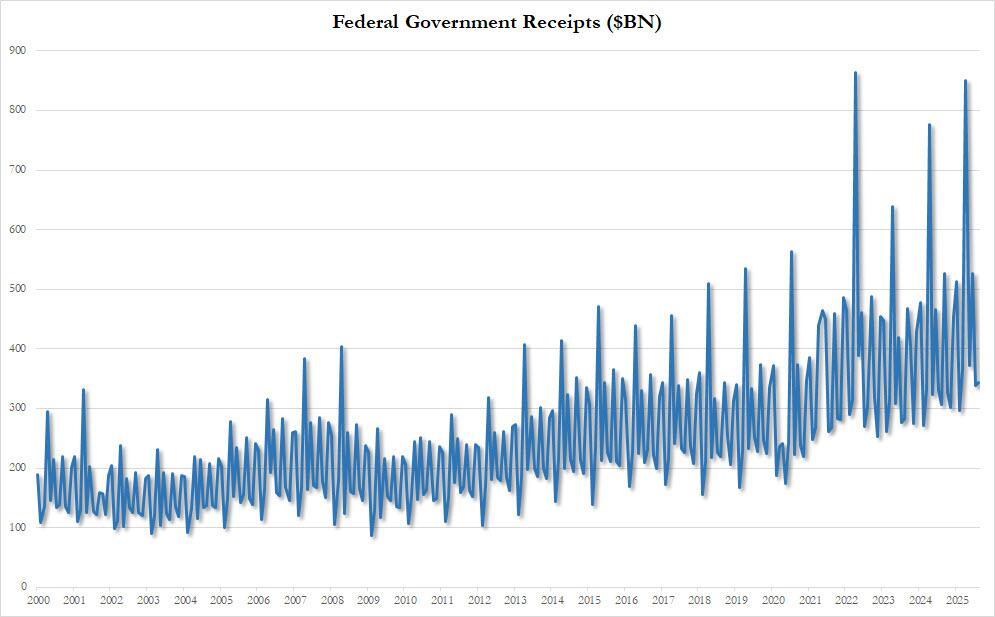
March tax receipts totaled $385 billion, up $17 billion or 4.7% from March 2025...

... which translated into $413 billion on a 6 month moving average basis, roughly where it has been for the past few years.

Outlays totaled $549 billion, up $21 billion, or 3.9% higher from a year earlier.

Unlike tax revenues, outlays were at the high end of the 6 month moving average, at just over $608 billion.

One can see how the moving averages between revenue and spending diverge in the chart below.

On a cumulative basis, six months into fiscal 2026 (which ends in September), the US budget deficit was $1.169 trillion, down about 11% from the $1.307 trillion accrued through this point in 2025. Aside from the crisis 2021 year, this was the third biggest cumulative budget deficit in US history half-way into the fiscal year.

Another way of visualizing the deficit, here it is broken down by main sources of revenue and outlays.

Customs duty collections softened in the month following the US Supreme Court's annulment of President Donald Trump's broadest global tariffs imposed under an emergency law. Customs receipts totaled $22.2 billion in March, down from $26.6 billion in February and monthly totals in the low $30 billion range late last year, but up from $8.2 billion in March 2025.

The drop in tariff collections is seen clearly on the next chart.

Now that bad news: the March total was an accounting gimmick. After accounting for calendar-related adjustments of benefit payments, the March deficit would have been $250 billion, substantially higher than the year ago number.
Worse, the monthly budget data did not show a major increase in spending on the Iran war, with military and defense program outlays rising just $2 billion or 3% to $65 billion during the conflict's first month. That means that the April (and onward) deficits will be sharply higher on the billions in war spending that will now have to go through the US income (technically loss) statement.
Putting it all together, the big picture emerges, one where outlays on most categories continues to rise - certainly defense, social security and health - but as a result of the drop in rates in the past 1.5 years, the gross interest expense on US debt has been relatively flat in 2026, and in March it was $1.26 trillion, or where it started the year.

Still, at $1.3 trillion in gross interest expense, the amount of money the US spends on debt interest is now remains the 2nd highest spending category and will likely surpass Social Security spending, at just over $1.6 trillion, should either rates go up again or once total US debt surges as it certainly will in the next recession.
Finally, while total deficit may be lower than it was in the prior year, it is probably safe to say that gross interest will keep rising every year until the end: indeed, as shown below, at $623 billion for the first six months of fiscal 2025, cumulative gross interest was 7% higher than the $582 billion for the same period in 2025.
