Authored by Milan Adams via preppgroup.home.blog,
There’s a strange kind of comfort people have when they think about disaster. Not the dramatic kind you see in movies, but something quieter, almost subconscious—the belief that if something really bad were to happen, there would still be time to react. Time to think. Time to leave. Time to make the right decisions.

The problem is, history doesn’t really support that idea.
When things begin to fail on a large scale, they don’t do it in a clean or predictable way. Systems don’t politely warn you before they collapse. They stall, they glitch, they slow down—and then suddenly, they stop. And in that moment, when what people assumed was permanent turns out to be fragile, the real danger begins. Not from the disaster itself, but from the reaction to it.
People don’t like uncertainty. And when uncertainty turns into fear, fear turns into something much harder to control.
Most conversations about collapse focus on causes. People argue about what would trigger it—a massive cyberattack, a coordinated terrorist event, an EMP that wipes out electronics, or an economic crash that spreads faster than anyone can contain it. All of those are possible, in their own way. But they all share one thing in common: they don’t need to destroy everything to create chaos. They only need to disrupt enough of the system for people to realize that normal life isn’t coming back anytime soon.
And when that realization spreads, it spreads faster in some places than others.
The uncomfortable truth is that the places most people feel safest today—the big, powerful, resource-rich cities—are often the ones that would deteriorate the fastest. Not because they’re weak, but because they are so heavily dependent on constant flow. Food, energy, transportation, law enforcement, communication—everything has to keep moving. And when it doesn’t, even briefly, the cracks start to show.
At first, it looks manageable. Maybe a power outage. Maybe empty shelves in a few stores. Maybe delayed services. Nothing that feels like the end of the world. But then the pattern becomes harder to ignore. Supplies don’t come back. Information becomes inconsistent. People start noticing the same small problems everywhere they go. And slowly, quietly, a kind of tension builds in the background.
It’s not panic yet. Not openly. But it’s there.
And once it reaches a certain point, it doesn’t stay contained.
That’s when the environment around you starts to matter more than anything else.
Because not all places break the same way.
Some collapse quickly, almost violently, as if the system holding them together was under pressure for too long. Others decay more slowly, stretching the crisis out over days or weeks until people wear down mentally and emotionally. But the outcome tends to be the same: resources become scarce, movement becomes difficult, and trust between people starts to erode.
When that happens, the difference between a survivable situation and a dangerous one often comes down to location.
Population density plays a bigger role than most people realize. In highly concentrated areas, everything accelerates—shortages, frustration, conflict. A grocery store that might serve a small town for weeks can be emptied in hours in a major city. Roads that seem efficient under normal conditions become completely unusable when everyone tries to leave at the same time. Even basic services, like access to clean water or medical care, can become limited far faster than expected.
But density isn’t the only factor. There are other, less obvious risks that tend to overlap in the worst possible places: dependence on external supply chains, limited natural resources, high living costs that leave people with little financial buffer, strict regulations that limit self-defense, and geography that works against you rather than for you.
When several of these factors exist in the same place, the result is something that looks stable on the surface—but is extremely vulnerable underneath.
And there are a few places in the United States where that vulnerability is hard to ignore.
1. New York City, New York — A System That Can’t Afford to Stop

New York City has always had a kind of energy that’s difficult to describe unless you’ve experienced it. Everything moves quickly, constantly, almost as if the city itself doesn’t really rest. There’s an underlying assumption built into that rhythm—that things will keep working, that the systems behind the scenes will continue to function no matter how much pressure they’re under.
But that assumption is exactly what makes the city so fragile in a crisis.
New York doesn’t produce what it consumes. It relies almost entirely on continuous inflow—food shipments arriving daily, fuel being transported in, goods moving through a tightly coordinated network that leaves very little room for disruption. Under normal conditions, that system works so efficiently that most people never think about it. But in a collapse scenario, efficiency becomes a liability.
If those supply lines are interrupted, even briefly, the effects would be immediate. Not catastrophic at first—just noticeable. Stores would still have food, but less of it. Certain items would disappear faster than others. People would begin to buy more than usual, not necessarily out of panic, but out of instinct. That instinct alone would accelerate the problem.
Within a very short period of time, the situation would shift from inconvenience to scarcity.
And scarcity changes behavior.
* * * Ahem...

In a city as densely populated as New York, even a small imbalance between supply and demand becomes amplified. There are simply too many people relying on too little space, too few resources, and too many assumptions about how things are supposed to work. When those assumptions break down, the psychological impact can be just as dangerous as the physical one.
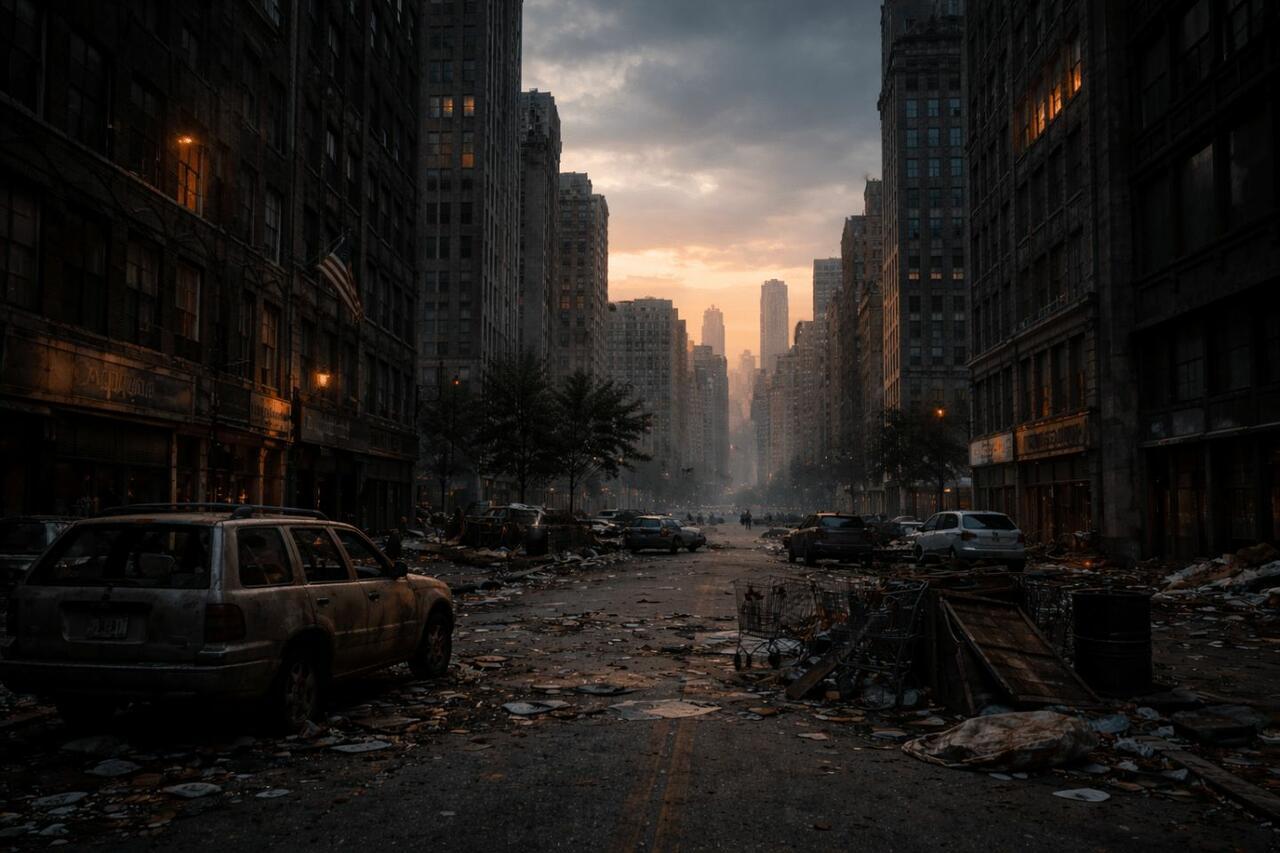
Another factor that often gets overlooked is movement—or more accurately, the lack of it. People tend to believe that if things get bad, they can just leave. It’s a comforting idea, but in a place like New York, it’s not realistic. The city’s layout doesn’t allow for easy evacuation under pressure. Bridges and tunnels act as bottlenecks, and highways leading out can become congested within hours, if not sooner.
Once traffic stops moving, it doesn’t gradually improve—it locks in place. Cars become obstacles instead of transportation. And when people start abandoning them, the situation becomes even more chaotic. Movement shifts from organized to unpredictable, with thousands of individuals trying to find their own way out at the same time.
At that point, the city changes in a way that’s difficult to reverse.
It becomes quieter, but not in a peaceful sense. The usual background noise—traffic, conversation, music—fades, replaced by something more irregular and harder to interpret. Distant sounds carry further. Small disturbances feel larger. And the sense of anonymity that normally defines the city begins to disappear, replaced by a heightened awareness of everyone around you.
That’s often when the real tension begins.
Because once people understand that the system isn’t coming back quickly, priorities shift. Survival becomes more immediate, more personal. And in a place where millions of people are facing the same realization at the same time, even small conflicts can escalate faster than expected.
New York doesn’t need a catastrophic event to become dangerous. It only needs a disruption that lasts long enough for people to lose confidence in the system.
And once that confidence is gone, it’s very difficult to restore.
2. Los Angeles, California — Distance Becomes a Problem

If New York’s vulnerability comes from density, Los Angeles presents a different kind of risk—one that isn’t immediately obvious because it’s spread out over a much larger area. At first glance, that might seem like an advantage. More space, more routes, more options. But in reality, that distance is exactly what makes the city difficult to navigate in a crisis.
Los Angeles is built around movement. Not just casually, but fundamentally. Daily life depends on the ability to travel—often long distances—between home, work, and essential services. Without reliable transportation, the city doesn’t function the way it’s supposed to. It fragments.
In a collapse scenario, that fragmentation would happen quickly.
Fuel shortages alone would be enough to disrupt the entire system. Even before fuel runs out completely, the perception that it might become scarce would trigger a rush. Long lines at gas stations would form almost immediately, and within a short time, availability would become inconsistent. Some areas might still have access, while others would not, creating uneven conditions across the city.
That unevenness is where problems begin to grow.
Because when people don’t have equal access to resources, tension increases—not just between individuals, but between different parts of the same city. Movement becomes restricted, not by official barriers, but by practical limitations. And when people can’t move freely, their options start to narrow.
Water is another critical factor that adds pressure to the situation. Los Angeles depends heavily on imported water, transported from distant sources through a complex infrastructure system. If that system is disrupted, even partially, the consequences wouldn’t be immediate collapse—but a steady, escalating problem that becomes harder to manage over time.
Unlike food, which people might ration early, water tends to become urgent more quickly. And once access becomes uncertain, behavior shifts in a way that’s difficult to control.
What makes Los Angeles particularly concerning in a long-term scenario is the way time works against it. The city doesn’t necessarily break all at once. Instead, it deteriorates in stages. At first, people adapt. They adjust routines, conserve resources, find temporary solutions. But as the situation continues without resolution, those adjustments become harder to maintain.
Fatigue sets in.
And fatigue changes how people think.
Decisions become shorter-term, more reactive. Patience decreases. Cooperation becomes less reliable. And as more people reach that point, the overall stability of the environment begins to decline.
By the time the situation becomes openly dangerous, it often feels like it happened gradually—even though the underlying causes were present from the beginning.
Los Angeles doesn’t collapse in a dramatic way.
It wears down.
And by the time people realize how serious the situation has become, many of the options they thought they had are already gone.
If the first places on this list feel dangerous because of people, the next ones are different in a way that’s harder to ignore. Here, it’s not just density or infrastructure that works against you, but the environment itself—geography, climate, and the kind of risks that don’t wait for society to weaken before they become a problem. In these places, even in normal times, there’s already a quiet tension beneath the surface, a sense that things are being held together with more effort than most people realize.
And when that effort disappears, the situation doesn’t just become unstable—it becomes unforgiving.
3. New Orleans, Louisiana — A City That Can Disappear Overnight

There’s something about New Orleans that feels different even on a normal day. It’s not just the culture or the history, but the awareness—subtle, almost unspoken—that the city exists in a place where it probably shouldn’t. Much of it sits below sea level, protected not by natural elevation, but by systems that have to work perfectly to keep everything in place. Levees, pumps, barriers—structures that hold back something much stronger than themselves.
And as long as those systems function, life goes on.
But in a collapse scenario, the assumption that those systems will keep working becomes a risk in itself.
Unlike other cities where failure unfolds gradually, New Orleans carries the possibility of sudden, overwhelming change. A major storm doesn’t need much warning, and without reliable infrastructure or coordinated response, even a manageable event can escalate into something far more destructive. Water doesn’t negotiate. It doesn’t slow down out of consideration. When it comes in, it takes space immediately and completely.
What makes the situation more unsettling is how quickly familiar surroundings can become unrecognizable. Streets turn into channels, neighborhoods into isolated pockets, and movement becomes not just difficult, but dangerous. Even small changes in water levels can cut off entire areas, making escape routes unreliable or nonexistent.
In a functioning society, emergency services, coordinated evacuations, and resource distribution help manage these risks. But without that structure, individuals are left to navigate conditions that are constantly changing and increasingly hostile. The difference between a safe area and a dangerous one can shift in hours, sometimes minutes.
There’s also a psychological factor that often goes unnoticed until it’s too late. When people are surrounded by an environment that feels unstable, their sense of control begins to erode. Decisions become reactive rather than planned, and the margin for error becomes smaller with each passing hour. In a place like New Orleans, where the line between stability and disaster is already thin, that loss of control accelerates everything.
It’s not just about surviving the initial event. It’s about what comes after—limited clean water, damaged infrastructure, reduced access to supplies, and an environment that doesn’t return to normal quickly, if at all. Recovery, even under ideal conditions, takes time. Without support, that time stretches into something much more uncertain.
New Orleans isn’t just vulnerable.
It’s exposed.
4. San Francisco, California — When the Ground Itself Isn’t Stable

San Francisco presents a different kind of unease, one that doesn’t come from water or distance, but from something far less predictable. The ground beneath the city isn’t as stable as it appears, and that fact alone changes how you have to think about long-term safety. Earthquakes aren’t constant, but they don’t need to be. The possibility is always there, quiet and invisible, waiting for the right conditions.
In everyday life, it’s easy to ignore that risk. Buildings stand, roads function, and the city moves with its usual rhythm. But in a collapse scenario, the ability to respond to a major seismic event becomes severely limited. Infrastructure that might otherwise be repaired quickly remains damaged. Services that would normally be restored in hours or days stay offline indefinitely.
And when that happens, the city doesn’t just pause—it fractures.
San Francisco’s layout adds another layer of complexity. It’s a dense urban environment built on uneven terrain, with limited space and a high dependence on external resources. There’s very little room for expansion, very little flexibility in how the city can adapt under pressure. When systems fail, there aren’t many alternatives.
A significant earthquake in an already unstable situation wouldn’t just cause physical damage. It would disrupt everything that people rely on to maintain order—transportation, communication, access to basic necessities. Roads could become impassable, not just from debris, but from structural instability. Bridges, which connect the city to surrounding areas, could become unusable, effectively isolating large portions of the population.
Isolation, in that context, becomes more than just an inconvenience.
It becomes a serious risk.
Another factor that makes San Francisco particularly challenging is its cost of living. In normal times, that translates into economic pressure. In a collapse scenario, it means many people have fewer reserves—less stored food, fewer backup resources, less margin for unexpected disruption. When the system fails, there isn’t much of a buffer.
And then there’s the atmosphere itself. San Francisco often feels enclosed, not in a physical sense, but in a psychological one. The combination of dense development, surrounding water, and limited escape routes creates a subtle sense of containment. In normal conditions, it’s part of the city’s character. But in a crisis, that same feeling can become something else entirely.
Something more restrictive.
Because when movement becomes limited and the environment becomes unpredictable, the sense of being able to leave—of having options—starts to disappear.
And once that happens, people begin to act differently.
San Francisco doesn’t just face the risk of collapse.
It faces the risk of being cut off in the middle of it.
By the time you get to this point, a pattern starts to form. Not the kind that’s obvious at first glance, but something deeper—the realization that collapse doesn’t look the same everywhere, yet it always leads to the same kind of silence. Not peace, not calm… just the absence of what used to be normal.
And sometimes, the most unsettling places aren’t the ones that fall apart suddenly, but the ones that already feel like they’re halfway there.
5. Detroit, Michigan — When Collapse Isn’t Sudden… It’s Familiar

Detroit is different from the other places on this list in a way that’s difficult to ignore once you think about it long enough. It doesn’t rely on a single point of failure, or one overwhelming risk that could trigger everything at once. Instead, it carries something slower, something that has already been unfolding for years—a gradual weakening of systems, a steady loss of structure, a kind of quiet erosion that doesn’t attract attention until it becomes impossible to reverse.
In some areas, that process is already visible. Entire neighborhoods that feel disconnected from the rest of the city, buildings left empty long enough that they no longer look temporary, streets where movement is limited not because of traffic, but because there’s simply less reason for people to be there. It creates an atmosphere that’s hard to describe unless you’ve experienced it directly—something between absence and tension, as if the space itself remembers what used to exist there.
And that’s what makes Detroit unsettling in a collapse scenario.
Because when something is already weakened, it doesn’t take much to push it further.
Unlike cities that depend heavily on constant inflow, Detroit’s risks are tied more to what’s already missing. Economic instability, reduced infrastructure in certain areas, and a long-standing struggle to maintain consistency across the city create conditions where recovery is already uneven. In a full-scale collapse, that unevenness becomes more pronounced.
Some areas might hold together for a while. Others might deteriorate quickly.
And the gap between them becomes harder to navigate.
There’s also a psychological weight that comes with being in a place where decline isn’t entirely new. People adapt to difficult conditions over time, but that adaptation can work both ways. It can build resilience, but it can also normalize instability. When the line between “temporary problem” and “permanent change” has already blurred, it becomes harder to recognize when a situation has crossed into something more serious.
In Detroit, a collapse wouldn’t necessarily feel like a sudden break.
It would feel like a continuation.
A deepening of something that was already there.
And in some ways, that’s more dangerous than a rapid collapse, because it doesn’t trigger immediate action. It doesn’t create a clear moment where people decide to leave or change course. It lingers, stretches, and slowly removes options until there are very few left.
By the time it becomes undeniable, it’s often too late to react effectively.
Final Thoughts — The Places You Choose Matter More Than You Think
There’s a common idea that survival in a collapse scenario depends mostly on preparation—having supplies, having a plan, knowing what to do when things go wrong. And while all of that matters, it overlooks something more fundamental.
Where you are when it begins matters just as much, if not more.
Because no amount of preparation fully compensates for being in the wrong environment.
What all of these places have in common isn’t just risk. It’s dependency—on systems, on infrastructure, on conditions that have to remain stable for everything else to function. When those conditions disappear, the transition isn’t smooth. It’s abrupt, uneven, and often unpredictable.
New York shows how quickly density can turn pressure into chaos, how a system that feels powerful can become fragile the moment it stops moving. Los Angeles reveals how distance and dependency can isolate people, turning space into a barrier rather than an advantage. New Orleans stands as a reminder that nature doesn’t need permission to take over, and that some places exist on borrowed stability. San Francisco highlights how invisible risks—like the ground beneath your feet—can become decisive when there’s no capacity to respond. And Detroit, in its own way, demonstrates that collapse doesn’t always arrive suddenly. Sometimes, it’s already there, waiting to deepen.
The unsettling part is that none of these places feel dangerous in everyday life.
That’s what makes them so easy to overlook.
Because collapse doesn’t announce itself clearly. It doesn’t give you a perfect moment to act. It begins quietly, spreads unevenly, and only becomes obvious when enough has already changed that going back isn’t simple anymore.
And by then, your options are limited by where you started.
That doesn’t mean the situation is hopeless. It just means that awareness matters more than comfort, and realism matters more than assumption. The idea isn’t to live in fear, but to understand how different environments respond under pressure, and to think about what that means before it becomes necessary.
Because when everything else becomes uncertain, the one thing you can’t easily change… is your location.
And sometimes, that’s the difference between adapting to a situation—and being trapped inside it.