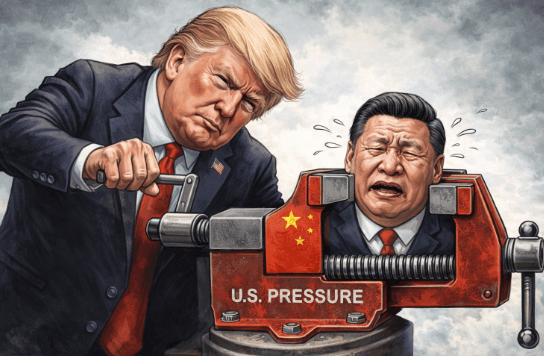
President Trump's four-and-a-half-month crusade across the Western Hemisphere, and now into the Middle East, increasingly looks like a massive blitz to acquire - or control - energy assets and maritime chokepoints as part of a broader economic pressure campaign against China, which depends heavily on the Gulf and Venezuelan crude.
"Chokepoint after chokepoint: the administration is methodically building a portfolio of assets that they are stacking against China: the Panama Canal, which is the only exit route for oil and gas from the Gulf of Mexico to China; Venezuela and her oil that used to go to China; Kharg Island and Iran's oil which used to go to China, and SoH through which Iran's and all Arab countries' oil used to go everywhere but mostly to China," Zoltan Pozsar of advisory firm Ex Uno Plures wrote in a March note.

Pozsar's view is important because, when placed alongside Chinese President Xi Jinping's comments earlier today that the world is slipping into "disarray," the larger picture comes into sharp focus.
"The international order is crumbling into disarray," Xi told Spanish Prime Minister Pedro Sánchez in Beijing. He used a Chinese expression indicating not only chaos but also moral decay.
What Xi calls disorder increasingly looks like the unwinding of the global order that allowed China to roam freely across markets, resources, and trade corridors for years. In the Trump era, that ability appears to have been systematically dismantled - to some degree - in just four months.
Xi's comments are his first public statements on the US-Iran conflict, as new economic data overnight show the conflict took a sharp toll on Chinese exports in March.
China has criticized Trump's military action against Iran and called the US naval blockade of the Strait of Hormuz "dangerous and irresponsible," while warning it could respond if Washington links the conflict to a new round of tariffs on Chinese exports.
For more context, about half of China's crude imports came from the Gulf/Middle East before the war disruption. Reuters reported the region accounted for 52% of China's oil imports. That share recently fell to 31% as Hormuz-related disruptions forced China to replace crude supplies with imports from Brazil and Russia.
Pozsar noted: "Again, the game is not to control Venezuela and Iran to choke China…"
And you might ask why Trump is squeezing China. Well, as Pozsar pointed out, "The aim is not to deny energy to China. The aim is to level the playing field between the two countries. To be blunt, in ways I couldn't be at Credit Suisse: if you fuck me on rare earths, I fuck you on energy."
President Trump has previously said his meeting with Xi in Beijing was pushed to May because of the conflict. The question now is whether Washington and Beijing can still strike a deal.