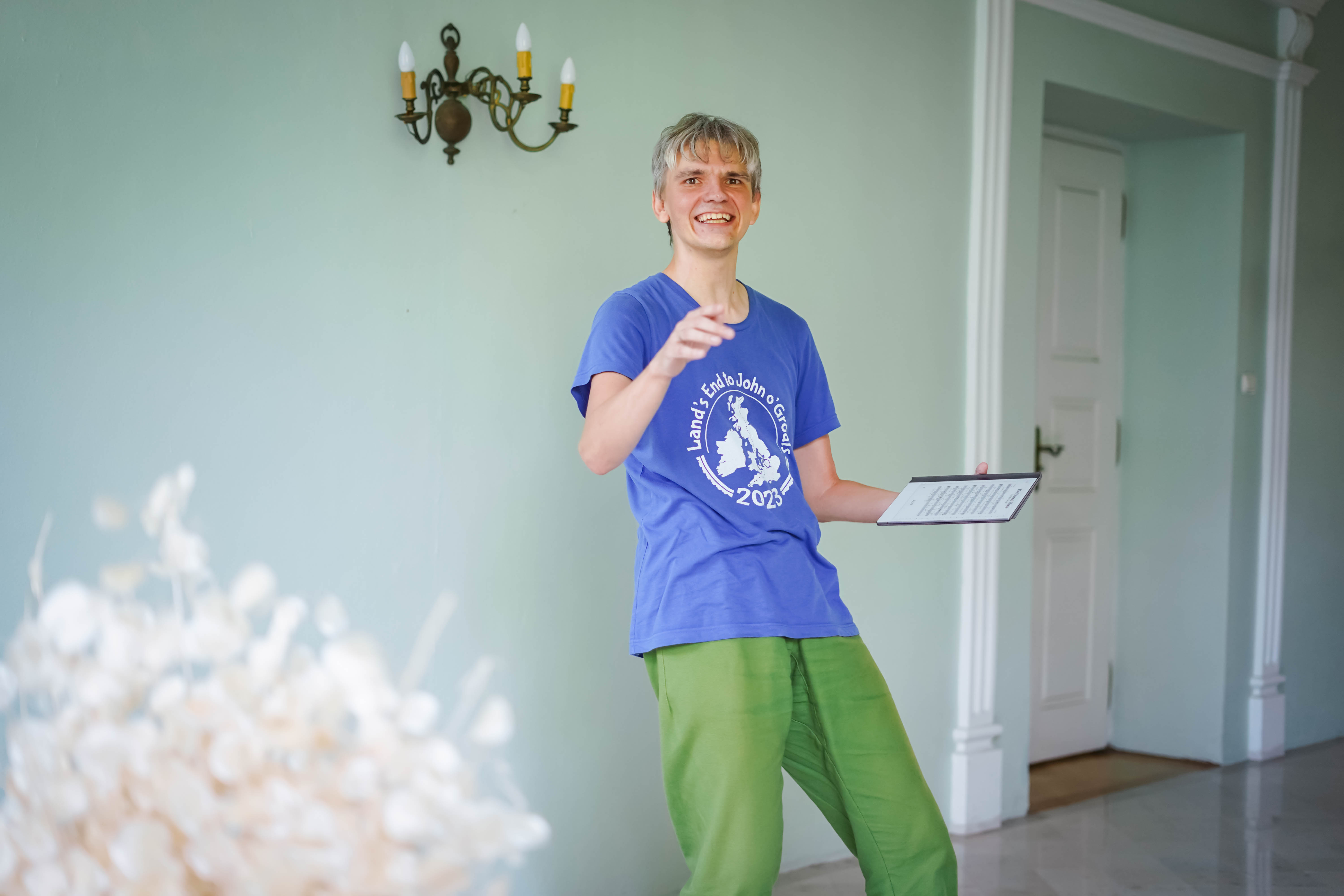
This is a story of a most unexpected journey — one that is just starting. If somebody had told me four years ago that I’d be writing this today, I would have stared at them in astonishment or laughed dismissedly. Yet here I am, writing about a late-found hobby that has somehow become a very important part of my life.
It almost feels like making a confession. Deep breath. Okay, here we go:
In 2022, at the age of 38, I’ve picked up singing.
Background
I’ve always viewed people who could “do music” — whether singing or playing an instrument — with reverent admiration. They were born, I felt, gifted in a way that I was not: with a talent to produce beautiful things out of sound. Seen from outside, this seemed like arcane magic: a world that I can admire, but having a border I cannot transgress.
Sure, I liked listening to music. Like almost everybody else, I have acquired a musical taste over time, and I find enjoyment in experiencing music that is to my taste. I’ve long found myself humming along to songs I know and like. I would sometimes sing in the shower, when I knew nobody was listening. In short, I was an everyman.
But to actually sing, you know, out loud, with all of myself? In front of people?
And then things happened.
Twist of fate
It started with someone falling off a horse.
Not me, and, fortunately, it didn’t result in any severe long-term health problems. But there were fractures, and they did force my wife’s friend to look for another pastime; something she could do while letting her body recover. Singing seemed like a safe option.
Some time later, out of the blue, my wife, Anna, received a call: “hey, wanna join me on a 3-day singing retreat next week?” Hesitatingly, she accepted. After the workshop, she returned happy and rejuvenated, and reported having a lot of fun. From then on, she started having regular lessons with Olga, an opera singer and teacher, one of the organisers of that event.
I was happy for Anna, but the idea it might be something for me still hadn’t crossed my mind. A few more months passed. Anna was invited to take part in a concert of Christmas carols performed by Olga’s students. “A Christmas concert of singing-lovers, with the audience taking part,” read the headline. I went there to support Anna from the audience, not paying much attention to the “taking part.”
I had a great time. This was not your ordinary concert: it had an informal vibe to it, one of a social gathering in the village hall. The border between performers and audience was really blurred. There were lyrics available at every seat so people could sing along if they felt like it. Most importantly, there was a heartfelt, welcoming atmosphere of acceptance. It was then that I first thought: why don’t I try?
I booked my first lesson with Olga some time later, and we continue to see each other weekly to this day. I might have dropped off if it weren’t for…
Euphorism
You might not be familiar with this term — to the best of my knowledge, it is Eliza’s invention. (Eliza is Olga’s colleague, another opera singer turned mentor, and a co-organiser of that summer retreat I mentioned.)
It is perhaps more instructive to understand euphorism through the lens of what it is not. In traditional musical education in Poland, I’m told, much emphasis is placed on perfecting technique through drills. These are forced onto people without taking their needs into account; pervasive evaluation abounds. You are supposed to do things well, at all times, and punished for doing them badly. The system produces a lot of people with perfect technique who are deeply unhappy and hate what they do.
Euphorism rejects that. It is a system of values based on love and creativity; it is the radical notion that you have a voice, that your voice matters, and that there’s room for you to express yourself through your voice. It is an approach to connecting with yourself that reaches far beyond voice.
This resonates deeply with me. I realised I was picturing myself as having “no voice”, being “always out of tune”, and having a “wooden ear”. Someone might have told me these things a long time ago, or it might have been my inner impostor. Words like these can silence a human being for ages!
Mind you, it’s not that the euphoristic approach rejects technique altogether. On the contrary, it is practiced a lot! But it’s viewed as a means to an end — a byproduct of the journey of radical acceptance — rather than as an end in itself.
By a strange twist of fate, I found myself surrounded by people embracing that acceptance. It’s a good place to be in, and I am grateful that I can be here.
Unexpected discoveries
There are many. I don’t want these to come off as absolute truths; rather, these are my personal impressions. Postcards from a journey, if you will.
I love singing.
Singing is one of the most immersive, flow-inducing activities that I know of. When I sing, I become barely aware of the world around me; it almost vanishes. The only existing thing is my body and what it’s about to express. Writing or programming sometimes induce a similar state of mind, but I’m not aware of any other activity, except maybe sex, that triggers it this reliably.
Singing induces energy. I’ve had a lifelong struggle of being low on energy (partially explained by the belated diagnosis of ADHD), and the immersiveness does good things to the dopamine flow in my brain. In 2024, I accompanied Anna to another edition of the summer singing retreat, by now extended to four days; I started tired and returned bustling with energy and enthusiasm like I almost never do. Four days! It felt like an equivalent of two weeks, maybe more, of my usual Canarian holiday.
These days, I look forward to my lessons with anticipation. They’re a highlight of the week.

I’m making progress! I remember how much I struggled with the first song I’ve tried to practice (Leonard Cohen’s “Take This Waltz”). We put it aside for some time, on grounds of it being a bit too difficult for me. Now I can sing it comfortably.
My vocal range has widened, too. When I was starting, it was maybe an octave and a half. Now I can reliably sing between F♯2 and D4, and sometimes manage to stretch this a bit from either end (with falsetto I can go to E5 but this register remains almost completely unexplored).
I started paying more attention to nuances of seemingly well-known songs, discovering small details I wasn’t aware of before. A semitone here, subtle variations of rhythm there… I can notice them if I look closely enough. The “wooden ear” accusation was not true, after all!
It turned out that the variables “I like the song” and “I feel comfortable singing it” almost don’t correlate. This made me appreciate some songs I had hitherto dismissed as “just another radio tune” or “hear-and-forget”. “Careless Whisper” comes to mind.
I don’t know how Olga does it, but she often comes up with visual/spatial metaphors that suddenly make things click for me. “Imagine you’re a frog on a lily pond, and you need to jump to the next leaf.” Or, “Don’t try to sing upwards; sing to the front.” On multiple occasions I heard myself produce some sound and was like, “wait, did I just sing this?!”
Being in tune is important, but it is nowhere as important as I had originally thought. I no longer let this worry eat me or make me forget about the joy; I allow myself to err. Plus, it’s not all created equal: some places are critical, but oftentimes it doesn’t matter all that much if you’re a minor third off. Music is forgiving!
I’ve taken to karaoke parties. There’s something primordial in social singing, and, to me, karaoke epitomises that feeling of primordiality. It’s also a celebration of imperfection, and in fact, I’m not a great fan of venues where people sing too well: at one point it ceases to be about having fun and starts being about showing off. I enjoy informal atmosphere with uneven distribution of skill. If someone sings well, they’re a pleasure to listen to. If they struggle, I admire them for trying anyway.
It’s sometimes difficult to find sheet music. Songbooks are hard to come by; MuseScore and MusicNotes are great, but some of the more obscure stuff just isn’t there. Lifehack: you can email the artists directly, and more often than not, they will be super eager to help out if you mention you’re learning to sing! This is how I got hold of the score to Julia Ecklar’s “God Wrote in Lisp”, for example. (Thanks Julia and Eli!)
The end
On the contrary, it’s only the beginning of my adventure. I certainly hope so.
I’m not going to say that “you should try it”, because I loathe telling people what they should or should not do. Instead, I hope this is an inspiration to someone. Neuroplasticity may degrade over time, but it never completely wears off; consequently, it’s never too late to start learning. It’s great to be a beginner, and it’s great to find enjoyment in imperfection.
I can’t help finishing with an excerpt from the hymn that I borrowed the title from.
My life flows on in endless song;
Above earth’s lamentation,
I catch the sweet, tho’ far-off hymn
That hails a new creation;
Thro’ all the tumult and the strife
I hear the music ringing;
It finds an echo in my soul—
How can I keep from singing?