Now that we have actually good AI, I have this vision of a form of computing that doesn’t involve me using a computer so much. Imagine you had the day’s emails to go through. It would be nice if the ones that required a simple decision could be dispatched with a few pen-strokes: I could write down a date that would work for that meeting; check a box to accept that invitation; etc. If an email required me to review a draft, I'd love to mark up a print version on my couch, sans screen, and have those notes scanned and sent off as if I'd done the whole thing on Google Docs.
The point is not to give up on virtuality, but just to save the end user from having to interact with it. It's great to be able to send information to anyone in the world instantly; but let me do it without the glaring screen and the thousand distractions. Is such a thing even possible? I'm not sure, but I just now uploaded a first draft of this post, handwritten in a small notebook, into ChatGPT. Its transcription was nearly perfect.
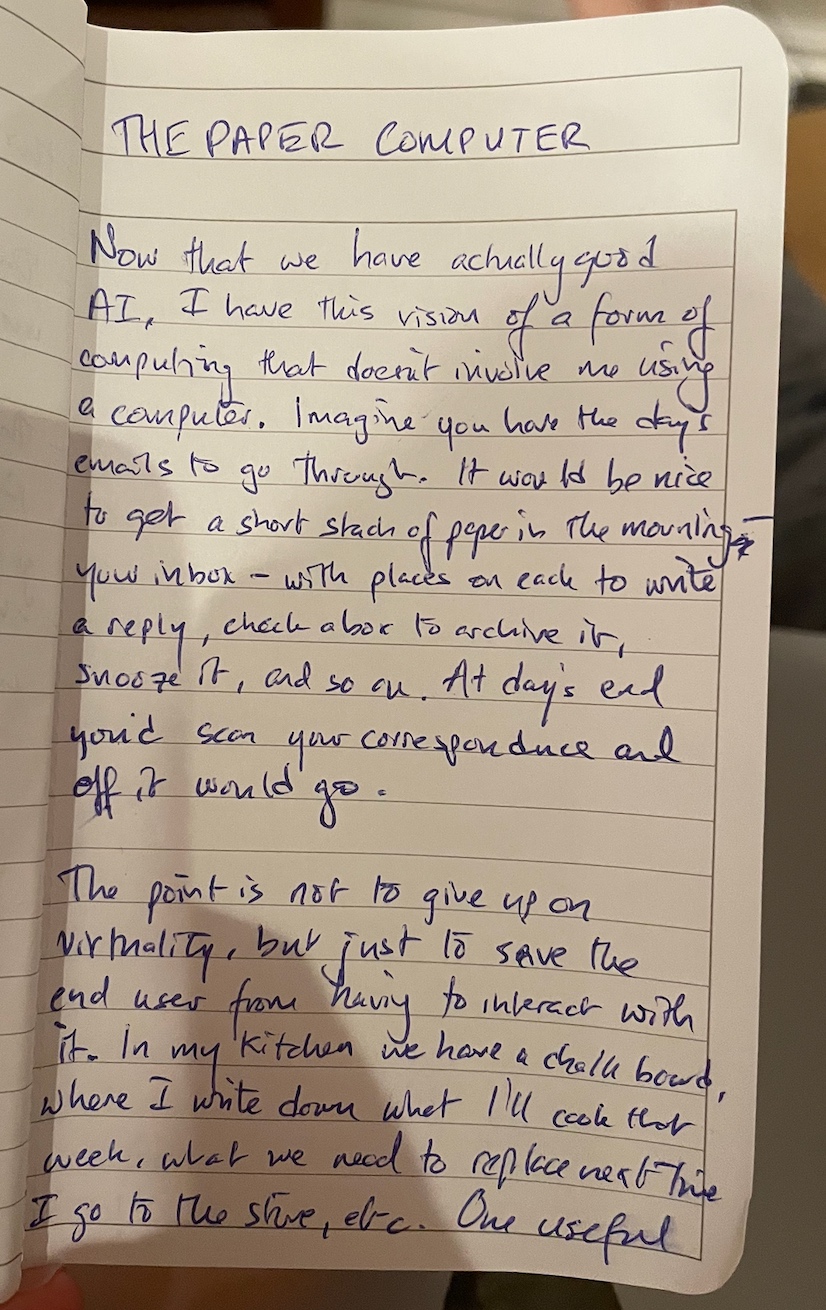
A first draft of this blog post
Here's another example: when I really want to play with re-arrangements of a complicated outline, or when I want to collaborate with someone else on one, I find myself laying physical note cards on a table. Having real objects to work with allows for more flexibility than software. If the problem demands it, you can stack cards, draw on them, cut them, tape things to them, etc.—and none of these improvised ways of organizing has to be coded up in advance.
Space turns out to be a good way to organize information. I gather that in the paper days if you had a big project you were working on, say a book, it would spill out into the room you were working in: chapter outlines pinned up on the walls, stacks of books in meaningful piles on the floors, folders with drafts and clippings. Certain sections of the work in progress would become associated in your mind with certain parts of the room. Chapter 3 would be over there.
I rarely use paper or physical space this way because it lacks critical conveniences. A huge wall-mounted paper calendar is maybe the best way to plan and visualize a large coordinated effort. (In "making-of" documentaries you find that movie shoots are often planned this way.) Everyone can see it and point to it because it's at human-scale; you can express many dimensions of information simultaneously using shape, color, position, size, and any other physical attribute. But I have a hard time understanding how I'd keep such a calendar up to date. In practice, like almost everyone else, I use a virtual calendar that automatically adds events as I'm invited to them, syncs with other people's calendars, reconciles time zones effortlessly, and interoperates with other programs like email.
Could we get the best of both worlds? In other words, shouldn't one goal of rapid technical advancement be some melding of the physical and virtual worlds such that I can sit quietly in an easy chair with pen and pad; or lay cards out on a table to organize my thoughts; or turn a room into the embodiment of a project; and yet have the same flexibility, portability, persistence, and remixability as in the digital versions of these things?
I spend a lot of my day on screens. There are many problems with these things, articulated well by Bret Victor in the context of his Dynamicland project. Screens are small, antisocial, and they have a tiny vocabulary of affordances compared to physical objects. Plus they have the problem that they make it difficult to just use your calendar, todo list, or map—or even just respond to a friend's message—without encountering something else along the way, like a social network, short-form video, Slack, the news, or some other notification. To state the obvious: your phone is the best place to keep your calendar and inbox and todo list because you always have it with you, but of course that makes it ripe for other intruders. Bundling makes your phone indispensable, but also a menace.
If nothing else I'd like it if operating systems and web browsers helped me be less distracted and frenetic, instead of encouraging exactly that multi-tasking freneticism. When I opened my phone or computer, it'd be nice if it was constrained to operate in a mode purpose-built for whatever task I intended to use it for. If I want to look something up, for instance, my phone should be a look-up machine (ie no texts, no apps, no ads, just a place for my question and the answer). If I want to compose a word of the day entry, I should launch straight into a browser with the tabs I regularly use for that, including the CRM, Webster's dictionary, and the OED; if I want to work on an article, my computer should assume the form of a typewriter, word processor, or McPhee mode note-processor depending on what stage I'm at. In each of these modes everything else should disappear, inaccessible. At least then you could mimic in software that thing you get from physical objects—which is that they are usually built to do one, and only one, thing well. My alarm clock, for instance, is just an alarm clock; and that's what I like about it!
Not too long ago I spoke to a roboticist for an article I was writing, who worked with large autonomous earth-moving machines—e.g. a retrofitted excavator that could lift a boulder, scan its every edge and dimple, then model how it would settle amongst other boulders in a retaining wall before placing it there. He imagined a future in which such machines enabled a return to natural materials in the built world. He talked about old stone walls he’d seen in New England. Those walls, made of loose rocks found in situ, are lovely and sturdy, and adaptive—constantly rebuilt as farmers go about their work and notice areas that need patching up, adding stones they find lying around. But this is the very reason such walls aren't really built anymore. They're too labor-intensive. We live in a prefab world because the scarce thing now is not material or money but "the works and days of hands."
I am moved by the idea that our future could feel less futuristic than pastoral. High tech could save us from high tech. We'd go back to the old interfaces without giving up the conveniences of the new ones. Read, write, communicate, create—and hardly ever see or touch a screen.
I'm not sure that'll happen or be what people want. But shouldn't we be thinking of ways to use the new magic to spend less time tapping and clicking?