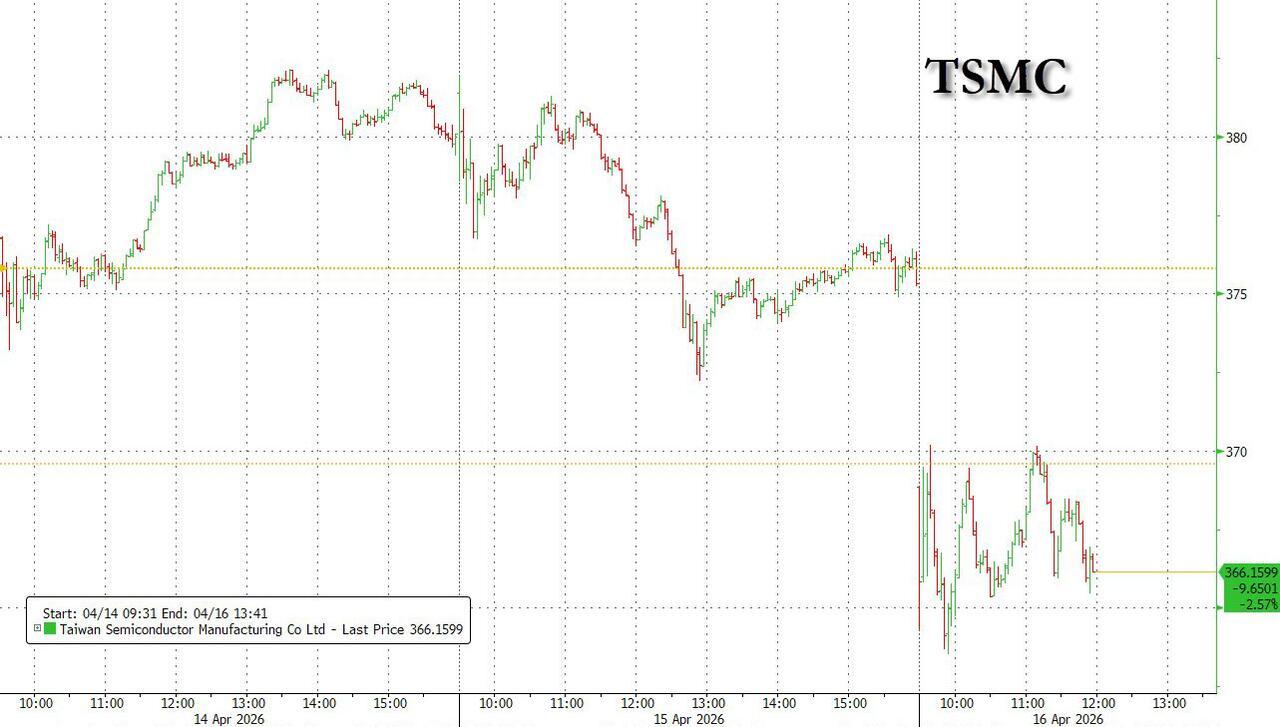
Taiwanese chip giant, Taiwan Semiconductor Manfuacturing Co, said Thursday its net profit surged to a fresh record in the first quarter, fueled by the global artificial intelligence race despite the war in the Middle East. Massive demand for AI hardware means business is booming for TSMC -- the biggest contract maker of microchips used in everything from Apple phones to Nvidia processors.
TSMC's net profit for the first three months of the year jumped 58.3% YoY to NT$572.5 billion ($18 billion), beating analyst estimates of NT$540.20 billion as governments and tech giants continue to pour huge sums into building data centers that can train and run AI tools such as chatbots, image generators and agents that can execute tasks. A weaker Taiwanese dollar had also boosted the firm's revenues from overseas sales: the company said net revenue rose 35.1% YoY to a record NT$1.13 trillion. Gross margin was 66.2% in the first quarter, further increased from a record 62.3% last quarter.
Here is the full Q1 breakdown:
- Sales NT$1.13 trillion, +35% y/y, estimate NT$1.12 trillion
- Net income NT$572.5 billion, +58% y/y, estimate NT$542.38 billion
- Gross margin 66.2% vs. 62.3% q/q, estimate 64.5%
- Operating profit NT$658.97 billion, +62% y/y, estimate NT$623.82 billion
- Operating margin 58.1% vs. 54% q/q, estimate 55.6%
While overall earnings were stellar, largely thanks to relentless AI chip demand, one weak point was smartphone revenue, which fell 11% compared to the previous quarter as the industry faces an ongoing memory shortage.
"The recent situation in the Middle East... brings further macroeconomic uncertainties, as such we are being prudent in our business planning," TSMC chairman CC Wei said. TSMC CFO Wendell Huang said the company did not expect the war to impact its supply of key chipmaking materials such as helium and hydrogen in the near term, despite mounting fears that the collapse in Qatar helium exports would wreak havoc on global chip production.
"We source from multiple suppliers in different regions, and we have prepared safety stock inventory on hand," Huang told an earnings call, adding that energy supplies were also sufficient to continue operations as normal for now.
TSMC said its revenue for the April-June quarter will reach another record of between $39 billion and $40.2 billion, which represents 32% year-over-year growth at the midpoint. Gross margin is expected to be between 65.5% to 67.5%. Commenting on the forecast, Bloomberg said that “TSMC’s 2Q gross-margin guide above 1Q’s record suggests rising chemical and gas costs tied to Middle East disruption aren’t enough to derail the company’s structural margin reset”
That said, TSMC warned the surging price of gas and chipmaking chemicals could weigh on the company's profitability and the global economy, while increasing component costs, including for memory chips, could affect the price-sensitive consumer market.
The results are in line with those of leading memory chipmakers, including Samsung Electronics, SK Hynix and Micron Technology, all of which have benefited from the global AI infrastructure boom. Samsung earlier this month flagged preliminary first-quarter operating profit surging 755% year on year, driven by an unprecedented memory shortage. Micron's gross margin reached 74% in the fiscal quarter ending February 2026 and is expected to rise further to around 81% in the current quarter, underscoring the strength of demand.
A note from UBS analysts had predicted strong quarterly results for TSMC but warned that consumer demand was weakening as a result of higher prices caused by a global memory chip shortage that is a side-effect of the AI boom. "Cloud AI demand continues to strengthen, but we think supply constraints will limit meaningful upside for TSMC this year," the UBS team said. "Middle East tensions add a layer of macro uncertainty, but AI spend should stay insulated, barring a protracted conflict."
TSMC's good news was bad news for PC manufacturers, who are facing a rare double-whammy: TSMC's foundry price hikes are converging with memory cost inflation, creating a cost squeeze that's already forcing retail price increases. The math is straightforward-chips cost more to make, and memory modules are pricier to buy-and the result is a fundamental upward pressure on every PC built.
TSMC's 2026 price adjustments target the advanced nodes that power premium laptops and desktops. The company notified clients that prices for sub-3nm processes will rise 3% to 10% starting January 1, 2026, with the exact increase depending on the node 3%-10% by node. TSMC currently sells 3nm wafers for approximately $20,000 each, and 2nm wafers will exceed $30,000 when mass production begins 3nm at ~$20,000, 2nm above $30,000. These are the chips that go into flagship devices, and the cost differential is material. For context, TSMC's Arizona facility, which is now producing 4nm chips, costs 5-20% more to operate than Taiwan-based manufacturing, a factor baked into the pricing strategy Arizona operations 5-20% more expensive.
The memory side of the equation is equally aggressive. DRAM and NAND flash prices have been climbing as suppliers tighten contract terms and inventories normalize. Asus, one of the world's largest PC vendors, responded in early January 2026 by implementing price increases of 15% to 20% on selected notebook and desktop models Asus price increases 15-20%. The company explicitly cited "RAM and storage cost pressure" as the driver, linking the shift directly to supplier pricing rather than logistics or labor Asus attributed increases to memory costs. Asus targeted specific consumer and commercial models-but the effect was immediate: Taiwan retailers began raising prices on competing brands' systems to preserve their own margins retailers raised prices on rival brands.
* * *
TSMC is also planning record capital spending of up to $56 billion in 2026, part of a broader push by Asia's chip industry that could total at least $136 billion. ASE Technology Holding, the world's largest chip-packaging and testing provider, updated its guidance and said investment this year will exceed earlier forecasts.
"We expect AI to continue fueling growth for TSMC despite weak non-AI demand," said Mark Li, veteran semiconductor analyst with Bernstein Research. "Fortunately for TSMC, we see no impact to its business as the capacity released by non-AI customers will be quickly filled by AI customers who could not find sufficient capacity before."
TSMC Chairman and CEO C.C. Wei also commented for the first time on Tesla and Intel's collaboration on Terafab advanced chipmaking facilities in the U.S. and on Intel's push into the contract chipmaking business and advanced chip packaging. Recently Elon Musk says his company is embarking on its own in-house chip business because capacity from its chip suppliers, including TSMC, Samsung and SK Hynix, is insufficient to meet its needs.
"Actually both Intel and Tesla are TSMC customers, but they are [also] our competitors. We view Intel as a formidable competitor, and do not underestimate them," Wei said. "But I will say that there are no shortcuts. The fundamental rule of the foundry never changes. We need technology, leadership, manufacturing excellence and customer trust, which has been mentioned by Jensen [Huang]" -- Wei said, thanking the Nvidia CEO for his words.
Wei said it takes two to three years to build a new chip plant and another one to two years to ramp it up. TSMC, he added, is also building new fabs to satisfy its customers. "The capacity is very tight and we are working hard to make sure we can meet customer demand."
Despite TSMC's record Q1 results, US-listed shares are down 2.3% (having risen nearly 19% off a recent low). The failure of either TSMC or European chip giant ASML (which sasnk 3% on concerns over shrinking sales to China and sky-high expectations from investors) to catch a tailwind from positive reports could be a bellwether for the wider chip industry as earnings season rolls on.

It is also the latest example of how astronomical expectations have weighed on chipmaker stocks. Last quarter, Nvidia’s blowout fourth-quarter earnings report was met with a 5% sell-off.