image: BYTE Magazine, 1981
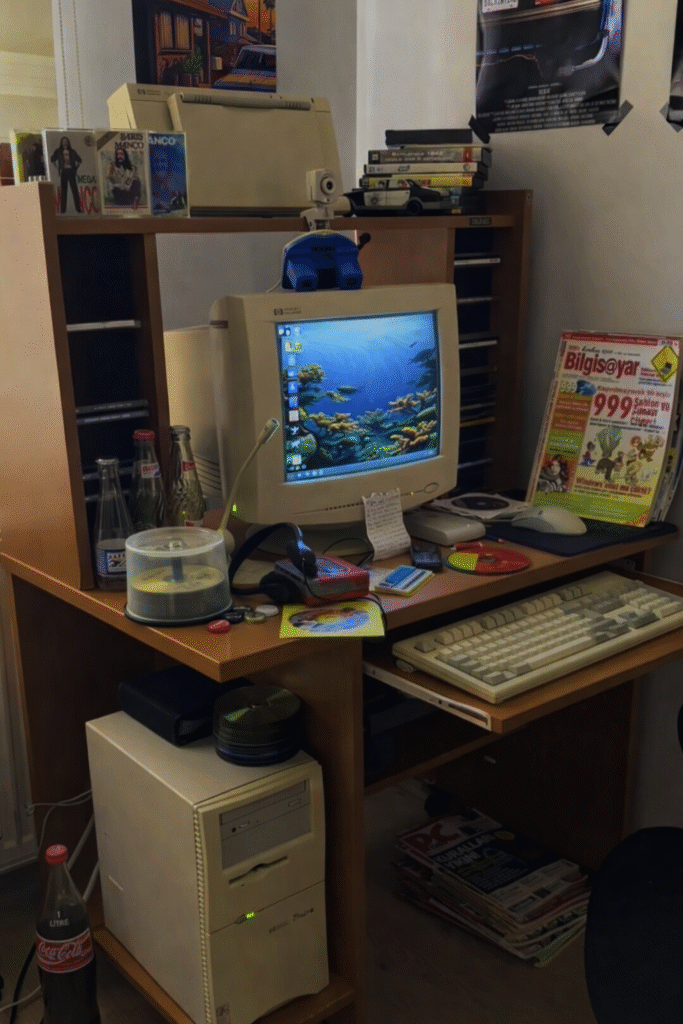
There was a time when the internet had a place in the home. It wasn’t something diffuse or constant. It didn’t follow you through the day. It existed at a specific point, usually in a shared space: the living room, that place where the newspaper was read, where guests came through, where family life happened. There, in a corner, sat the family computer. It arrived with a certain weight, almost like a piece of furniture. Sometimes it came with a digital encyclopedia (Encarta, for instance) that already gave the impression of containing the world on a disc. Soon after, that world seemed to expand with the arrival of the internet. For parents, it might have felt like an extension of what already existed: a more efficient, faster, more complete tool. For those of us who were younger, it was something else. Not so much an improvement as an opening. That corner was a door.
In my case, it was also a regulated space. My sister and I negotiated schedules: seven to eight-thirty for one of us, eight-thirty to ten for the other. The last shift was the most coveted. Not just for the chance to stretch it a little, but because the world seemed more alive at that hour. The chats filled up, names appeared on the lists, there was more movement. «I’m going online» wasn’t a casual phrase. It was an appointment, something that happened at a precise time. That system of shifts wasn’t just a practical solution. It said something about the way the internet was woven into the household. It didn’t just have a place; it had a time. There were moments of access, moments of waiting, moments when it simply wasn’t available. You went in and came out.
The furniture itself reinforced that logic. It wasn’t an ordinary desk but a fairly specific design: a compartment for the CPU, another for the monitor, a sliding tray for the keyboard, slots for discs, shelves for papers, manuals, and pencils. Everything seemed designed so that each element would find its place and, at the same time, so that the whole would stay contained within a clear structure. That kind of furniture organized more than just objects. It organized a relationship with technology. It suggested that the computer (and with it, the internet) was something used under particular conditions: seated, in that spot, for a certain amount of time. Something that was switched on and off, opened and closed.
This idea was never stated outright. But the house embodied it. The layout of the space, the schedules, the family negotiations—all of it pointed in the same direction. The internet appeared as a powerful tool, but still a bounded one. Something that could be folded into domestic life without completely upending its order.
Seen from today, that scene now seems strange. It’s not nostalgia. It’s something else: the distance left by an idea that no longer holds. Because what that desk organized wasn’t just devices. It organized an expectation: that the internet could be contained. Contained in a place, a schedule, a shared practice.
That expectation didn’t vanish overnight. It came apart gradually. The computer stopped being strictly a family object when it began moving into individual spaces. Laptops let the screen leave the common room. Then wireless connections made the fixed point on the wall unnecessary. Later, the smartphone finished altering the scene: you no longer had to go to the computer. The connection began to follow you. Screens started spreading through the house. Then they left it. The connection stopped being something that happened at certain moments and became something continuously available.
At some point, the phrase «I’m going online» lost its meaning. Not because it disappeared overnight, but because it stopped describing a recognizable experience. The connection stopped being an act and became a condition.
This shift isn’t only technical. It changes how everyday life is organized. When access is no longer concentrated in one place and one time slot, certain scenes disappear too. There are no more shifts to negotiate, no shared waiting in front of the same screen. The experience fragments. Each person connects from their own device, on their own time, each on their own. The home stops having a digital point. It begins to be crossed by the digital in all its parts.
In that sense, the old family computer desk isn’t just an object that got left behind. It’s the trace of a way of thinking about technology. The idea that the internet could have a place. And, more precisely, that it could be something bounded, shared, or negotiated. Something that fit into life without becoming indistinguishable from it.
The family computer isn’t the first object to start out as a tool and end up as something else. The mechanical clock is a well-known example. At some point it was one artifact among many, located in certain spaces, associated with certain functions. But over time, the measuring of time stopped depending solely on the clock as a visible object. It came to organize life more broadly: work, social coordination, the rhythms of daily existence. Time stopped living only in the clock. It began to function as a structure within which activities take place.
Something similar can be observed with the internet. In its early phase, it could be thought of as a resource you accessed from a fixed point. Over time, that boundary became harder to sustain. The connection grew continuous, and the distinction between being inside or outside lost its clarity. More than a tool used at certain moments, it became the medium in which different practices unfold.
Perhaps the hardest thing to notice is that this kind of transformation doesn’t announce itself as an obvious break. At first, technologies tend to appear as something manageable, something that can be integrated into what already exists. Only later does it become clear that they didn’t simply perform a function; they altered the framework within which that function made sense.
The family computer desk still appears in some homes, or in images that circulate as artifacts of another time. It no longer occupies the same place. Not only because it was replaced by more efficient devices, but because the idea that sustained it stopped being plausible. The idea that the internet could stay in a corner. And, perhaps, that certain things could remain contained once they had started to expand.