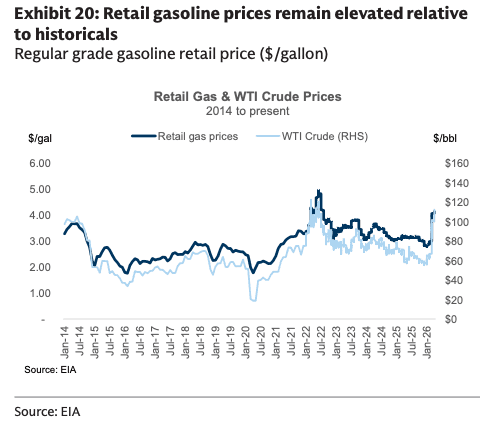
In Goldman's first-quarter "Nicotine Nuggets" survey of retailers and wholesalers covering roughly 44,000 U.S. stores, or about 28% of all tobacco outlets nationwide, analysts observed that once the national average for regular 87-octane gasoline hit the politically sensitive $4-a-gallon level, the squeeze on consumers began to emerge. One of the clearest signs of stress was a downshift in purchases as budget-conscious consumers started pulling back on tobacco purchases or, in some cases, trading down.
"The outlook remains cautious but retailers & wholesalers generally see the environment as stable despite ongoing concerns on the consumer and recent pressure from higher gas prices," Bonnie Herzog, managing director and senior consumer analyst at Goldman, wrote in a note on Friday morning.

According to the survey, 58% of respondents said consumer behavior had noticeably changed once 87-octane gasoline prices at the pump crossed the $4 threshold, while another 26% said they have not seen changes yet but expect them if prices remain elevated.

The biggest changes cited were consumers downtrading in stores, buying less fuel, and purchasing less overall inside stores. Some retailers also reported fewer trips, weaker inside sales, and more "splash and go" visits at the pump, where customers buy smaller amounts of fuel and skip in-store purchases.

She said, "Downtrading was strong in Q1, as roughly 80% of respondents indicated that deep-discount cigarettes gained share."
Main points of the survey:
Specific changes in behavior noted included consumers purchasing less in stores (indicated by 32% of respondents), downtrading in stores (47%), downtrading at the gas pump (11%), driving less (16%), and purchasing less fuel (37%).
Multiple respondents noted seeing fewer customer trips to stores as a result of their higher retail fuel prices (with one noting higher basket sizes as a result of trip consolidation), along with overall lower levels for inside-store sales. One respondent pointed to considerable pressure on the consumer buying at budgeted dollar increments (a rapidly growing consumer segment), which naturally purchases less fuel as the price increases.
Negatively, one retailer is witnessing more "splash and go" trips to the pump (fewer gallons and fewer people converting to inside sales). That said, the retailer also sees a shift in consumer behavior toward value, which has been a benefit to the nicotine pouch category in this regard, as higher engagement with fuel reward promos has led to category sales - with VELO Plus sales for the retailer up 20%+ in the last three weeks.
Herzog and her team "remain cautious on the U.S. tobacco/nicotine industry near-term given continued cig volume declines in Q1 and pressures on the tobacco consumer as a result of the inflationary backdrop and recently higher gas prices, although we see continued robust growth for the nicotine pouch category."
The "Nicotine Nuggets" report underscores just why politicians are so sensitive to surging gasoline prices: once fuel prices spike, cash-strapped consumers are forced into difficult trade-offs, whether that means buying less gas or diesel, cutting back elsewhere, or, in some cases, trading down in tobacco products.
Late last year, Herzog told clients, "Buy nicotine, energy drink, and candy stocks."
Professional subscribers can read the "Nicotine Nuggets" note on our new Marketdesk.ai portal.